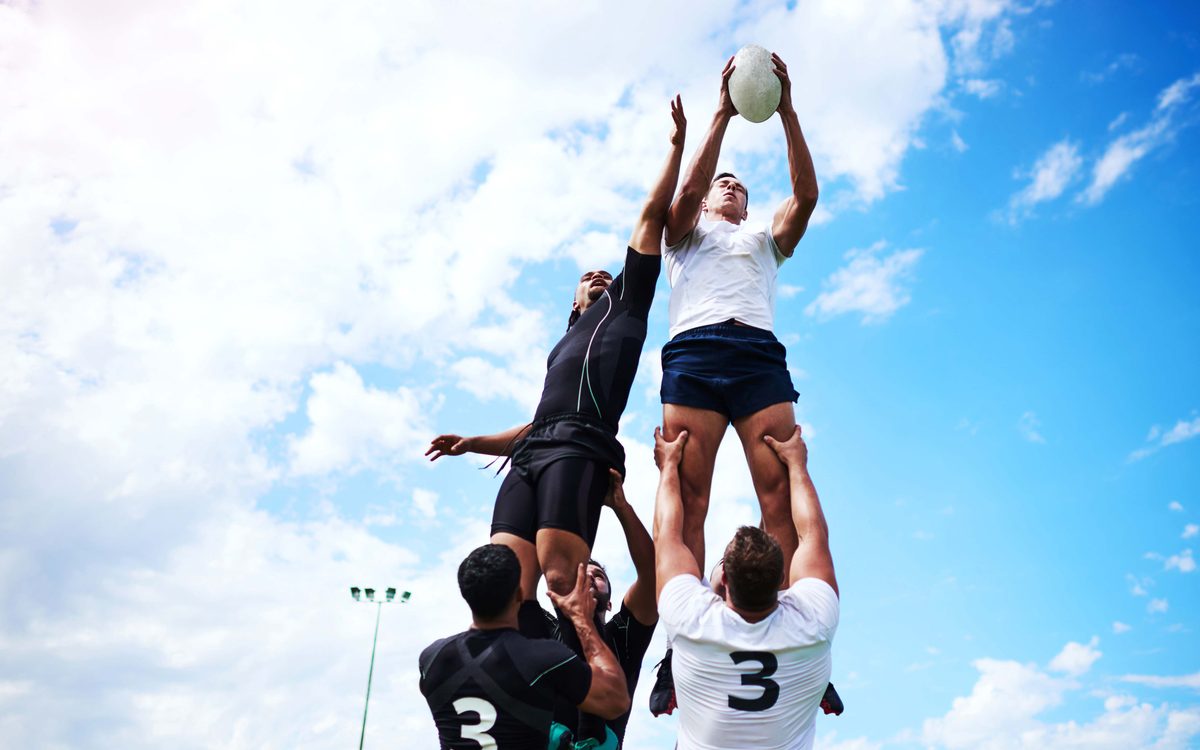
Twenty metres out, the clock is red, the kicker sets the ball, and the crowd goes quiet. Rugby union mental training is the practice of attention, confidence, routines and composure that sit beside physical and technical work, for kicks, tackles, set pieces and the minutes after a mistake.
Quick answer: Mental skills for rugby are mostly routines and practice: a repeatable pre-kick or pre-match routine, imagery, small controllable goals, a quick reset after mistakes and clear team communication. Research is mostly small and some studies are of rugby league or sevens. None of it guarantees performance. Anxiety, depression, disordered eating or burnout are health matters: see a professional, and in the US call or text 988.
Composure in contact
Rugby asks players to run toward collisions. A 2023 study (Dixon and colleagues, Journal of Sports Sciences) interviewed 18 elite rugby league players and described “psychological readiness for collision” as a theme, including bracing and being caught unaware. Rugby league is a different code, so treat it as a window into contact sports rather than a union result. Coaches commonly use a progressive contact build-up and a short cue before contact (general coaching practice, not a studied recipe).
Decision-making and fatigue
In a 2021 study of 20 elite junior league players (Redman and colleagues), a match simulation did not significantly reduce decision-making. A 2025 study (Hacques and colleagues) of 102 players from elite training centres, using a 3-versus-3 game, looked at how individual or team goals can shape decisions. In interviews with 20 elite South African sevens players (Kruyt and Grobbelaar, 2019), players described needing to perform when fatigued, to perform under pressure, to go “back to zero” after a mistake, and to stay cohesive as a team. See our rugby sevens page for the shorter game.
Kicking routines and pressure
Place kicks are a rugby-specific pressure moment. Jackson’s 2003 analysis of 572 place kicks at the 1999 Rugby Union World Cup (Journal of Sports Sciences) is an older study. A 2026 position statement from Exercise and Sports Science Australia (Schweickle and colleagues, Sports Medicine) covers pre-performance routines, psychological skills training and mindfulness, and says pressure can help or hurt depending on how an athlete reads it. A routine means the same few steps before each kick or lineout throw so the body knows what comes next. That is a tool, and not a guarantee of a good kick.
Imagery and confidence
A 2023 randomized crossover study of 10 professional players (Beaven and colleagues, International Journal of Sports Physiology and Performance) tested a 15-minute mental rehearsal before rugby tasks, reporting effects on passing skill and stress resilience. A 2026 controlled study of adolescent rugby players (Di Corrado and colleagues) tested a personalised imagery program for anger expression and resilience. Both are small and short, so read them as promising, not proven. A 2025 study of 76 players in the Italy national squad before the 2024 Six Nations (Robazza and colleagues) linked self-confidence, mental toughness and coping, and a 2009 diary study of five professional union players (Nicholls and colleagues) tracked stressors, coping and emotion in training and matches. A simple use of imagery is to picture a lineout call, a kick or a defensive line before training, and then do it.
Goal setting and motivation
Our sources did not test goal-setting formulas in rugby, so here is general practice: set small, controllable goals (win my tackle line, get to the breakdown first) in place of outcomes you cannot control (win the match). Review them with a coach after the game. Motivation dips are normal, particularly in a long season; see the health section below if low mood lasts.
Teamwork, leadership and communication
Rugby has 15 players who must decide in seconds. A 2026 study of 169 team athletes in rugby, soccer and basketball (Cammarata and colleagues) compared belonging, cohesion and closeness, and a 2026 interview study of 8 professional women’s rugby captains (Cotterill and Cheetham) explored leadership experiences. Clear calls, shared defensive structures and honest review sessions are the practical side.
Responding to setbacks
A knock-on, a missed tackle or a penalty conceded is certain in any match. The sevens players in Kruyt and Grobbelaar’s study described going back to zero. Many coaches teach a short reset: breathe out, one cue word, back to the next job. It is general practice rather than a proven fix.
Competition preparation
Build a pre-match routine you can repeat anywhere: the same warm-up, a few minutes of imagery, a role-specific checklist. Logistics, kit and travel are covered on the rugby hub; the nutrition page covers fuelling. Practise under fatigue and noise, so match day is not the first time.
Mental health is different from mental performance
Focus, confidence and routines are performance skills. Anxiety, depression, disordered eating, burnout and the effects of concussion are health matters for a qualified professional. A 2020 study of 233 UK rugby league Super League players (Nicholls and colleagues) found 13.7% had moderate or severe anxiety symptoms and 2.6% depressive symptoms, and a 2026 study of 235 former elite Australian rugby league players (Iverson and colleagues) found 29.2% had moderate to severe symptoms on the DASS-21 and that worry about concussion was linked to more symptoms. The International Olympic Committee’s 2026 consensus statement (Reardon and colleagues, British Journal of Sports Medicine) covers mental health in elite sport. If you or a teammate are struggling, talk to a doctor or a licensed mental health professional. In the US, call or text 988, the Suicide & Crisis Lifeline, any time. We did not find a World Rugby or NCAA mental-health resource page to cite, so ask your school, club or union for what it offers.
Frequently asked questions
How do I stay calm before a big match?
A repeatable routine helps: the same warm-up, breathing, a few minutes of imagery and a short cue. These are tools, not guarantees, and nerves are normal.
How do kickers handle pressure?
Many use a fixed pre-kick routine. A 2026 Exercise and Sports Science Australia position statement covers pre-performance routines and says pressure can help or hurt performance depending on how an athlete reads it.
Does visualisation work for rugby?
Small studies in professional and adolescent players have tested mental rehearsal and imagery, and results are encouraging but limited. Use it as an extra to physical practice.
How should I bounce back from a mistake?
Elite sevens players in a 2019 study described resetting after errors. A short cue and a quick return to the next job is common coaching advice.
When is it more than nerves?
If worry, low mood, trouble sleeping, disordered eating or loss of interest last, see a doctor or licensed mental health professional. In the US you can call or text 988.
Sources
- Dixon et al. 2023, psychological readiness for collision in elite rugby league, J Sports Sci
- Hacques et al. 2025, decision-making under goal priming in rugby, Acta Psychol
- Redman et al. 2021, decision-making during match simulation, J Strength Cond Res
- Kruyt and Grobbelaar 2019, elite sevens players interviews, Front Psychol
- Schweickle et al. 2026, ESSA position statement on pre-performance routines and psychological skills, Sports Med
- Jackson 2003, place kicks at the 1999 Rugby Union World Cup, J Sports Sci
- Beaven et al. 2023, imagery in professional rugby players, IJSPP
- Di Corrado et al. 2026, imagery programme in adolescent rugby players, Children
- Robazza et al. 2025, Italy national squad Six Nations, Psychol Sport Exerc
- Nicholls et al. 2009, professional union players diaries, Scand J Med Sci Sports
- Cammarata et al. 2026, team athletes, Front Psychol
- Cotterill and Cheetham 2026, professional women’s rugby captains, Behav Sci
- Reardon et al. 2026, IOC consensus statement on mental health, Br J Sports Med
- Nicholls et al. 2020, anxiety and depression in UK Super League players, BMJ Open Sport Exerc Med
- Iverson et al. 2026, former elite Australian rugby league players, Arch Clin Neuropsychol
- 988 Suicide & Crisis Lifeline
General information for education only, not medical advice. It does not replace a visit with a doctor, physical therapist or athletic trainer. See how we write and check our pages in our editorial policy.