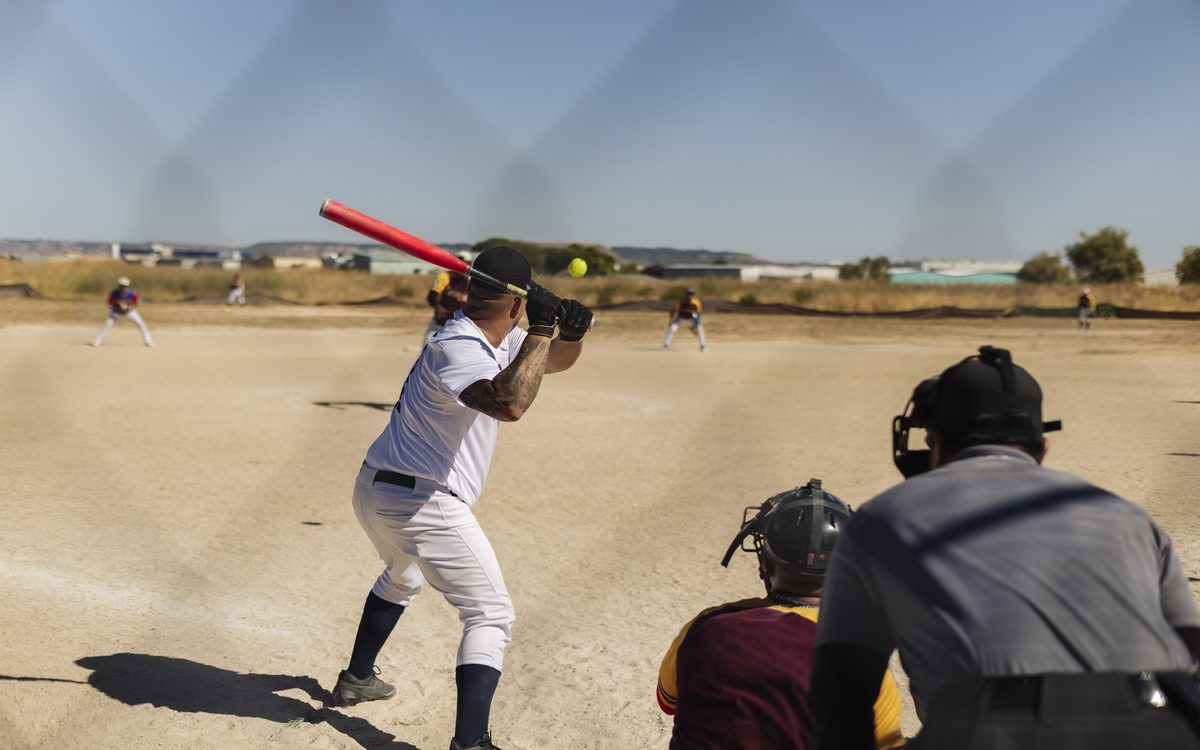
Eight o’clock on a Thursday, the first game of a new rec-league season. The pitcher lobs the ball so high it seems to hang under the lights, you take a cut, and it drops into the gap. Nobody dives for a bunt, nobody steals, and the whole bench is already talking about who brings snacks next week. Slow-pitch softball (also written slowpitch or slo-pitch) is softball with a high-arc underhand pitch, ten players in the field and a lot of hitting. This page is the starting guide: how the game works, the basic skills, and how a complete beginner finds a team.
Quick answer: A slow-pitch game is won by scoring more runs. The pitcher throws underhand in an arc that must peak between 6 and 12 feet, ten fielders play (four in the outfield), and bunting and base stealing are not allowed. To start, find a local league through your parks department or your USA Softball state or metro association, check the league’s own rulebook, and bring a glove. Rules differ by organization, so the league’s rulebook is the one that counts.
This is the starter page. For the format at a glance and who plays it, see the slow-pitch softball hub; for rules of the wider sport, see the softball hub.
How a slow-pitch game works
Two teams take turns batting and fielding, and the team with more runs at the end wins. Beyond that headline, the World Baseball Softball Confederation (WBSC) describes the format in a few lines: a team fields 10 players with four outfielders instead of three, and games can be coed or played by men or women only. How many innings or minutes a game lasts is set by the league or tournament, so ask when you sign up rather than assuming.
The pitch is the heart of the sport. Per the WBSC, it is delivered underhand with one foot in contact with the pitching plate until release, and it must reach a height of at least 6 feet and no more than 12 feet. The home plate umpire judges the arc. A strike is a pitch that crosses part of the plate between the batter’s front shoulder and back knee, and because the ball comes down at a steep angle, any pitch that touches any part of the plate on its way down is a ball, even if it would have passed through the zone.
The rules that surprise new players
- No bunting and no stealing. Runners must stay in contact with their base until the pitch is hit or crosses home plate (WBSC).
- Two-strike foul. A foul ball with two strikes is a third strike and the batter is out, so strikeouts are rare and mostly come this way (WBSC).
- No wild pitches or passed balls. The WBSC describes a pitch as effectively dead until it is hit, so runners cannot advance on a missed ball.
- Ten fielders. The WBSC says outfield positions are not fixed. Coed leagues add their own gender rules, so check yours.
Pitchers in this game are not trying to overpower anyone. The WBSC says they rely on accuracy and variety, such as spin, movement and changes of pace, to get hitters to put the ball on the ground or in the air rather than hit hard line drives. In USA Softball play, the pitching distance for ages 14 and up is 50 feet, according to its rule comparison for 2026. Other organizations and age groups may use other distances.
Basic skills a beginner should learn first
The skills below are general coaching practice, not drawn from a slow-pitch study, and any league coach or experienced teammate can show you each one in a few minutes.
- Hitting. Because the pitch drops steeply, most beginners swing too early. Practice watching the ball all the way down, then swinging at the point where it reaches your zone. Hitting the ball on the ground or in the air to open space matters more than power.
- Fielding. Start in a balanced stance with your glove low and out in front. For grounders, get your body in line with the ball; for fly balls, take your first step back, not forward. With four outfielders, calling “mine” loudly is half the skill.
- Throwing. Step toward your target and finish with your chest facing it. Warm up your arm with short throws before long ones.
- Running the bases. Know the force-out rule (a runner forced to advance can be out when a fielder with the ball touches the base) and the rule that you hold your base until the pitch is hit or reaches the plate. Learn the safe-at-first routine your league uses, such as a double base, before the first game.
Levels: from rec league to national team
Recreation and league play. This is where almost everyone starts: city and parks leagues, church leagues, company teams and weekend tournaments, in men’s, women’s or coed divisions. USA Softball, the national governing body, says it offers recreational, league, tournament and national championship play in slow pitch, fast pitch and modified pitch, with more than one million members across all of them. It does not give slow-pitch-only counts.
Tournaments and national teams. USA Softball runs Slow Pitch National and Futures teams for men and women. Its Border Battle against Canada began in 2009 for men and 2017 for women; through 2025 the US men lead 13 to 2 and the US women lead 6 to 1.
Schools. Slow-pitch is a very small part of high school sport. The NFHS 2024-25 participation survey counted 5,767 girls in slow-pitch at 368 schools, against 338,315 girls in fastpitch at 15,726 schools. Most school and youth softball is fastpitch.
Where to find a team or league
- Your local parks and recreation department. Many run adult slow-pitch leagues and can tell you when registration opens. Some leagues welcome individuals and place them on a team.
- Your USA Softball state or metro association. USA Softball says its national office does not help find local teams or leagues, so you contact the state or metro association. Memberships are handled through those associations, often through RegisterUSASoftball.com, and tournaments are listed at TournamentUSASoftball.com.
- Other sanctioning bodies. Organizations such as NSA, USSSA and Senior Softball-USA also sanction slow-pitch play with their own rules and bat lists. A league will tell you which one it follows.
Reading the official rulebooks
The WBSC publishes the international slow-pitch rulebook, and its 2026-2029 edition was released in March 2026, according to our search; we could not open the full text to check the changes. USA Softball’s Official Rules of Softball is a free download for members. Leagues often modify rules, including bats and the pitch arc, and the league’s printed rules decide a dispute on the night. Our gear page lists what we could and could not confirm about bats and equipment.
Your first night: a short checklist
- Ask the captain which bats, cleats and face protection the league allows.
- Bring a glove, water and a snack, and arrive early enough for a warm-up. Our injury-prevention page covers what to do before first pitch.
- Learn your league’s sliding and base rules, including how it handles collisions at first.
Slow-pitch softball rules and getting started FAQs
How do you win a slow-pitch softball game?
By scoring more runs than the other team when the game ends. The league or tournament sets the length of a game and any run-ahead or time-limit rule.
How high does the pitch have to be?
The WBSC says a legal pitch must reach at least 6 feet and no more than 12 feet high, and the home plate umpire judges it. Some organizations set their own limits.
Can you bunt or steal in slow-pitch?
No. Both are prohibited under the WBSC description, and runners must stay in contact with their base until the pitch is hit or reaches home plate.
Do I need my own bat to start?
Not always. Many leagues have team bats or teammates who share, and a league can only use bats its sanctioning body allows. Ask the captain before buying, because lists differ by organization.
How do I find a beginner-friendly league?
Start with your local parks and recreation department or your USA Softball state or metro association, tell them you are new, and ask about recreational or coed divisions.
Sources
- WBSC, Slow pitch softball
- USA Softball, About
- USA Softball, Slow pitch national teams
- NFHS, 2024-25 participation survey
- USA Softball rule comparison (2026 pitching distances), as recorded in our softball notes
- British Softball, WBSC slowpitch rulebook news (2022)
General information for education only, not medical advice. It does not replace a visit with a doctor, physical therapist or athletic trainer. See how we write and check our pages in our editorial policy.