This article contains affiliate links: if you buy through them we may earn a commission, at no extra cost to you. Read our affiliate disclosure.
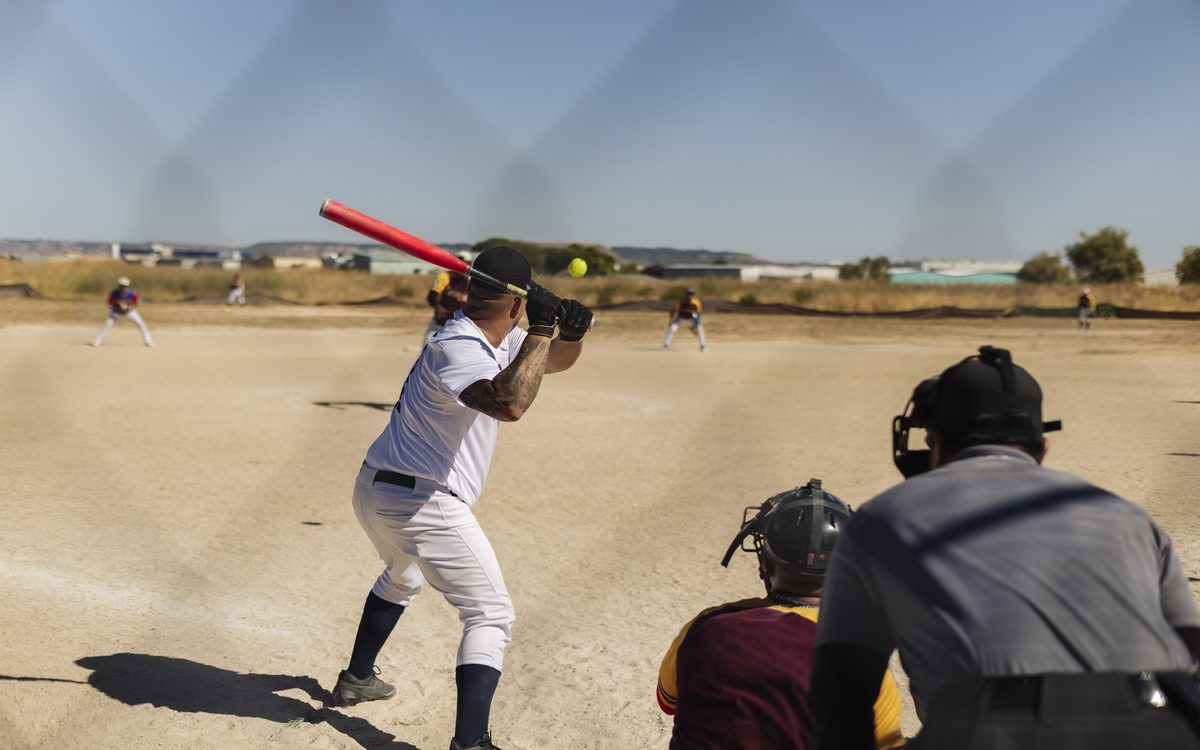
Thursday night under the lights at a city park: the pitcher lobs the ball high over the plate, the batter waits, and the ball is launched into the gap while ten fielders shift. Nobody is stealing a base, nobody is bunting, and everyone is grinning. Slow-pitch softball (also written slowpitch or slo-pitch) is the version of softball with an underhand pitch thrown in a high arc, ten players in the field, and a lot of hitting.
Slow-Pitch Softball guides: what do you need?
New to slow-pitch softball? Start with the first card. Everything here is general education, not medical advice.
History & Origins of Slow-Pitch Softball
Slow-pitch is the form of softball in which the pitcher throws the ball in a high arc, which makes hitting and fielding the focus and keeps the game open to many ages and skill levels. It grew out of the wider sport, whose origin is commonly linked to Chicago in 1887, with George Hancock credited with the name “softball” (National Softball Hall of Fame). That history page mentions slow-pitch without giving a date, so we do not state when it began or who invented it.
For the sport’s best-documented milestones, softball joined the Olympic programme in 1996 as a women’s fast-pitch event, was removed from 2009, and returned for Tokyo 2020. Slow-pitch is not an Olympic discipline (Olympedia).
- 1887 (commonly cited): Softball’s origin is linked to Chicago.
- 1996: Fast-pitch softball debuts at the Olympics; slow-pitch is not part of the programme.
- 2021: Softball returns at Tokyo 2020.
Official results and records
We did not confirm slow-pitch athletes or championship results on an official page, so we list none here. For national championships, rules and hall-of-fame members, go to the source:
How we keep this current: we re-check facts after each major championship and update this page. Spot an error? See our editorial policy.
It is a popular adult game and also has national teams. This page covers how it differs from fastpitch, who plays it, the injuries that research ties to softball in general, and the gear that makes sense. One thing to know up front: slow-pitch is not an Olympic sport. This is general information, not medical advice.
Slow-pitch softball at a glance
| What it is | Softball with a high-arc underhand pitch, ten fielders (four outfielders), and no bunting or base stealing. |
|---|---|
| How it is won | The team with more runs at the end of the game. |
| Teams | Men’s, women’s or coed, as the WBSC describes the format. |
| Pitching distance | 50 feet for ages 14 and up in USA Softball (40 feet for girls 10U and 46 feet for 12U), per its rule comparison. |
| Governing bodies | The WBSC worldwide; USA Softball is the national governing body in the US. Other groups, such as NSA and USSSA, also sanction play. |
| Olympic status | Not an Olympic event. Olympic softball is women’s fastpitch. |
How slow-pitch works
The WBSC describes the format in a few lines. A team has 10 players on the field, with four outfielders instead of three, and the game can be coed or played by men or women only. The pitch is underhand, with one foot on the pitching plate until the ball is released, and a legal pitch must arc at least 6 feet and no more than 12 feet high. The home plate umpire judges the arc. The ball has to cross the plate between the batter’s front shoulder and back knee, and because pitches descend, a pitch that touches any part of the plate on the way down is a ball.
Several rules are very different from fastpitch. Bunting and base stealing are not allowed; runners must stay in contact with their base until the pitch is hit or reaches the plate. A foul ball with two strikes is a third strike. And there are no wild pitches or passed balls that let runners advance: the pitch is effectively dead until it is hit. Strikeouts are rare, and good pitchers rely on accuracy and variety to get batters to hit grounders or fly balls instead of line drives.
Rules can differ by organization (USA Softball, NSA, USSSA, local parks departments), including bats and the pitch arc, so read your league’s rulebook. Our softball rules page has more on the fastpitch game.
Who plays it, and at what level
Youth and school. Slow-pitch is a small part of school sports. The NFHS participation survey for 2024-25 counted 5,767 girls playing slow-pitch at 368 schools, compared with 338,315 girls in fastpitch at 15,726 schools. Most youth softball is fastpitch; see the youth softball page.
Adult recreation. This is where slow-pitch lives: city and church leagues, company teams, weekend tournaments. USA Softball, named the national governing body by the U.S. Olympic and Paralympic Committee in 1978, says it has more than one million members (players, coaches and umpires) and 120,000 teams across all formats, and conducts over 100 national championships a year. It did not give slow-pitch-only counts.
National teams. USA Softball funds men’s and women’s Slow Pitch National and Futures teams that compete internationally. The men’s Futures team began in 2012, the women’s national team in 2017 and the women’s Futures team in 2019. The annual Border Battle against Canada began in 2009: through 2025 the US men lead 13-2, and the US women, starting in 2017, lead 6-1.
Olympic status
Softball has been in the Olympics from 1996 to 2008 and in 2020, and returns for Los Angeles 2028 as a six-team women’s fastpitch tournament at Softball Park in Oklahoma City. Slow-pitch is not part of that program. The WBSC runs both formats and is recognized by the IOC as the authority for baseball and softball, but the LA28 event is fastpitch. Check the official programme for the current Games.
Physical demands
We found no published study that measured energy use or workloads in slow-pitch. Reading the rules, the game is built from short bursts: a swing, a sprint to first, a few steps in the field. Because runners cannot steal and must hold the base, there is no stealing sprint. This is our reading of the rules, not a measurement.
Health and safety for slow-pitch
This section is general information. If something hurts, see a sports medicine doctor, physical therapist or athletic trainer.
What gets hurt
Most research covers softball overall rather than slow-pitch alone. A national estimate of emergency department visits from 1994 to 2010 put softball injuries at about 2.1 million; the hand and wrist (22.2%) and face (19.3%) were the most commonly injured areas, and being hit by a ball was the most common mechanism (52.4%), accounting for 89.6% of face and 75.7% of head injuries. Adults were more likely than children to be hurt while running (relative risk 2.36) and diving for a ball (4.61). The authors urged more use of face guards, mouth guards, safety softballs and break-away bases. A 2025 study of upper-body softball injuries seen in emergency departments from 2012 to 2021 (fastpitch and slow-pitch together) found most happened while fielding (41.8%) or from contact with the ball (36.8%), and that players aged 23 and over were mostly male (72.1%).
Pitchers and infielders are close to the batter. A 2005 lab study of slow-pitch bats and polyurethane softballs found batted-ball speeds of 134.0 to 159.7 km/h (roughly 83 to 99 mph), which left a pitcher between 0.409 and 0.361 seconds to react. The recommended limit from the USSSA and the Amateur Softball Association was 137.2 km/h (about 85 mph), equal to 0.420 seconds. The authors concluded high-tech bats with these balls can exceed recommended safety limits. That is one reason many players, and some leagues, look at face protection for the pitcher and infield, and at the bat certification list, which varies by league.
- Head and face. Ask whether your league allows or requires face protection for pitchers and infielders. For concussion, the CDC’s HEADS UP guidance is to recognize the signs, take the player out of the game, and have a healthcare provider decide when to return. Call 911 for danger signs such as repeated vomiting, a seizure or a worsening headache.
- Running and sliding. Adults get hurt more often than children when running and diving. The study authors urged break-away bases; ask your league whether it uses them. Warm up before you play.
- Heat. Summer evening leagues still run hot. The NATA position statement recommends 7 to 14 days of gradual heat acclimatization and treats suspected exertional heat stroke as an emergency (cool first, transport second, call 911).
Training, recovery and nutrition pointers
A short warm-up before first pitch is sensible for any age. Afterward, sleep (the CDC recommends at least 7 hours for adults) and a meal do more than any gadget. For the shared basics, see the softball training, recovery and nutrition and supplements pages.
Gear for slow-pitch
- Bat: use a bat that your league’s certification list allows; leagues differ, so check before buying.
- Glove: a fielder’s glove sized for your position.
- Face and mouth protection: a fielder’s mask and a mouthguard, if your league allows them.
- Footwear: cleats allowed by your league (some leagues ban metal) and ankle support if you have a sprain history.
Three picks from Amazon listings: the RIP-IT Defense fielder’s mask, which the listing says is made for female athletes and has a ponytail strap; the Shock Doctor Gel Max mouthguard; and the ASO EVO ankle stabilizer. Details come from the listings, not our testing, and a mask only helps if your league permits it. See the ankle brace guide and the softball gear page.

RIP-IT Defense Fielder's Mask
- Listing: made for female athletes
- Ponytail strap
- Washable padding
$39.99 at Amazon, as of Nov 17, 2026 02:07 UTC
Check price on Amazon
Shock Doctor Gel Max Mouthguard
- Boil-and-bite, gel-fit liner
- Youth and adult sizes
- Fit before first use
$11.99 at Amazon, as of Nov 17, 2026 02:07 UTC
Check price on Amazon
ASO EVO Ankle Stabilizer
- Ankle stabilizer brace
- Low-profile design
- Ask a clinician about fit
Related sports and disciplines
- Softball: the parent sport (fastpitch), with injuries and leagues and associations pages.
- Baseball: the sister sport.
Slow-pitch softball FAQs
What is the difference between slow-pitch and fastpitch?
The pitch. In slow-pitch it is an underhand lob that must arc between 6 and 12 feet; in fastpitch it is a hard, fast windmill pitch. Slow-pitch also uses 10 fielders and bans bunting and base stealing.
How many players are on a slow-pitch team?
Ten in the field, with four outfielders. Leagues set their own roster and coed rules.
Can you steal or bunt in slow-pitch?
No. Both are prohibited, and runners must stay on their base until the ball is hit or reaches the plate.
Is slow-pitch softball in the Olympics?
No. Olympic softball is women’s fastpitch, which returns for Los Angeles 2028 in Oklahoma City. Slow-pitch has national teams and international play but is not part of the Olympic program.
Should I wear a mask in slow-pitch?
It is a personal choice within your league’s rules. Research shows being hit by a ball is the main cause of face and head injuries in softball, and high batted-ball speeds are possible with modern bats. If your league allows it, a fielder’s mask or mouthguard is an option; ask a sports medicine professional if you are unsure.
Sources
- WBSC, Slow pitch softball
- USA Softball, Slow pitch national teams
- USA Softball, About
- USA Softball, LA28 softball in Oklahoma City
- NFHS, 2024-25 participation survey
- Birchak et al. 2013, softball injuries in US EDs (PubMed)
- Painter et al. 2025, upper-extremity softball injuries (PubMed)
- McDowell and Ciocco 2005, batted ball speed in slowpitch (PubMed)
- NATA exertional heat illnesses (PubMed)
- CDC HEADS UP
- CDC, Sleep
Keep exploring: the softball guide, softball injuries, our recovery shoes guide, recovery tools, and every other sport on our sports hub.