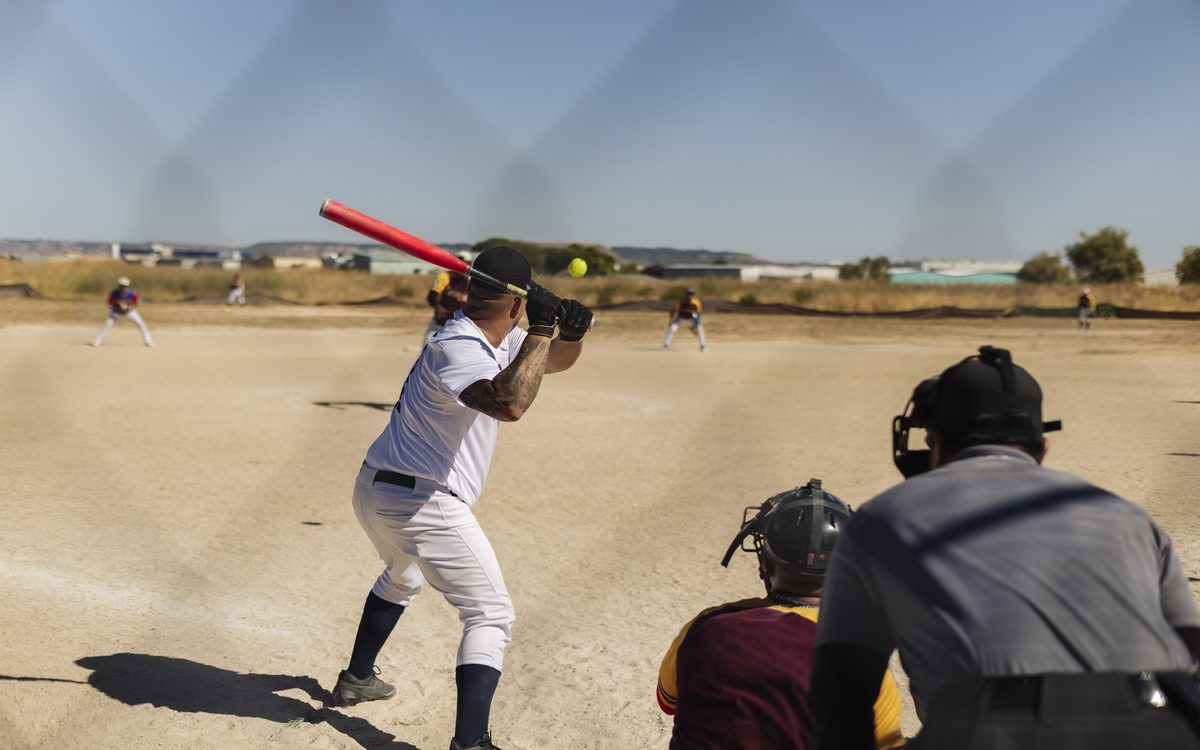
It is the sixth inning, you are the tying run on second, and the ball is hit to left. Your legs need to explode for ten seconds, your lungs need to recover for the next at-bat, and your shoulder has to throw if you take the field. Slow-pitch training is the work you do between games so that a few bursts of speed, a lot of swings and some hard throws feel easier and less risky. This page is a plan for the recreational adult player, with the caution that no published study we found measured the workload of slow-pitch softball itself.
Quick answer: Slow-pitch is a game of short bursts, so a sensible plan builds general fitness (about two and a half hours of moderate activity a week, per WHO guidelines), regular strength work, some sprints, plus swinging and throwing practice. Add load slowly in the preseason, keep a day or two for rest, and keep one tournament weekend from becoming your biggest week all year. Check with a doctor before you ramp up if you have a health condition or have been inactive.
What the game asks of your body
We found no published measurement of energy use, heart rate or sprint counts in slow-pitch. Reading the rules, the picture is a stop-and-start sport: a swing, a run to first (no stealing, so no stealing sprints), a few steps in the field and long stretches of standing around between plays. Fielders cover ground, hitters rotate hard through the trunk, and anyone who throws makes repeated overhand throws. That is our reading of the rules, not a measurement.
Real-world risk comes in the same places. Research on slow-pitch injuries has repeatedly pointed to sliding, being hit by a ball and collisions (see our injuries page). Fitness will not cover those, but being stronger and more balanced helps you handle ordinary running and throwing.
A sensible weekly shape
The World Health Organization’s 2020 guidelines say adults should do 150 to 300 minutes of moderate activity, or 75 to 150 minutes of vigorous activity, a week, plus regular muscle-strengthening. That is a health guideline, not a slow-pitch plan, but it is a good frame. The week below is general coaching practice for a recreational player with one game a week, not a prescription.
- Game day: warm up, play, eat and drink, and go easy the next morning.
- Strength, 2 days: squats or leg presses, hip hinges (deadlifts, bridges), lunges or step-ups, rows and presses, and trunk rotation or anti-rotation work.
- Speed and agility, 1 short day: a few 20 to 30 meter sprints with full rest, plus quick changes of direction.
- Skills, 1 or 2 short sessions: a bucket of balls off a tee or a toss, grounders and fly balls, and easy throws.
- Easy aerobic, 1 or 2 days: brisk walking, cycling or swimming to build the base for tournament days.
- Rest: at least one day with no planned exercise.
Strength and conditioning for a swing-and-sprint sport
Legs and hips. Sprinting to first and fielding on uneven ground load the hips, hamstrings and ankles. A 2017 meta-analysis of soccer programs (Al Attar and colleagues) found that those including the Nordic hamstring exercise had about half the hamstring injury rate of programs that did not. That is soccer, not softball, but hamstring strain is a common non-contact injury in many running sports, so strong hamstrings are a reasonable goal for anyone who sprints.
Trunk and shoulders. Swinging a bat is a rotational movement, and throwing is an overhead one. A 2021 systematic review (Paul and colleagues, Sports Health) found that decreased range of motion in the upper and lower body, unbalanced strength and fatigue were identified as risk factors for throwing injuries in softball players. It reviewed fastpitch studies and excluded slow-pitch, so it is only suggestive for slow-pitch players, but its message, balanced strength and good motion in both the arm and the hips, is easy to follow. Our injury-prevention page covers warming up the arm.
Loosli and colleagues, who surveyed adult slow-pitch players and reviewed clinic records in a 1988 paper in The Physician and Sportsmedicine, suggested preseason conditioning and strengthening to prevent injuries. It is a dated paper with a small sample, but nothing newer overrules the idea.
Skills work: hitting, fielding, throwing
Skills are best practiced in short, frequent doses, as general coaching practice. For hitters, a tee or a soft toss of 10 to 15 minutes works on contact and placement; because the game is so hitting-heavy, “hit it where they are not” counts for more than raw power. For fielders, rolling grounders to yourself and calling fly balls with a partner builds the footwork. Throwers should warm up the arm gradually and avoid heavy throwing on tired days. If you pitch, accuracy matters most, and the arc is hard to repeat when you are tired, so build leg and core endurance as well.
Periodisation basics: offseason, preseason, in-season
Periodisation just means planning the year in phases. This is a general coaching framework, not a slow-pitch research finding.
- Offseason: build general fitness and strength with the most volume and the least game stress.
- Preseason (4 to 8 weeks before the first game): add sprints, rotational power, swinging and throwing, and ramp up skills gradually.
- In-season: keep strength work to one or two lighter sessions, protect your sleep and keep game-day energy.
- Tournament weekends: treat them as a spike in load. Eat, drink and sleep deliberately, and cut non-essential training the week before.
Older players and returning players
Many slow-pitch players are in their 30s, 40s and beyond, or are coming back after years away. The WHO guidelines apply to all adults, and the same message holds: build up gradually and do both aerobic and strength work. If you are returning after injury or have a health condition, see a sports medicine doctor, physical therapist or athletic trainer first. Our recovery page covers sleep and mobility, and the injury-prevention page explains why a standard warm-up matters even more as you age.
Slow-pitch training FAQs
How fit do I need to be for slow-pitch softball?
There is no fitness standard for rec leagues. The game is short bursts with a lot of standing around, so most healthy adults can play, and a general program (WHO guidelines: 150 to 300 minutes of moderate activity a week plus regular strength work) is a reasonable base.
What should I do in the preseason?
General coaching practice: build leg and hip strength, add short sprints, and start swinging and throwing a few weeks before the first game, increasing gradually.
Do I need to lift weights for slow-pitch?
You do not need to, but regular muscle-strengthening is part of the WHO guidelines, and a 2021 review of throwing injuries in fastpitch softball linked unbalanced strength and limited motion with injury. Light, regular strength work is a sensible choice.
How should I prepare for a tournament weekend?
Treat it as extra load: sleep well all week, drink and eat before and between games, keep the week before easy, and tell your captain if something hurts.
Is there a slow-pitch-specific workout with research behind it?
Not that we found. We looked and found no study that measured slow-pitch workloads, so everything here is general fitness guidance plus softball injury research, labeled as such.
Sources
- Bull et al., WHO 2020 guidelines on physical activity and sedentary behaviour, Br J Sports Med (Europe PMC)
- Paul et al. 2021, injury prevention programs for throwing injuries in softball players, Sports Health (PubMed)
- Al Attar et al. 2017, Nordic hamstring exercise programs, Sports Med (PubMed)
- Loosli et al. 1988, Injuries in slow-pitch softball, Phys Sportsmed (PubMed)
- Burnham et al. 2010, Mechanisms of slow-pitch softball injuries, Air Force Safety Center (PubMed)
- Wheeler 1984, Slow-pitch softball injuries, Am J Sports Med (PubMed)
General information for education only, not medical advice. It does not replace a visit with a doctor, physical therapist or athletic trainer. See how we write and check our pages in our editorial policy.