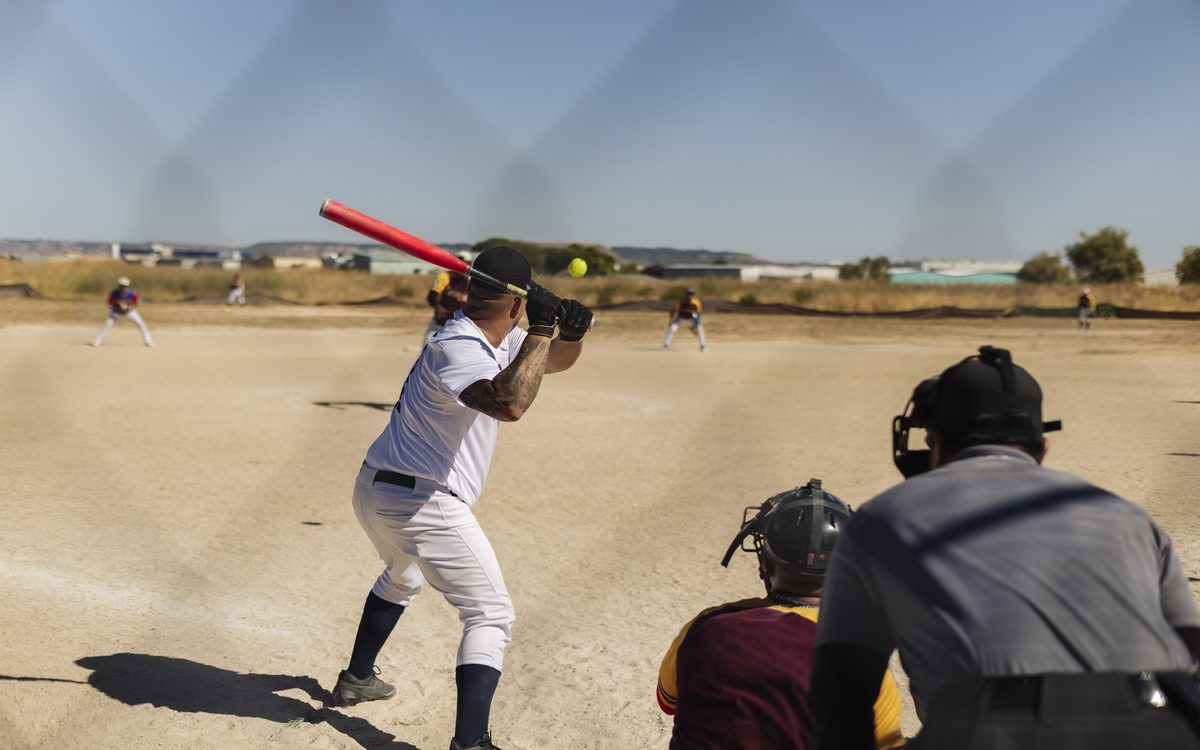
Bases loaded, last at-bat, and the pitcher’s arc looks like it is hanging in the lights for an hour. You hear your own heartbeat, the bench is chanting, and you notice you are gripping the bat too tight. Mental training for slow-pitch is the practice of staying calm, focused and clear while the game happens: a routine at the plate, a reset after a mistake, an honest goal for the night. It sits next to physical training; it does not replace it. This page is for recreational and tournament players.
Quick answer: Pressure can help or hurt performance, according to a 2026 position statement from Exercise and Sports Science Australia. Strategies with support include pre-performance routines, attentional focus strategies, psychological skills training and mindfulness. In slow-pitch the practical version is a simple at-bat routine, a short reset after errors, and goals you control, such as seeing the ball down. Nothing here guarantees results. If worry, low mood or burnout is hurting your life, that is a health matter: talk to a doctor or mental health professional, and in the US you can call or text 988.
General information, not medical advice. For the sport itself see the slow-pitch softball hub and the rules and getting started page.
Confidence and focus in a game of waiting
Slow-pitch asks hitters to wait for a high arc and swing at the right moment, so patience and attention are the main mental skills. We found no slow-pitch-specific psychology research, so the suggestions here are general coaching practice built on the ESSA statement, which reviews sport psychology evidence for performance under pressure. Confidence comes from preparation: players who have taken a hundred swings off a tee know what a good swing feels like.
- Pick one focus cue per at-bat, such as “watch it all the way down” or “hit it where they are not.” One cue beats a head full of tips.
- Return to the present. Between pitches, step out, breathe and look at something neutral, then re-engage.
- Let go of the last play. A routine for the next pitch (a breath, a glove tap, a word) lets you move on from an error or strikeout.
Goals and motivation
Goals you can control keep rec ball fun. Outcome goals, such as “get three hits,” depend on the pitcher and the fielders; process goals, such as “take a full swing at strikes” or “call every fly ball,” do not. This is a general coaching approach, not a slow-pitch finding. Motivation is usually social in slow-pitch: friends, the team, the post-game gathering. Keeping it fun is not a lesser aim. A 2026 systematic review of 14 studies of athletes in slumps (Rajpoot and colleagues, Sports) linked burnout and controlled motivation with decline, and resilience with less burnout, in athletes more generally.
Imagery and pre-game routines
Imagery means rehearsing a skill in your mind: seeing yourself hit a line drive or field a grounder. A three-to-five-minute session before a game, picturing your routine and a couple of swings, is a common coaching suggestion; the ESSA statement lists pre-performance routines and psychological skills training among strategies with support, though not for slow-pitch specifically. A pre-game routine can be as simple as arriving early, doing your warm-up in the same order and having the same snack. Routines work by lowering the chaos, not by guaranteeing outcomes.
Handling pressure and setbacks
The ESSA position says pressure can have both facilitative and debilitative effects, and that training environments with some pressure, such as a game-like scrimmage where something is at stake, can prepare athletes for it. For a rec team, that might be taking the last at-bat of practice with a small bet, such as who buys drinks. After a mistake, one general technique is a short reset phrase and a deep breath; afterward, review once (what could I do differently?) and move on.
Decision-making, tactics and teamwork
Slow-pitch is a team game with real decisions: where to place the ball, whether to hold at third, who covers when four outfielders chase a fly. Communication is the skill that makes it work. Agree before the game who calls what, use loud, short words (“mine,” “back,” “two”) and treat a dropped ball as a team error rather than an individual one. In coed games, clear roles on shifts and fielding assignments avoid collisions, which research (Burnham, 2010) lists among the leading injury mechanisms in slow-pitch.
Mental health is not the same as mental performance
Mental skills are for performance. Anxiety, depression, disordered eating and burnout are health matters that need a qualified professional, not a routine. The International Olympic Committee’s 2026 consensus statement on mental health in elite athletes says mental health symptoms and disorders are common among athletes, can affect performance and can be treated, and that with appropriate support many athletes can continue to train and compete. If you or a teammate are struggling, talk to a doctor or licensed mental health professional. In the US, you can call or text the 988 Suicide & Crisis Lifeline at 988 any time; it is free and confidential. If someone is in immediate danger, call 911.
Slow-pitch mental training FAQs
How do I stop overthinking at the plate?
Choose one simple cue for the at-bat, use the same few seconds of routine before each pitch, and keep your breath slow. This is general coaching advice rather than a slow-pitch finding.
How do I get over a slump?
Slumps are common and usually mix timing, confidence and luck. Go back to simple process goals (watch the ball, take a full swing), practice off a tee, and talk to a coach or experienced teammate. If worry about it is affecting your sleep or mood, see a professional.
Does visualization actually work?
The ESSA position statement lists psychological skills training and pre-performance routines among supported strategies, but it does not promise results, and we found no slow-pitch-specific study.
What if I feel anxious before games?
Some nerves are normal. If anxiety is intense, frequent or spills into daily life, talk to a doctor or licensed mental health professional. In the US you can call or text 988 for crisis support.
How can a coed team communicate better?
Agree on calls before the game, assign who covers what, keep feedback positive and short, and treat mistakes as team problems. It is general advice rather than research.
Sources
- ESSA position statement, Performance under pressure in sport 2026 (Europe PMC)
- IOC consensus statement, mental health in elite athletes 2026 (Europe PMC)
- 988 Suicide & Crisis Lifeline
- Burnham et al. 2010, Mechanisms of slow-pitch softball injuries, Air Force Safety Center (PubMed)
- Rajpoot et al. 2026, From Slump to Comeback, systematic review, Sports (PubMed)
General information for education only, not medical advice. It does not replace a visit with a doctor, physical therapist or athletic trainer. See how we write and check our pages in our editorial policy.