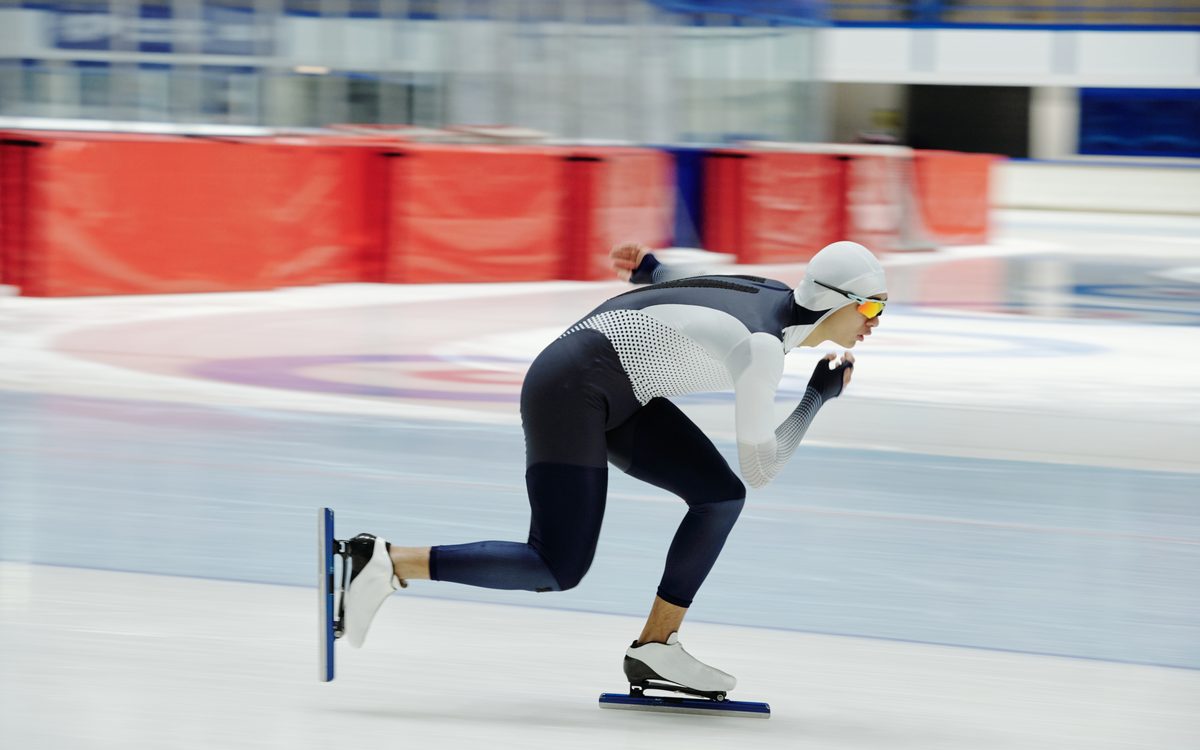
It is the start of a 1000 m. Two skaters in different colored armbands stand at the pre-start line, then step up to the start line and hold still. A voice says “Ready,” a beat later there is a shot, and two skaters explode out of their crouches into the first corner. Nobody is racing the person next to them. Each is racing the clock. That is the heart of long track speed skating, also called big-oval or ice speed skating: skaters race in pairs around a 400 m oval, and the fastest time wins. This page explains the rules in plain words, the skills a beginner works on first, and how to find a place to start. The wider sport is on our speed skating hub, and the discipline overview is on the long track speed skating page.
Quick answer: Long track is a race against the clock on a 400 m oval, two skaters at a time, always counterclockwise. Skaters swap lanes once each lap, and the inner-lane skater has to give way to the one coming out of the outer lane. Beginners start by contacting a local club, borrowing skates and learning to glide, push and turn before worrying about clap skates or race times. Check the current rulebook for your competition.
The oval and the pairs
The ISU 2026 Speed Skating Sports Rules describe a track with two lanes, a length of no more than 400 m, and an inner curve radius of 25 to 26 m. World Cups, World Championships and the Olympics are held on a 400 m track. Skaters go counterclockwise, and in most races two skaters skate at the same time, one starting in the inner lane and one in the outer lane. White and red armbands mark the inner and outer lane starters.
The ISU rules put the lane change on the crossing straight. Each skater changes lane once per lap. The skater coming from the inner lane into the outer lane must not hinder the other skater and is responsible for any contact unless the other skater acts obstructively. Cutting the inner line in a curve, crossing the lane markings more than once or interfering with the other skater can lead to disqualification under the same rule. On a 400 m track the 1000 m and 1500 m do not allow a lane change on the first straight.
Distances and Olympic events
The ISU rulebook lists distances of 100, 500, 1000, 1500, 3000, 5000 and 10,000 m, plus the mass start, team pursuit, team sprint and mixed relay. Olympic events differ by sex. As recorded in the ISU rules, women race 500, 1000, 1500, 3000 and 5000 m and men race 500, 1000, 1500, 5000 and 10,000 m, and both have the mass start and the team pursuit. That makes 14 medal events (seven for each) at Milano Cortina 2026, according to Olympic Canada. Check the official programme for the next Games.
Olympic long track has a long history. Olympic Canada notes men’s racing at Chamonix 1924, women’s racing as a demonstration in 1932 and official from Squaw Valley 1960, the team pursuit from Turin 2006 and the mass start from PyeongChang 2018.
Starts, finish and fouls
At the start, skaters step to the pre-start line, then the start line, and must hold still until the starter’s signal. The ISU rules say the first false start gets a warning and the next false start by a skater in that pair is a disqualification. A skater finishes when the front tip of the blade crosses the line. Throwing the body across the line or kicking the skate out is forbidden.
Team pursuit and mass start
The team pursuit is three skaters per team (the ISU rulebook allows teams of three or four), two teams starting at the middle of the straights. The team’s time is taken when its third skater crosses the line, so a team stays together and the leader takes turns at the front. Women’s Olympic races are six laps and men’s are eight.
The mass start has no lanes: the pack skates 16 laps together. Sprint points are awarded after laps 4, 8 and 12 (3, 2 and 1 points for the first three) and the final sprint scores 60, 40, 20 points and so on. The ISU rules say skaters who are lapped must leave the race, and impeding, blocking, charging or pushing can lead to disqualification. Because skaters are in a pack, the mass start and team events carry extra safety rules for protective equipment, covered on our gear page.
The skills a beginner works on first
General coaching practice, not something the rulebook sets, usually builds the first skills in this order:
- Balance and glide on one foot, with knees bent and head up.
- A push to the side rather than backward, finishing with the leg fully extended.
- The low position, with the chest forward and the knees bent, which is held through the straights.
- Crossover turns around the curve, leaning to the left because skating is counterclockwise.
- On clap skates, the push that finishes with the blade snapping back to the boot (the clap), added later.
Long track is traditionally skated on clap skates, where the blade partly separates from the boot, says US Speedskating. A 2000 study of ten elite skaters found that the clap skate raised skating velocity by about 5% (Houdijk et al., Med Sci Sports Exerc). Many beginners start on standard fixed-blade skates borrowed from a club.
How a beginner starts
US Speedskating says there are only six long track ovals in the United States (Anchorage, Salt Lake City, Butte, Roseville, Milwaukee and Lake Placid) and just over 60 ice speed skating clubs, and that many clubs lend skates. Its steps are simple: use the Find a Club map, contact the club before the first session, share your shoe size so they can find skates, and wear sweatpants, a warm top, warm socks, gloves, a helmet and knee pads. Learn to Skate USA, endorsed by US Speedskating, US Figure Skating and USA Hockey, teaches basic skating in six levels. Coaches and helpers are mostly volunteers who are current or former skaters, so ask what the club recommends before you buy anything.
Levels
US Speedskating groups skaters by age: under 13 (youth), 13 to 19 (junior), 20 and over (senior) and 30 and over (masters). The USS long track rulebook lists time standards for national events; ask your club for the current ones. For choosing between the oval and its shorter cousin, see short track speed skating.
Long track speed skating rules FAQs
Do long track skaters race each other directly?
Mostly they race the clock. Two skaters start at once in separate lanes, and the results are times. The mass start and, partly, the team pursuit are the events where tactics against other skaters matter.
Why do skaters change lanes every lap?
So both skaters skate the same distance. One lane has a longer curve than the other, and the crossing straight evens it out. The skater coming from the inner lane must give way.
Is long track the same as short track?
No. Long track is a 400 m oval in pairs, while short track is a smaller oval of about 111 m (ISU Short Track rules) where skaters race in packs. See our short track page.
Do I need clap skates to start?
No. Clubs often loan standard skates first, and US Speedskating says to ask your club before buying. Clap skates come later, once your glide and push are steady.
Where do I find the official rules?
In the ISU Speed Skating Sports Rules and the US Speedskating long track rules and regulations, both listed below.
Sources
- ISU 2026 Speed Skating Sports Rules (as of 12 June 2026)
- US Speedskating Long Track Rules and Regulations 2025-26
- US Speedskating, Get Started and Find a Club
- US Speedskating, Speedskating 101 (age groups)
- Olympic Canada, Long track speed skating
- Houdijk et al., clap skate, Med Sci Sports Exerc 2000
General information for education only, not medical advice, and not a substitute for the current rulebook or a coach. See how we write and check our pages in our editorial policy.