This article contains affiliate links: if you buy through them we may earn a commission, at no extra cost to you. Read our affiliate disclosure.
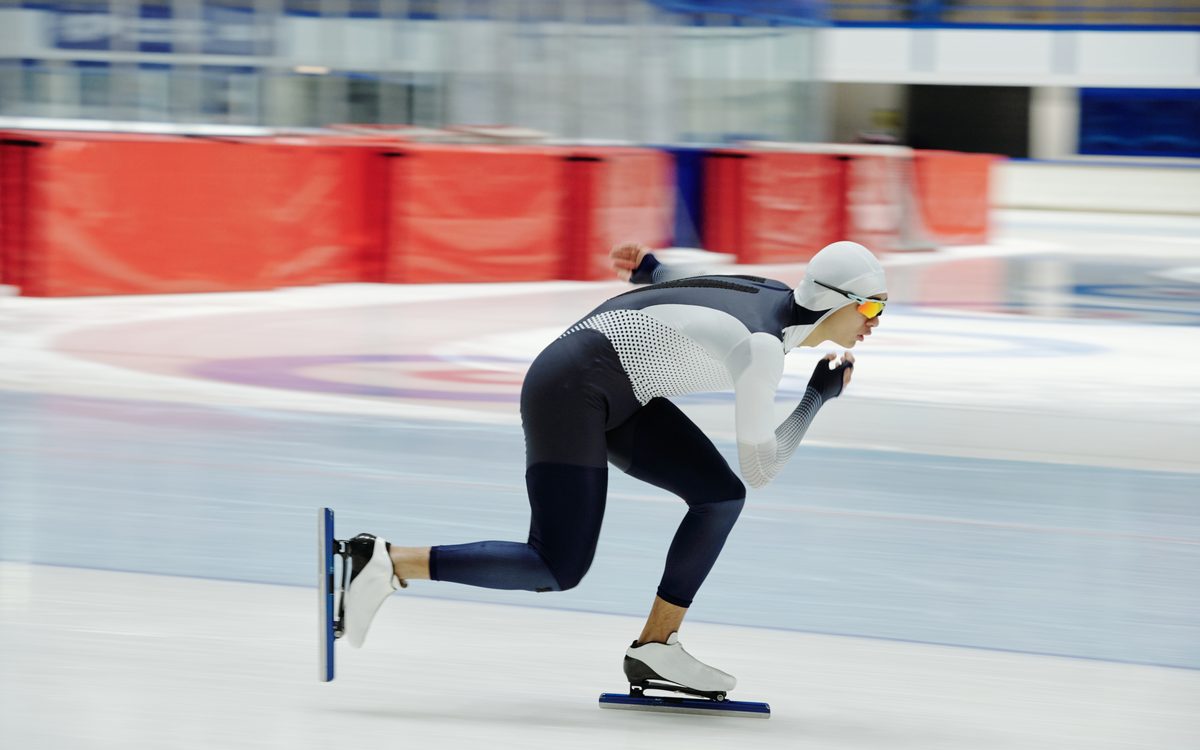
Two skaters crouch on the starting line of a 400-meter oval, one in the inner lane and one in the outer. The gun cracks, the blades bite, and for well under a minute the only sound is the rasp of steel and the roar of the crowd. It is a race against the clock. Long-track speed skating (also called long track, “big oval” or simply speed skating, to tell it apart from short track) is the timed ice-skating sport raced on a 400-meter oval, in pairs, over distances from 500 meters to 10,000 meters.
Long-Track Speed Skating guides: what do you need?
New to long-track speed skating? Start with the first card. Everything here is general education, not medical advice.
History & Origins of Long Track Speed Skating
Long track is the oldest form of competitive speed skating: racing against the clock on a 400 m oval. Olympedia records that the sport was contested on Dutch canals and has been raced in the Netherlands since at least 1676; the first World Championships took place in 1889 (Olympedia). We cannot document a single first race or inventor, so we do not name one. Men’s long track was part of the first Winter Olympics in 1924, and women became full medal competitors in 1960 after a 1932 demonstration. The Lake Placid Games of 1932 are noted for American-style pack racing replacing the European time-trial format, and later Games added team pursuit (2006) and mass start (2018).
- 1676 (at least): Speed skating is contested in the Netherlands.
- 1889: First World Championships.
- 1924: Long track debuts at Chamonix; Charles Jewtraw wins the 500 m on January 26 (US Speedskating).
- 1932: Lake Placid Games; women demonstrate the sport.
- 1960: Women’s events become official at Squaw Valley.
- 2006: Team pursuit added at Torino.
- 2018: Mass start added at PyeongChang.
- 2026: At Milano Cortina, Jordan Stolz wins the men’s 500 m and 1000 m with two Olympic records (US Speedskating).
Legends of the Sport
Listed by era, not ranked. Medal counts are from Olympedia unless linked otherwise.
- Charles Jewtraw (USA): 500 m winner in 1924, the first US Winter Olympic gold.
- Clas Thunberg (Finland): five Olympic golds among seven medals in the early Games.
- Lidiya Skoblikova (USSR): six golds at the 1964 Games, from all four women’s events.
- Eric Heiden (USA): five gold medals at the 1980 Lake Placid Olympics, aged 21 (US Speedskating).
- Bonnie Blair (USA): six Olympic medals, five gold, and the most decorated US female Winter Olympian.
- Claudia Pechstein (Germany): nine Olympic medals, five of them gold.
- Sven Kramer (Netherlands): nine Olympic medals, four of them gold.
- Ireen Wust (Netherlands): 13 Olympic medals, six gold, the most in Olympedia’s list.
- Jordan Stolz (USA): two golds and a silver at Milano Cortina 2026.
Official results and records
For current champions, world records and standings, use the official sources:
- International Skating Union (ISU): rules, records and championships
- ISU results: World Cup and World Championships results
- Olympics.com speed skating: Olympic results
- US Speedskating: US national results
How we keep this current: we re-check facts after each major championship and update this page. Spot an error? See our editorial policy.
Long-track speed skating at a glance
| What it is | Skating on a 400 m oval, two skaters at a time, each against the clock. Part of the speed skating family with short-track speed skating. |
|---|---|
| How it is won | Fastest time wins; times are recorded to the hundredth of a second. In the mass start and team pursuit, the finish order or the team’s time decides it. |
| Olympic events | Women: 500, 1000, 1500, 3000, 5000 m, mass start, team pursuit. Men: 500, 1000, 1500, 5000, 10,000 m, mass start, team pursuit. 14 medal events at Milano Cortina 2026. |
| Participants and levels | Youth, junior, senior and masters classes in club skating in the US; national teams and ISU World Cups at the top. |
| Where it is played | Indoor and outdoor 400 m ovals; in the US the Utah Olympic Oval in Kearns is the best-known one. Many skaters start on ice clubs and inline skates. |
| Governing bodies | International Skating Union (ISU) worldwide; US Speedskating in the United States. |
| Season | The 2026-27 ISU World Cup season starts in November 2026; the Olympic events were held in February 2026. |
How long-track racing works
In the individual distances, two skaters race at the same time, in separate lanes, and switch lanes once per lap so both cover the same distance. Olympic Canada explains that if both skaters arrive at the crossover point together, the one coming from the outside lane has the right of way. The ISU rules set the oval at 400 meters with two lanes, and skaters go counterclockwise, crossing lanes on the straight.
Two events are different. In the mass start, all the skaters race together for 16 laps, with intermediate sprints after laps 4, 8 and 12 that award 3, 2 and 1 points, and a final sprint worth 60 points to the winner. In the team pursuit, two teams of three start on opposite sides of the oval and take turns leading while the others draft behind. The team’s time is taken when the third skater crosses the line; the women’s race is 6 laps and the men’s 8.
Elite skaters race on clap skates, whose blade is hinged at the front of the boot and clicks back against the heel as the foot pushes off. A study of ten elite skaters by Houdijk and colleagues in 2000 found they skated faster with the clap skate, about 5 percent faster in velocity than with conventional skates. For the full rule set see our speed skating rules page.
Disciplines and distances
- Sprint distances (500 m and 1000 m): a start, a few seconds of all-out power, and the outer-lane-to-inner-lane skill of taking a corner at speed. At Milano Cortina 2026, American Jordan Stolz won gold in both, setting Olympic records, according to US Speedskating.
- Middle and long distances (1500 m to 10,000 m): pacing races over many laps; 3000 m is a women’s event and 10,000 m a men’s event.
- Mass start: the pack race described above; it joined the Olympic program at PyeongChang 2018.
- Team pursuit: three skaters, drafting and rotating; it debuted at the Olympics at Turin 2006.
Who skates long track, and at what level
Getting started. US Speedskating invites newcomers to find a club and try the sport. The Learn to Skate USA program is endorsed by US Speedskating, U.S. Figure Skating and USA Hockey, and many long-track skaters first raced on short track or inline skates. Racing categories are Youth (under 13), Junior (13 to 19), Senior (20 and over) and Masters (30 and over).
School and college. We did not find a high school (NFHS) or NCAA championship in speed skating; the pathway runs through clubs, national championships and ISU events. See the youth speed skating page.
Elite. The US long-track national team trains at the Utah Olympic Oval, which has Olympic-quality ice in summer. The ISU runs the World Cup and the world championships; US Speedskating names its World Cup team each fall.
Olympic status. Speed skating has been on the Winter Olympic program since Chamonix 1924. Women’s events appeared as a demonstration sport at Lake Placid 1932 and became official at Squaw Valley 1960. Long-track speed skating was on the program at Milano Cortina 2026 with 14 medal events (7 men’s and 7 women’s), held at the Milano Speed Skating Stadium between 7 and 21 February 2026 according to the published schedule. For the current Games, check the official programme; we have not confirmed the program for the next Winter Games. It is not a Paralympic sport.
Physical demands
The distances tell the story. A 500 m race is under a minute of near-maximal effort, while a 5000 m or 10,000 m race is a long aerobic effort with the skater held in a deep crouch, hips and knees bent, for many laps. In general terms, the crouch keeps the thighs and hips loaded and the push-off to the side uses the glutes and the muscles around the hip and ankle. Mass start adds repeated surges and tactical decisions. The 2024 scoping review below found one small study linking training load with injuries in long-track skaters, so a gradual build-up is a sensible habit. The specifics of a training plan belong with a coach; our speed skating training page has more.
Health and safety for long-track skaters
This is general information, not medical advice. If you are hurt, see a sports medicine doctor, physical therapist or athletic trainer.
What the studies show
Research on long track is still thin. A 2024 scoping review by Hendricks and colleagues in the Scandinavian Journal of Medicine and Science in Sports looked at injury studies in competitive ice speed skating (long and short track) and found competition injury rates of 2 to 18 percent of participants and seasonal prevalence of physical complaints of up to 84 percent for back pain. It also found that no study had yet tested whether a prevention measure works. A one-season study of 84 highly trained Dutch long-track skaters aged 15 to 21, in the British Journal of Sports Medicine, recorded 283 health problems (187 injuries and 96 illnesses). Among sudden injuries, the head, shoulder and lower back had the highest burden in days lost; among gradual-onset injuries, the knee had the highest burden, followed by the upper back, lower leg and lower back.
Falls, cuts and head injuries
Long track has fewer collisions than short track, but a fall at speed ends in a slide into the padded boards. The Dutch study put the head at the top of the burden list for sudden injuries, so concussion awareness matters. The CDC’s HEADS UP program lists headache, dizziness, confusion and balance problems as signs; anyone who hits their head should stop and see a healthcare provider before returning, and call 911 for danger signs such as repeated vomiting or a seizure. Because a skate blade can cut, the ISU long-track rules allow shin guards and padded knee protection worn inside the suit, as well as helmet, neck protection and gloves, and set special safety equipment for the mass start.
Overuse and the crouch
The low position loads the knees and lower back, which matches what the studies found. Knee pain that lingers, swelling, back pain that does not settle or a knee that gives way needs a professional, not more laps.
Training, recovery and nutrition pointers
Many long-track skaters train off the ice on inline skates, slide boards and in the weight room. Sleep comes first: the CDC, citing the American Academy of Sleep Medicine, recommends 9 to 12 hours for children 6 to 12, 8 to 10 for teens and at least 7 for adults. For the sport-wide guides, see training, recovery and nutrition and supplements. Recovery tools such as foam rollers are about comfort, not treatment.
Gear for long-track skating
- Clap skates: a boot with a hinged blade, fitted to the skater and sharpened. Newcomers often rent first.
- Skin suit and protection: a tight race suit; shin guards and padded knee protection go under it. Check your club’s cut-resistance and helmet rules.
- Neck protection: a cut-resistant neck guard is a common choice. Check what your club or rink requires, and look for a certification.
- Dryland tools: a slide board lets you practice the sideways push at home.
Three picks to start: the Bont M3 long-track clap ice blade (the maker lists a spring clap mechanism and 58 Rockwell steel), the Bauer NLP21 cut-resistant neck guard in youth and senior sizes, and the SPRI slide board for dryland practice. More on the speed skating gear page.
Bont M3 Long Track Clap Ice Blade
- Spring clap mechanism
- 58 Rockwell steel
- Not pre-sharpened

Bauer NLP21 Cut Resistant Neck Guard
- Cut-resistant
- Youth 10-14 in, senior 13.5-17 in

SPRI Slide Board
- 71 x 20 in, 4 lb
- Booties and bag included
$45.28 at Amazon, as of Nov 17, 2026 02:07 UTC
Check price on AmazonRelated sports and disciplines
Parent: speed skating. Sibling: short-track speed skating. Other ice sports: figure skating and ice hockey.
Long-track speed skating FAQs
What is the difference between long track and short track?
Long track is raced on a 400 m oval in pairs against the clock. Short track is raced in packs on a 111.12 m track and can include contact and falls. Both are on the Winter Olympic program; long track dates to 1924.
How long is a long-track race?
Olympic distances range from 500 m (just over a lap) to 10,000 m for men (25 laps). Women’s Olympic distances end at 5000 m. The mass start is 16 laps.
Why do the skaters change lanes?
The two lanes would otherwise be different lengths. By switching once per lap, both skaters cover the same distance.
Can adults take up long-track speed skating?
Yes. US Speedskating has a Masters class for skaters 30 and over, and clubs offer learn-to-skate sessions. Ask a club about rental skates and the protection they require.
Is long-track speed skating safe?
It has fewer collisions than short track, but falls, cuts, and knee and back overuse injuries happen. Research is limited, and no prevention program has been proven yet in studies, so follow your club’s equipment rules and see a professional for pain that does not settle.
Sources
- Olympic Canada: Speed Skating, Long Track
- US Speedskating: Speedskating 101
- US Speedskating: Get started
- NBC Olympics: Milan Cortina 2026 speed skating schedule
- Hendricks et al. 2024, scoping review of ice speed skating injuries (PubMed)
- Hendricks et al. 2024, Dutch youth long-track skaters (PubMed)
- Houdijk et al. 2000, clap skate (PubMed)
- CDC HEADS UP: signs and symptoms
Keep exploring: the speed skating hub, speed skating injuries, gear, our recovery tools guide, the foam roller guide, and every other sport on the sports hub.