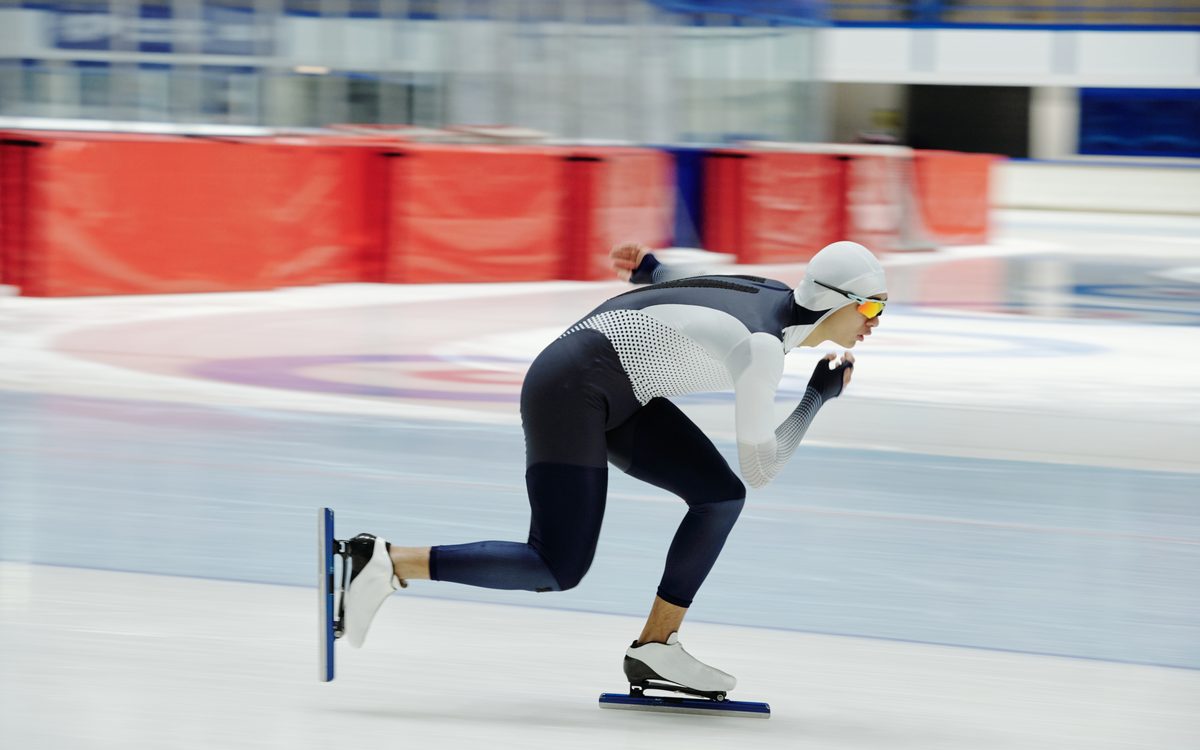
Summer, and the ice is hours away. A skater is on a track bike at a steady, chatty pace, then in the gym for squats, then on a slide board in a pair of booties, sliding side to side in a deep crouch. The ice is where the racing happens, but much of long track speed skating training is done off it. Long track speed skating training means building the fitness to hold a low, powerful position around a 400 m oval, from the 500 m sprint to the 10,000 m. This page reviews what studies say about how elite skaters train, then offers a sample week that is labeled as general coaching practice. For rules, see our rules and getting started page; for the sport overall, see the speed skating hub.
Quick answer: Elite long track skaters train a lot (a 2026 review gives 900 to 1,100 hours a year) and most of that is easy, with a smaller share of very hard work, a pattern called polarized training. The skating position puts heavy demand on the legs and back, so strength, slide-board work and cycling are used alongside ice time. Beginners and juniors do not need elite volume. Build up slowly and talk to a coach and a sports medicine professional about your plan.
What the sport asks of the body
Long track distances run from 500 m to 10,000 m (ISU Speed Skating Sports Rules), so the sport asks for a mix of power and endurance. A 2026 narrative review of Olympic ice sports (Sperlich et al., Scand J Med Sci Sports) described long and short track as needing high annual training volumes, 900 to 1,100 hours a year, with polarized, mixed-modal training. We did not find a source that gives exact energy-system shares for each long track distance, so we do not quote any.
The crouch is the sport’s signature. A 2015 literature review of long track skaters (Konings et al., Sports Medicine) found the crouched technique with small knee and trunk angles favorable for movement, but a smaller knee angle may increase the deoxygenation of the working muscles. The authors say elite skaters must balance a fast start against technique that breaks down later in the race, which is why pacing and technique matter so much.
How elite skaters distribute training
Orie and colleagues (Int J Sports Physiol Perform, 2014) interviewed Olympic-medal-winning coaches and skaters over 38 years and found a shift toward polarized training, meaning much low-intensity work and some high-intensity work with less in between. They wrote that this shift appeared to be the most important factor in the development of Olympic skaters, and, surprisingly, that total training hours and skating hours did not relate to time over the Olympiads. In other words, more hours were not simply better.
A 2025 study of Norwegian world-class coaches across Olympic endurance sports (Sports Medicine – Open) reported that a lighter week was usually placed every three to four weeks. We read that only in a search summary, so treat it as an example of how coaches plan, not as a rule.
A sample week (general coaching practice)
This is a general shape for a committed adult or older junior skater in the build period. It is not from a study, and it is not a prescription. Beginners should do far less, and anyone with an injury or health condition should ask a professional first.
- Two or three on-ice sessions: one technique session (glides, pushes, crossovers, low position), one speed or start session, and one longer skating session at an easy pace.
- Two off-ice easy aerobic sessions, such as cycling or running, at a pace where you can talk.
- Two strength sessions, with a leg-dominant focus plus trunk and hip work.
- One session of hard intervals, on the ice, the bike or a slide board.
- At least one full rest day, and a lighter week every few weeks.
Strength and power
A 2026 study (Sliedrecht et al., J Funct Morphol Kinesiol) followed 23 sub-elite to elite long and short track skaters, median age 18, for 39 weeks in a program that alternated strength and power blocks. Strength rose in the men but not clearly in the women, power was not compromised, and higher strength and power were linked with better performance in both disciplines. The authors noted that the findings show associations, not proof that the program caused faster times.
A 2016 study of 17 young short track skaters (Felser et al., Scand J Med Sci Sports) found that concentric knee-extensor strength was related to skating times and that force fell by about 25% when testing in skates compared with standing without skates, so it concluded that stabilizing the knee and ankle matters for transferring strength to the ice. That study was in short track, but the same low-position demands apply on the oval, so coaches often borrow the idea. For youth, the American Academy of Pediatrics recommends supervised, technique-focused resistance training (Pediatrics, 2020).
Slide board, cycling and dryland
The slide board copies the side push of skating without ice. In a 2026 study (Zhang et al., PLoS One) of 27 youth skaters, 4 weeks of slide-board interval work three times a week improved VO2max and anaerobic power more than 20 minutes of moderate continuous work did. It was a short study of young skaters, and its authors suggest interval structures differ for sprinters and distance skaters. Cycling is a common aerobic base. A study of 16 inline skaters (Stangier et al., J Strength Cond Res, 2016) found that cycling and running both improved endurance after eight weeks at about 52% of VO2peak, but the authors suggested that technique work should follow. Ankle balance training also has support: a 12-week, 15-minute circuit five days a week improved dynamic balance in 28 young speed skaters (Winter et al., J Sports Sci, 2015). See the gear page for slide boards.
Periodization basics
Plain periodization means organizing the year in phases. For long track the calendar has a long base phase in spring and summer, then a build into the autumn, a race period (the ISU 2026-27 season calendar has World Cups starting in November), and a short break after the season. General coaching practice is to raise load gradually and to schedule recovery weeks. Our recovery page covers sleep and load, and the injury prevention page covers why abrupt load increases matter.
Long track speed skating training FAQs
How many hours a week do long track skaters train?
Elite skaters average roughly 17 to 21 hours a week if you divide the 900 to 1,100 hours a year cited in the 2026 review by 52, but that is arithmetic on a yearly figure, not a weekly target. Juniors and club skaters train far less.
Is it better to train more hours?
Not by itself. Orie et al. found no relation between total or skating hours and Olympic results over 38 years, and a shift toward polarized training mattered more.
Do I need a slide board?
No. It is a useful extra for off-ice work, but a coach can substitute other low-position and interval work. Start with the sport itself.
How do I get better at the low position?
Coaches often use holds, low walks and imitation drills. This is general coaching practice. Tell your coach about any knee or back pain early.
Should kids lift weights for speed skating?
The AAP supports supervised resistance training for children and adolescents when technique is the focus. Ask a qualified coach.
Sources
- Sperlich et al., Olympic Ice Sports narrative review, Scand J Med Sci Sports 2026
- Konings et al., performance characteristics of long-track speed skaters, Sports Med 2015
- Orie et al., 38 years of training distribution in Olympic speed skaters, IJSPP 2014
- Sliedrecht et al., long conjugate sequence resistance training, J Funct Morphol Kinesiol 2026
- Felser et al., strength and short track performance in young athletes, Scand J Med Sci Sports 2016
- Zhang et al., slide-board HIIT vs MICT in young speed skaters, PLoS One 2026
- Stangier et al., cycling vs running for inline speed skating, J Strength Cond Res 2016
- Winter et al., proprioceptive training in young speed skaters, J Sports Sci 2015
- AAP, Resistance Training for Children and Adolescents, Pediatrics 2020
- Best-practice training characteristics within Olympic endurance sports (Norwegian world-class coaches), Sports Med Open 2025
- ISU 2026-27 season calendar
General information for education only, not medical advice. It does not replace a visit with a coach, doctor, physical therapist or athletic trainer. See how we write and check our pages in our editorial policy.