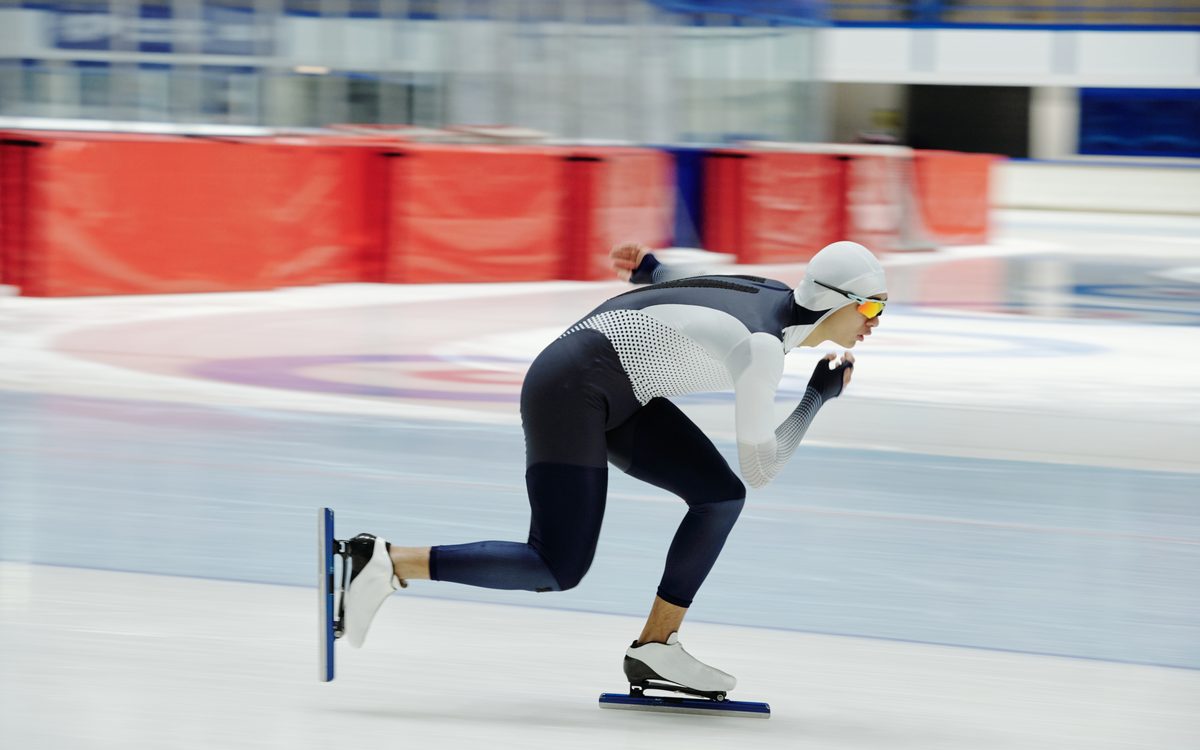
It is the third week of the build phase. A skater has added slide-board sessions and an extra on-ice workout, and the low back has started to ache by the end of every straight. Nothing is torn, nothing is swollen, and the skater tells nobody. Long track speed skating injury prevention is the set of habits around a skater, a proper warm-up, gradual training load, strength for the low position, sensible protection in pack races and honest reporting of pain, that aim to lower the chance of getting hurt. They lower the odds. They cannot promise anything. What each injury looks like is on our long track injuries page, so we do not repeat it here. For the whole sport, start at the speed skating hub.
Quick answer: The best-supported ideas are to raise training load gradually, build strength and balance for the low position, warm up before hard efforts and wear the protective gear your race requires. But the research is thin: a 2024 scoping review found that no study had tested whether any prevention measure works in ice speed skating. Treat the steps below as sensible habits, not guarantees. See a sports medicine doctor, physical therapist or athletic trainer if pain stays in one spot, shows up at rest or limits your skating, and call emergency services after a head injury with danger signs.
What the research does and does not show
A 2024 scoping review of ice speed skating (Hendricks, Verhagen and van de Water, Scand J Med Sci Sports) looked at 32 studies of long and short track, few of them high quality. It reported seasonal prevalence of physical complaints up to 84% (for back pain). It found two small studies linking injuries to strength deficits in short track and to training load in long track, and no study that evaluated whether prevention measures worked. In a one-season study of 84 Dutch skaters aged 15 to 21 (Hendricks et al., Br J Sports Med, 2024), the biggest time-loss burden from repetitive-mechanism injuries was the knee, 11.0 days per 1,000 hours, followed by the thoracic spine and lower leg. So the sensible targets are the knees, the back and head safety.
Warm up before hard work
We did not find a published warm-up program tested for long track skaters, in the way that FIFA 11+ was tested in soccer. What coaches usually do is general practice: a few minutes of easy movement to raise your heart rate, hip, knee and ankle mobility moves, light activation work for glutes and trunk, then several progressively faster glides or starts before an all-out effort. Because rinks are cold, add layers until you are warm, and take them off as you go. Our training page shows where hard sessions fit in the week.
Technique and the low position
Long track skaters hold a deep crouch for minutes at a time. A review of the sport (Konings et al., Sports Med, 2015) found that this position is biomechanically favorable but loads the working muscles heavily. The practical point, as general coaching practice rather than a tested method, is to build time in the position gradually and ask a coach to check your form when you are tired.
Back pain is the clearest example. A Dutch study of 236 young elite athletes (van Hilst et al., J Back Musculoskelet Rehabil, 2015) reported a 12-month prevalence of low back pain of 60% in speed skaters, and the more hours they trained the higher the odds. That is an association, not proof that training causes it, but it supports telling a coach early when your back hurts.
Progressive training load
The scoping review above links training load to injuries in long track skaters. No source gives a safe rate of increase for skaters, so we do not quote a percentage. General sports medicine practice is to add volume or intensity one thing at a time, to follow a hard week with an easier one, and to take care when you return from a break or change something (a new training block, new blades, a new slide-board routine). The recovery page covers sleep and load management.
Strength, balance and conditioning
Evidence that strength protects skaters is limited, but strength is linked with performance (see the training page) and with stabilizing the knee and ankle (Felser et al., 2016, short track). One trial gave 28 young speed skaters a 15-minute proprioceptive circuit five days a week for 12 weeks, and dynamic balance improved (Winter et al., J Sports Sci, 2015). It measured balance, not injuries. For the groin, a Copenhagen adduction exercise program was linked to 41% fewer groin problems in a trial of soccer players (Harøy et al., Br J Sports Med, 2019), but we did not find such a trial in skaters, so ask a professional whether it suits you.
Environment: ice, cold and surfaces
Skaters move on hard, cold ice and fall on it. US Speedskating’s injury prevention page says long track skaters should wear long sleeves and long pants. Cold air and cold muscles are a general reason to warm up well. Learn the lane-crossing rules, because most of them exist to avoid contact.
Protective equipment and fit
Standard long track races are run in pairs, so contact is rarer than in short track, a point we state from the format, not a study. But the ISU’s Communication 2636 says team events and the mass start involve risks of cuts, concussions and puncture wounds, especially from skate blades in a collision or fall. It requires full-body suits with cut-resistant fabric at ISU events (level 3 at the Olympics and all ISU events), neck protection that a blade cannot slip under, cut-resistant ankle protection, helmets to ASTM F1849, and gloves of at least cut level 3. The ISU says it cannot assure full protection under all conditions. Check the exact requirements for your own race, since the US Speedskating long track rules refer to the ISU communications for team races.
Helmets deserve honesty. Karton and colleagues (Br J Sports Med, 2014) tested speed skating helmets and found that they nearly eliminate catastrophic head injuries such as skull fractures, but that rotational acceleration stayed near the high end of the concussion probability range, similar to bicycle and hockey helmets. A helmet is not a concussion-proof device. Our gear page covers fit and inspection.
Youth considerations
We did not find youth-specific prevention research for long track beyond the Dutch youth study above. The AAP supports supervised, technique-focused strength work for young athletes.
What prevention can’t do
Falls, collisions and overuse injuries still happen to well-prepared skaters. No warm-up, brace or helmet makes injury impossible. Concussion in particular is a matter for a health professional: the CDC’s HEADS UP guidance is that a young athlete suspected of a concussion should be removed from play and cleared only by a health care provider.
When to see a professional
Get checked by a sports medicine doctor, physical therapist or athletic trainer if you have pain that lasts, pain at rest or at night, swelling, a joint that gives way, numbness, or pain that changes how you skate. After a head injury, go to urgent care or call emergency services if you see danger signs such as repeated vomiting, worsening headache, confusion or loss of consciousness. A deep cut from a blade is an emergency: apply direct pressure and call 911 (US).
Long track speed skating injury prevention FAQs
What is the most common long track injury?
In the Dutch youth study, the knee had the highest burden among repetitive-mechanism injuries and the head among sudden injuries. Details are on our injuries page.
Do I need cut-resistant gear for long track?
Only for events that require it, such as team events and the mass start under the ISU communication. Check your race.
Do helmets prevent concussions?
No. The Karton study found helmets nearly eliminate skull fractures, but rotational acceleration remained near the range linked to concussion.
Can stretching prevent back pain?
We did not find a trial showing that for skaters. Strength, load management and early reporting of pain are the steps coaches usually stress.
Sources
- Hendricks et al., scoping review of injuries in ice speed skating, Scand J Med Sci Sports 2024
- Hendricks et al., health problems among Dutch youth long track skaters, Br J Sports Med 2024
- Konings et al., Sports Med 2015
- van Hilst et al., low back pain in young elite athletes, J Back Musculoskelet Rehabil 2015
- Winter et al., proprioceptive training in young speed skaters, J Sports Sci 2015
- Harøy et al., Copenhagen adduction in soccer players, Br J Sports Med 2019
- Karton et al., speed skating helmet performance, Br J Sports Med 2014
- ISU Communication No. 2636, Protection equipment in Speed Skating and Short Track (21 May 2024)
- US Speedskating, Injury Prevention
- US Speedskating Long Track Rules and Regulations 2025-26
- CDC HEADS UP, signs and symptoms and response
General information for education only, not medical advice. It does not replace a visit with a doctor, physical therapist or athletic trainer. See how we write and check our pages in our editorial policy.