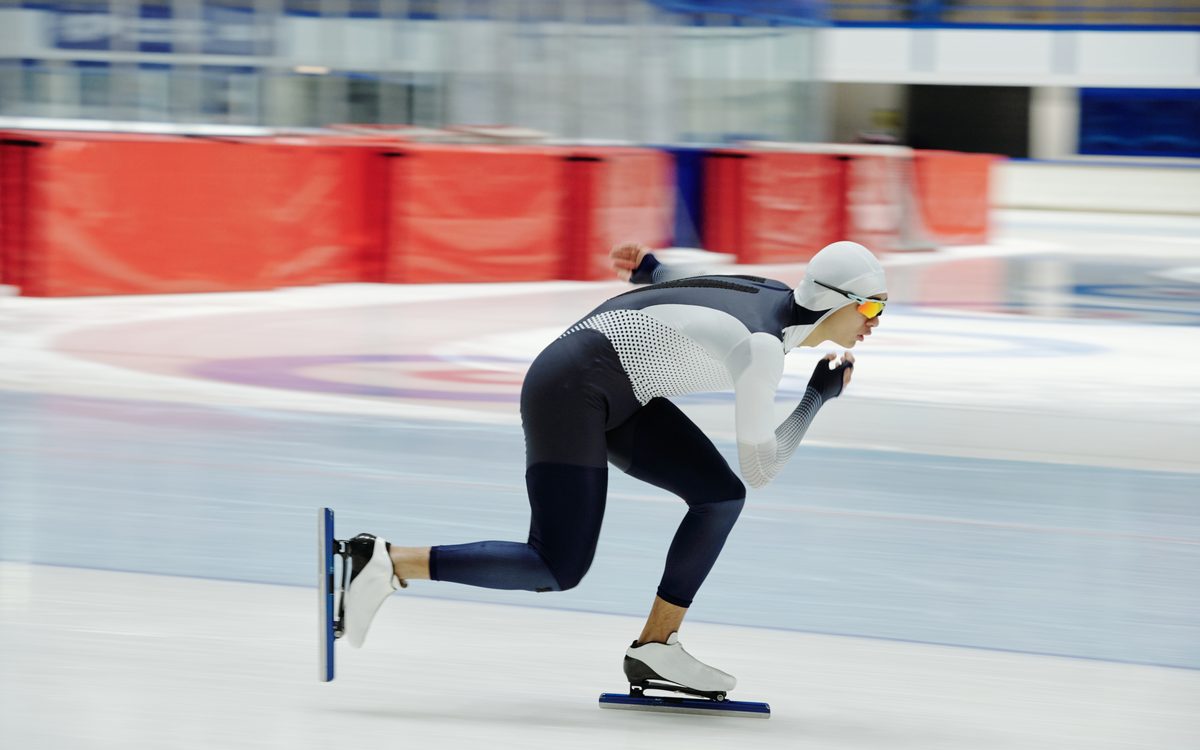
Two skaters stand behind the pre-start line. The arena goes quiet. Each skater has a few seconds that belong only to them, and then the starter’s signal goes. There is no opponent to shove and no pack to hide in, only a clock and a lap of 400 m that must be repeated, with burning legs, again and again. Mental training for long track speed skating is the practice of building skills, such as focus, self-talk, imagery, routines and emotional control, that help a skater perform the way they train. It is different from mental health, which has its own section below. For race-day logistics see our speed skating game day page, and for the sport overall see the speed skating hub.
Quick answer: Mental skills are trained like physical ones: in small, regular doses with a clear purpose. For long track, the most relevant are a repeatable start routine, pacing and self-regulation, and a way to refocus after a mistake. The research on skaters is thin, so treat these as sound general practice, not guaranteed results. If anxiety, low mood, disordered eating or burnout are involved, those are health matters for a qualified professional, not a mental training problem. In the US, the 988 Suicide and Crisis Lifeline is open by call or text to 988.
What research there is
A 2015 review of long track speed skating research (Konings et al., Sports Med) included 49 studies and noted that psychological studies were clearly under-represented. The authors pointed to self-regulation, the ability to manage effort and feelings, as an area that deserved more attention for understanding pacing. A 2022 study of 456 skaters from World Championships and the Beijing Olympics built and tested a psychological skills scale for speed skaters and found a five-factor, 17-item structure. It was a measurement study, so it does not show that any training works. A 2024 survey of 54 elite speed skaters and 102 physical education students linked mindfulness with mental skills such as emotion regulation and self-regulation, but one survey shows association, not cause. So the advice here borrows from general sport psychology and is labeled that way.
Confidence
In a sport judged by the clock, confidence tends to come from evidence: sessions completed, personal bests, training numbers. General practice is to keep a short log of what went well each week and to read it before a big race. Avoid comparing yourself with your pair partner; you are not racing them directly.
Focus
Long track has a built-in focus problem: a 5000 m is 12.5 laps of the same oval. Coaches often give skaters a few simple cues, one for the straight (long, relaxed push), one for the corner (lean and glide) and one for fatigue (stay low). A cue should be a word or two. This is general coaching practice.
Pacing and self-regulation
Konings et al. describe the skater’s central problem: obtaining a fast start without letting technique fall apart later, by distributing energy across the race. Mentally, that is pacing: holding back a little early and staying composed when the legs burn late. General practice includes learning lap-split targets in training, checking effort against them, and rehearsing late-race self-talk before it is needed. Coaches may also teach slow breathing to settle a racing heart before the line.
Start routine
The rules give each start a fixed shape. In the ISU rules, skaters go to the pre-start line, step to the start line, hold still and wait for the signal, and the first false start in a pair earns a warning while the next false start in that pair is a disqualification. That structure helps routine-building: a skater can script the seconds before the line (a breath, a cue word, a look at the lane, loose shoulders) and practice it at every training start. The routine is general practice; the rulebook only describes the procedure.
Imagery and visualization
Imagery means rehearsing a race in your mind: the start, the first corner, the crossing straight, the finish. It is widely used in sport psychology. General practice is to pair it with real practice, include the sensations and not just the sights, and rehearse problems and recoveries too. We did not find a trial of imagery in long track skaters, so we make no promises.
Goals and motivation
Goals work best when they include things you control, such as technique cues, sessions completed or a start routine. A time goal alone can sour a season when ice conditions or illness intervene. In a Dutch study of 84 elite youth long track skaters, the average weekly prevalence of health problems was 30.5% (Hendricks et al., Br J Sports Med, 2024), a reminder that injury and illness often interrupt plans, so goals should include a plan B. Motivation in a hard, solo training load comes and goes; variety, teammates and short-term targets help. That is general practice.
Handling pressure and setbacks
Nerves before a start are normal. Skaters often reframe them as readiness and use breathing and a routine to settle. A fall, a false start or a slow lap is a setback; practice a short reset, such as a breath, one cue word and the next lap. The mass start and the team pursuit add tactics: in the mass start, the ISU rules give sprint points after laps 4, 8 and 12 and a larger final sprint, so skaters choose when to hold back and when to go; in the team pursuit, the third skater sets the team’s time, so pace and the order of leaders matter (see the rules page).
Competition preparation
Plan the day before the race with your coach: warm-up timing, what to eat, how to handle the waiting between pairs, and a quiet routine. Our game day page covers logistics, and the recovery page covers sleep around meets.
Youth considerations
We did not find youth-specific mental training research for long track. For young skaters the general view is that fun, effort and learning come before results, and adults should avoid pressure around times. Take any distress seriously.
Mental performance is not mental health
Mental training aims at performance skills. Anxiety, depression, disordered eating, burnout or thoughts of self-harm are health matters that call for a qualified professional, such as a psychologist, psychiatrist or sports medicine doctor. The 2026 IOC consensus statement on mental health in elite athletes updates the 2019 statement with a systematic review and recommendations. In the US, call or text 988 (the 988 Suicide and Crisis Lifeline) for support. The ANAD Eating Disorders Helpline in the US is 1-888-375-7767, and the Association for Applied Sport Psychology has resources for finding a sport psychology professional. See our nutrition page for REDs awareness.
Long track speed skating mental training FAQs
How do I stop being nervous before a start?
Nerves are normal. A fixed routine, slow breathing and a single cue word are common general tools. If anxiety is overwhelming or constant, talk to a doctor or mental health professional.
Does visualization really work?
It is widely used, and sport psychologists suggest pairing it with practice, but we did not find a trial in long track skaters, so it is not guaranteed.
How do I pace a 5000 m?
Ask your coach for lap-time targets. The research says managing energy across the race is the central problem, and going out too fast can hurt late technique.
Is mental training only for elite skaters?
No. Basic habits such as routines and cue words are useful at any level, though the research is mostly in elite skaters.
When is it more than mental training?
When anxiety, low mood, disordered eating or burnout affect daily life, see a qualified professional.
Sources
- Konings et al., performance characteristics of long-track speed skaters, Sports Med 2015
- Exploring and developing a scale using item response theory for sport psychological skills in speed skaters, 2022
- The relationship between mindfulness and athletes’ mental skills, BMC Sports Sci Med Rehabil 2024
- Hendricks et al., Br J Sports Med 2024
- ISU 2026 Speed Skating Sports Rules
- IOC consensus statement, Mental health in elite athletes (2026), Br J Sports Med
- 988 Suicide and Crisis Lifeline, ANAD helpline and AASP resources
General information for education only, not medical advice. Mental training does not guarantee results and is not a substitute for care from a qualified professional. See how we write and check our pages in our editorial policy.