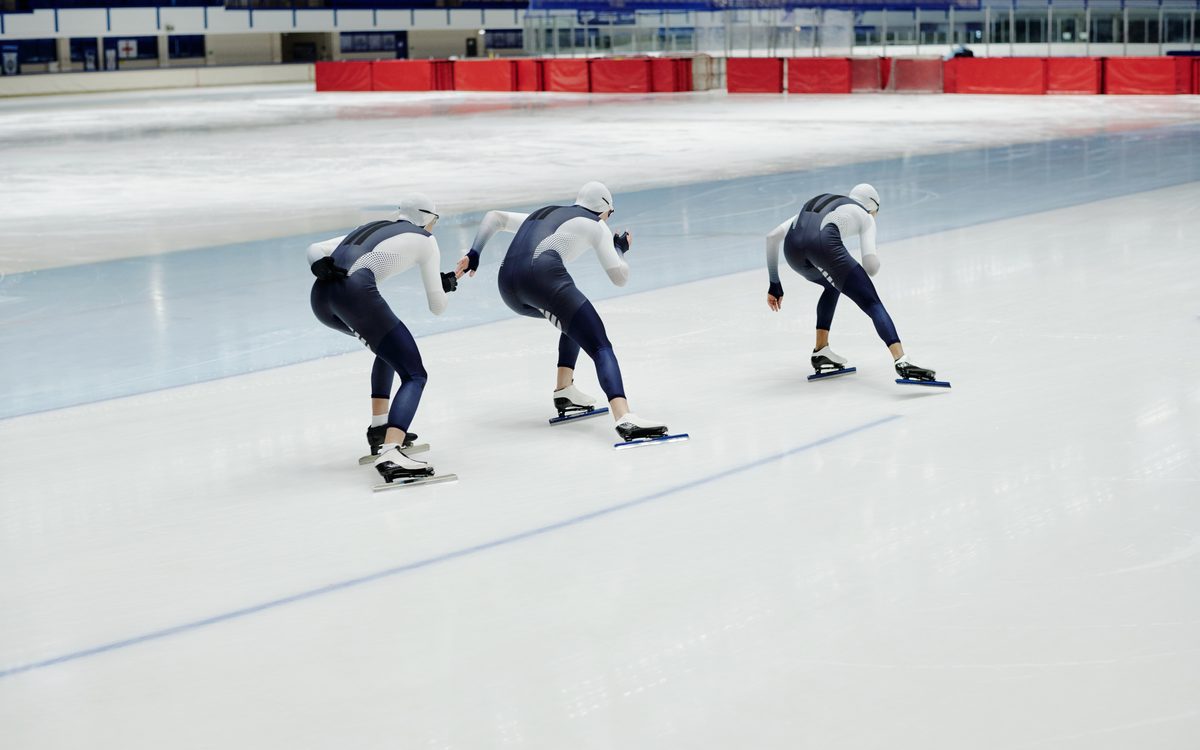
Saturday night after a regional meet: four rounds of the 500 m, a relay, hotel food, and a Sunday program that starts at 8 a.m. The legs feel heavy on the stairs and the skater wonders whether to roll, soak, sleep in or skip dessert. Short track recovery is everything a skater does between efforts, from minutes between rounds to days between hard weeks, to arrive at the next session ready. Sleep, food, easy movement and sensible load do most of the work, and the evidence for gadgets is mixed.
Quick answer: The best-supported recovery habits are enough sleep, enough food and fluid after hard sessions, rest days, and easy movement. Research on tools such as compression, massage and cold-water immersion is mixed, and cold-water immersion after strength training reduced strength gains in one study. Ordinary muscle soreness fades; sharp, one-sided, night or worsening pain is not soreness, so see a sports medicine doctor, physical therapist or athletic trainer.
General information, not medical advice. For training see training, for injuries see injuries, and for fueling see nutrition. The sport overview is on the short track speed skating hub and the parent sport is on the speed skating hub.
Why recovery matters more in short track
A competition day is a string of knockout rounds, so skaters race repeatedly with little rest. The ISU rulebook guarantees a minimum of 15 minutes between races (Rule 291). A 2018 study of World Cup races (Konings and Hettinga, International Journal of Sports Physiology and Performance) found that extra high-intensity efforts from the repechage system reduced the share of skaters who qualified in their next main race: in the 500 m, 57.3% of skaters who had qualified directly then qualified for the next stage, compared with 25.0% of those who had come through the repechage. A 2016 study (Hettinga and colleagues) found 12 talented short track skaters reported higher perceived exertion two and four hours after a short track time trial than after a long track one, and the authors suggest longer recovery is needed after short track training. Hard intervals also have a cost for sleep, as covered below.
Sleep
The American Academy of Sleep Medicine and Sleep Research Society consensus for healthy adults is seven or more hours a night. For children and teens, a consensus endorsed by the American Academy of Pediatrics gives 9 to 12 hours for ages 6 to 12 and 8 to 10 hours for ages 13 to 18. Early ice times make that hard. A 2024 randomized crossover study of 18 male adolescent speed skaters (Kong and colleagues) found that interval training and Wingate testing shortened sleep and lowered an HRV measure that night, while an aerobic capacity test did not. It was small, but it suggests that heavy interval days are when sleep needs the most protecting. Practical steps are general sleep-hygiene advice: a consistent schedule, a dark, cool bedroom, limiting caffeine late in the day and, at away meets, keeping a normal routine. A review of elite soccer players (Nedelec and colleagues, 2015) makes similar points, though it was not about skaters.
Managing training and competition load
Rest days are part of the program. The AAP (Brenner, 2016) recommends one to two days off a week from the main sport and about three months a year away from it, in one-month blocks, for young athletes. A 2024 AAP clinical report (Brenner and Watson) says that imbalance between training load and recovery can lead to overuse injury and overtraining. Some coaches track morning heart-rate variability (HRV) or simple wellness scores. In a small observational study of five international-class skaters (Iizuka and colleagues, 2020), morning HRV was lower at the end of a competition season than at the start, but one study of five skaters cannot set a rule. Common warning signs that a skater is carrying too much, general guidance rather than a diagnostic list, include a lingering drop in performance, constant tiredness, poor sleep, low mood and frequent minor illnesses. Those are a reason to talk to a coach and a clinician.
Between rounds and after a session
A 2025 study of 15 elite short track skaters (Kowalski and colleagues) compared active recovery cycling, pneumatic compression boots and an isocapnic breathing protocol between efforts. All three changed recovery markers, and for this sample the effects on subjective ratings, hormones, creatine kinase, jump performance and on-ice repeats were analogous. In other words, no method clearly beat the rest. A 2018 narrative review (Van Hooren and Peake) found an active cool-down largely ineffective for same-day and next-day performance and not shown to prevent injuries, though it may help how you feel, so an easy spin or skate is optional and personal. A warm layer, a snack and fluids between rounds are common practice (see nutrition).
Recovery tools: what the evidence says
- Massage: a 2018 meta-analysis of 99 studies (Dupuy and colleagues) of post-exercise techniques found massage among the most effective for soreness and perceived fatigue. Effects on performance are less clear.
- Compression boots and garments: reduced soreness in some studies; in the skater study above, boots were analogous to cycling and breathing.
- Cold-water immersion: a 2016 review (Machado and colleagues) suggests it can reduce soreness compared with passive rest, but a 2015 study in men (Roberts and colleagues) found it blunted strength and muscle gains over 12 weeks of strength training. Skaters who lift may want to avoid it right after strength sessions. Anyone with heart or circulation conditions should check with a doctor first.
- Wearables: HRV and sleep trackers give numbers, not diagnoses. Treat them as one input.
Mobility and flexibility
Skating asks for deep, held bends of the hips, knees and ankles and pushes mostly to one side in the curves. Skaters commonly spend time on hip, ankle, hamstring and thoracic spine mobility and on keeping the trunk strong, since back pain is common in the sport (60% of young speed skaters reported low back pain in a 12-month Dutch study, van Hilst and colleagues, 2015). The exercises are general practice, not tested prescriptions, and a physical therapist can tailor them. Stretching is not a proven way to prevent injury, so do not use it to push through pain.
Soreness or injury?
- Usually soreness: a dull ache in both legs, worst a day or two after hard work, easing with gentle movement.
- See a clinician: sharp or locking pain, pain in one spot that persists, swelling, pain at night or at rest, numbness or weakness, or anything that changes how you skate.
- After a fall or head knock: see our injuries page for concussion danger signs.
This split is general guidance. When in doubt, ask.
Short track recovery FAQs
How much rest do short track skaters need between races?
ISU rules require at least 15 minutes between races, but how skaters use that time varies. In a 2025 study of elite skaters, cycling, compression boots and breathing protocols all worked about equally, so use what is comfortable.
How many hours of sleep should a young skater get?
A consensus endorsed by the AAP gives 9 to 12 hours for ages 6 to 12 and 8 to 10 hours for ages 13 to 18. The adult recommendation is seven or more hours.
Do ice baths help skaters recover?
Evidence is mixed. A review found they may reduce soreness, and a study in men found they blunted strength gains from training. Check with a doctor if you have a heart or circulation condition.
Is soreness after interval training normal?
Dull soreness that eases with movement is common. Sharp, one-sided or worsening pain is different and deserves a visit to a sports medicine doctor, physical therapist or athletic trainer.
Should I take a rest day after a competition weekend?
Many coaches schedule lighter days afterward. The AAP recommends one to two days off a week for young athletes, and your coach can adjust the plan.
Sources
- Konings and Hettinga, preceding race efforts and pacing in short track, IJSPP 2018
- Hettinga et al., muscle oxygenation, fatigue and recovery in LT and ST, Front Physiol 2016
- Kowalski et al., recovery strategies in elite short track skaters, 2025
- Kong et al., interval training and sleep in adolescent speed skaters, 2024
- Iizuka et al., morning HRV in elite speed skaters across a season, Sports 2020
- Van Hooren and Peake, do we need a cool-down after exercise?, Sports Med 2018
- Dupuy et al., post-exercise recovery techniques: meta-analysis, Front Physiol 2018
- Machado et al., cold-water immersion temperature and time, Sports Med 2016
- Roberts et al., cold-water immersion and strength training adaptations, J Physiol 2015
- AASM and SRS, recommended sleep for a healthy adult, 2015
- Paruthi et al., recommended amount of sleep for pediatric populations, 2016
- Nedelec et al., sleep hygiene and recovery strategies in elite soccer players, 2015
- AAP, Brenner, sports specialization and intensive training, 2016
- AAP, Brenner and Watson, overuse injuries, overtraining and burnout, 2024
- van Hilst et al., low back pain in young elite athletes, 2015
- ISU Short Track Sport Rules 2026, Rule 291 (15 minutes between races)
General information for education only, not medical advice. It does not replace a visit with a sports medicine doctor, physical therapist or athletic trainer. See how we write and check our pages in our editorial policy.