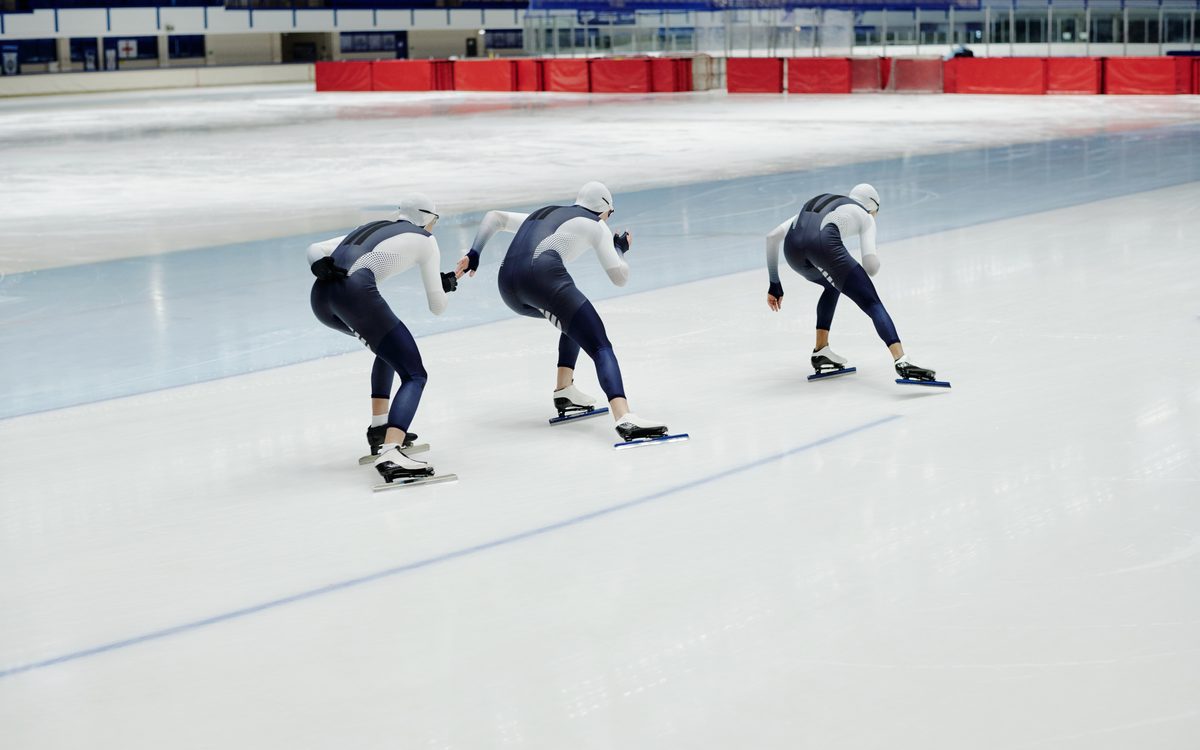
The skater is third into the last corner of a semi-final, two places from a final, and has maybe two seconds to decide: go inside now, or wait for the exit? Nothing in the legs can answer that. The head has to. Short track mental training is the set of skills, such as focus, routines, pressure management, race planning and bouncing back from a fall or a penalty, that help a skater use the fitness they have. It supports performance and cannot guarantee it.
Quick answer: Mental skills in short track are practical: a repeatable pre-race routine, a short list of focus cues, a plan for where to be in the pack, and a plan for what to do after a fall or penalty. Research on pressure supports routines and attention strategies in general, but we found little short track-specific research on imagery or goal setting, so most tips here are general coaching practice. Stress, anxiety, low mood, disordered eating or burnout are health matters: talk to a qualified professional.
General information, not medical advice. The rules behind the tactics are on our rules page, and the sport overview is on the short track speed skating hub. The parent sport is on the speed skating hub.
Confidence and focus
Confidence in short track comes from specific evidence: starts you have practiced, passes you have made in training, and lap times you hit. Focus is about narrowing attention to what matters in the next few seconds. In a 2026 position statement from Exercise and Sports Science Australia (Schweickle and colleagues), pressure can help or hurt performance, and four categories of strategy are described: pre-performance routines, implicit attentional strategies, psychological skills training and mindfulness. A 2026 meta-analysis of 21 studies of choking under pressure (Zeng and colleagues) found interventions such as quiet eye training, routines, mindfulness and self-talk generally reduced the decline in performance under pressure, with larger and steadier effects in closed-skill tasks than open-skill ones. A pack race is an open-skill situation, so the benefit may be smaller.
A pre-race routine
The heat box and the start commands already give a ready-made routine (the ISU rulebook calls skaters to the start, then “Ready,” then the gun). General coaching practice is to add a few personal steps before that: check skates and gear, take a few slow breaths, repeat one or two cue words (such as “low, quick, light”), and run a short plan for the first lap. Keep it short enough to repeat when a start is recalled. Because the “0 false start” procedure at ISU events penalizes a start that is too early or too slow, a calm, repeatable routine also supports a clean start.
Staying calm: breathing and attention
A 2026 randomized crossover study of 26 university speed skaters (Tomita and colleagues) found that a single session of focused attention meditation reduced state anxiety more than random thinking before a cycling interval session, without changing power output or fatigue. It was a cycling workout, not a race, and one session, so it shows the idea is workable, not that it wins races. Simple breathing before the start is common practice among coaches. The study also tested controlled breathing, which changed heart-rate variability.
Tactics and decision-making
Short track is a thinking sport. The pacing research gives coaches real talking points. In 500 m races, top-placed skaters were faster in every lap, and early position correlated with final position even from lap one, so a fast start seemed optimal. In the 1000 m, the crucial part was from about lap six to the finish (Noorbergen and colleagues, 2016). In the 1500 m (510 skaters, 85 races), the winner was in the lead more than half the time in the last three laps, and top finishers were faster than others only in the last five laps (Konings and colleagues, 2016). Skaters also grow more conservative with age: in a 2020 study of 140 junior men, older skaters saved more energy early (Menting and colleagues).
A coach can turn that into a plan: decide before the race where you want to be at the halfway point and when you will move, then adjust. Decide where you will pass based on the space you see, not on frustration. Remember the rule that makes the overtaking skater responsible for contact until the skaters are alongside (ISU Rule 295, covered on our rules page), so patience is also safety.
Setbacks: falls, penalties and bad rounds
Falls and penalties are part of the sport. In the 2025 analysis of 16 international competitions, 1,505 falls occurred in 18,631 race entries (Clement and colleagues). A penalty means disqualification from that race and no place in the next round of that distance (ISU Rule 296), and referee decisions on infringements are final. Arguing does not change them. The following is general coaching practice, not tested in skaters: take a few breaths, name what happened in one factual sentence, find one thing to do next, and save the review for later with the coach. After a fall, check how you feel before racing again, and see our injuries page for concussion danger signs. Extra rounds can also add fatigue: a 2018 study of World Cup racing (Konings and Hettinga) found skaters who came through the repechage were less likely to qualify in their next main race.
Goal setting and imagery
We found no short track-specific study of imagery or goal setting. As general practice, coaches often suggest a mix of process goals (a clean start, holding the line through the corners) and outcome goals (advance a round), and short mental rehearsals of a race. Treat these as practice habits, not proven methods for this sport.
Young skaters
The AAP clinical report on overuse, overtraining and burnout in young athletes (Brenner and Watson, 2024) calls burnout one of the primary reasons for dropping out of youth sports, defined as physical or mental exhaustion and a reduced sense of accomplishment. Fun, variety and rest are part of mental health for a young skater. US Speedskating’s youth track emphasizes skills and fun over times.
Mental performance is not mental health
Nerves before a race are normal. Anxiety that will not ease, a low mood, panic, trouble sleeping, disordered eating, or feeling emptied out and unmotivated is a health matter, and it needs a qualified professional (a doctor, psychologist or counselor), not a pep talk. The 2026 IOC consensus statement on mental health in elite athletes says mental health symptoms are common among elite athletes, can affect performance and that, with support and treatment, many athletes can continue to train and compete. In the US, the 988 Suicide & Crisis Lifeline is available by call or text. In an emergency, call 911.
Short track mental training FAQs
How do short track skaters handle pre-race nerves?
Common approaches are a repeatable routine, slow breathing and a short list of focus cues. A 2026 study of 26 speed skaters found focused attention meditation lowered anxiety before a cycling workout. It was not a race, so treat it as one idea to try.
Does visualization work for short track?
We did not find a short track-specific study. Many coaches use mental rehearsal as a general practice habit.
What should a skater do after a penalty?
Take a breath, accept that the referee’s decision is final, and talk it through with the coach later. This is general coaching practice. Under ISU rules a penalty means disqualification from that race and no place in the next round.
How do skaters plan tactics?
Pacing studies show a fast start helps in the 500 m, the 1000 m often turns around lap six, and in the 1500 m the winner usually leads late. Coaches use this to set a plan and adjust.
When is stress a health problem?
When it does not ease, or comes with low mood, panic, poor sleep, disordered eating or burnout. Talk to a doctor or qualified mental health professional. In the US, 988 offers crisis support.
Sources
- Schweickle et al., ESSA position statement, Performance Under Pressure in Sport, Sports Med 2026
- Zeng et al., counteracting choking under pressure: meta-analysis, 2026
- Tomita et al., focused attention meditation in speed skaters, Sensors 2026
- Noorbergen et al., pacing in 500 and 1000 m short track, IJSPP 2016
- Konings et al., pacing in 1500 m short track, IJSPP 2016
- Menting et al., pacing development in youth short track skaters, 2020
- Konings and Hettinga, preceding race efforts in short track, IJSPP 2018
- Clement et al., short track falls 2021-2023, 2025
- ISU Short Track Sport Rules 2026: Rules 294, 295, 296
- AAP, Brenner and Watson, overuse injuries, overtraining and burnout in young athletes, 2024
- Reardon et al., IOC consensus statement on mental health in elite athletes, 2026
- CDC HEADS UP, signs and symptoms
- 988 Suicide & Crisis Lifeline
General information for education only, not medical advice. It does not replace a visit with a sports medicine doctor, physical therapist or athletic trainer. See how we write and check our pages in our editorial policy.