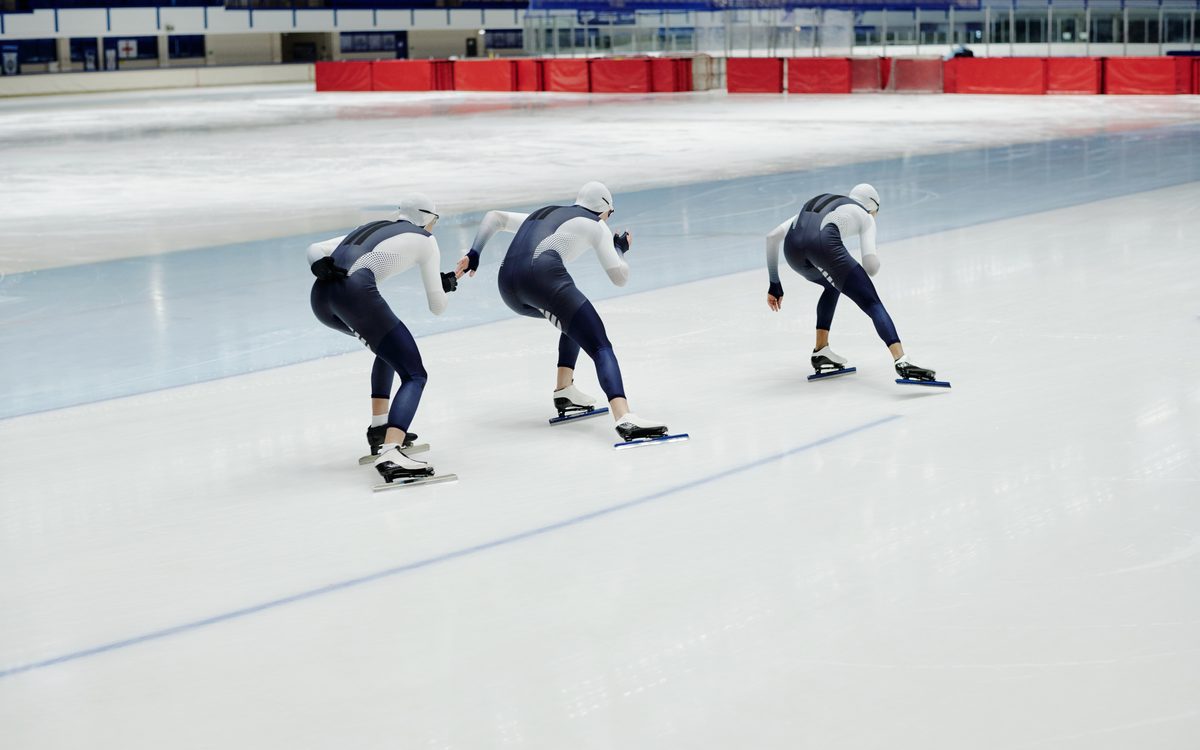
Five skaters shuffle to the line, each over a small dot painted on the ice 1.3 m from the next. The starter calls “Ready,” everyone drops into a crouch and goes still, and in that pause one skater’s blade creeps over the line. The gun is fired again, the starter calls out the lane and “False Start,” and the race begins over. Those dots, those commands and those penalties are all written in the International Skating Union (ISU) rulebook. Short track speed skating (often just “short track”) is mass-start racing on a small ice oval, where the first skater over the finish line wins and tactics matter as much as speed.
Quick answer: Short track is raced counterclockwise on a 111.12 m oval; the first skater over the line wins, and a skater who breaks the racing rules can be penalized and removed from that race. Newcomers start with a club (many loan skates) and basic skating skills before any racing. Rules here follow the ISU 2026 rulebook; your own event’s rules can differ below international level.
General information, not medical advice. This page covers how racing works and how to start. For the full picture see the short track speed skating hub; for safety see our injury prevention page, and for the longer-oval cousin see long track speed skating. The parent sport is on the speed skating hub.
The track and the distances
ISU Rule 280 sets the oval at 111.12 m, in a heated rink at least 60 by 30 m. Protective mats must be installed around the ice. Races run counterclockwise, so the inside of the track is on the skater’s left (Rule 295). Individual distances are 500, 1000 and 1500 m. That works out to about 4.5, 9 and 13.5 laps (our arithmetic). Relays are 3000 m for women, 5000 m for men at senior level and 2000 m (18 laps) for the mixed team relay.
How a race is won
A skater has completed the distance when the leading tip of the skate blade reaches the finish line (Rule 295). At ISU events and the Olympics, every distance is run as a knockout. Races are held in rounds, from heats or quarter-finals through semi-finals to a final, and the winners of each race move on, along with extra finishing places listed in the qualification table for that distance (Rule 291). Each final round actually holds two races: the Final, which decides the winner, and a Final B, which sorts out the next ranks. Racers per race are limited at ISU events: five in the 500 m and 1000 m quarter-finals, semi-finals and finals, and seven in the 1500 m semi-finals and final (Rule 291). Repechage races can give knocked-out skaters another chance, and a skater impeded by someone who was then penalized can be moved up if they were in a qualifying position (Rule 291).
The start
Skaters report to the heat box, where a steward checks their equipment. On the starter’s command “Go to the Start,” skaters step to their dots and stand still. At “Ready,” they drop into their start position and hold it until the gun (Rule 294). At ISU events, including the Olympics, the “0 false start” procedure applies: it is a false start to put the tip of the blade into the ice, cross the start line, touch the ice with a hand, move clearly before the gun, or be too slow into position, and a false start carries a penalty. Other international events can allow one free false start if their announcement says so.
Racing rules, cards and penalties
Overtaking is allowed at any time, but until the two skaters are side by side, the skater passing is responsible for any collision or obstruction, as long as the skater being passed is not acting improperly (Rule 295). The rulebook names five breaches: skating off the track, impeding, taking assistance, kicking out a skate and embellishment (exaggerating a fall or contact).
Sanctions come in three levels (Rule 296):
- Penalty for an ordinary breach. The skater is disqualified from that race and cannot take part in the next round of that distance.
- Yellow card for an unsafe, unsportsmanlike or hazardous offence. The skater is disqualified from the race, excluded from the next round and loses points accrued on that distance.
- Red card for a dangerous or grossly negligent breach, or after two yellow cards in the same event. A skater with a red card cannot take part in any further race in that event.
Minor mutual contact that does not change the result can be ruled shared responsibility with no penalty, and referee decisions on infringements are final (Rule 296).
Relays
Four skaters compete in each relay. Exchanges are made by touch, and the skater who has been touched becomes the one racing. A skater may be relayed at any time except during the last two laps, which one skater must skate alone, and the final exchange has to be finished on the straight before the first corner block. A warning shot signals the start of the last three laps. If a skater falls in the last two laps, a relay is allowed.
The mixed team relay is 2000 m (18 laps). Two women and two men race, in a fixed exchange order of woman, woman, man, man (four segments of 2.5 laps, then four of 2 laps). After a fall, a skater of the same gender normally covers the relay, with set exceptions (Rule 295).
Basic skills a beginner learns
The following is general coaching practice, not a rule. Beginners usually start with balance and stopping on the ice, then learn the low skating position, pushing sideways on the straights and crossing the right foot over the left through the curves . Starts and pack skills (holding a line, passing cleanly, relaying) come later, and a club coach should decide when a skater is ready to race in a pack.
How a beginner gets started
- Find a club. US Speedskating’s club finder is an interactive map. The organization says there are just over 60 ice speed skating clubs and that short track clubs exist in 37 states.
- Learn to skate. US Speedskating points newcomers to Learn to Skate USA, a program it endorses with US Figure Skating and USA Hockey, with six levels that can be taught in groups or used as personal goals.
- Ask about skates and clothing. Many clubs loan skates, so share your shoe size with the club. US Speedskating suggests warm layers, gloves, a helmet and knee pads for practice. Competition adds cut-resistant gear; see our gear page.
Levels and where to go next
According to US Speedskating’s 2025-26 short track regulations, age group divisions run from Junior E (ages 7 to 10) through D, C, B and A (up to 18) to Senior (19 to 29), plus masters.
Olympic status. Short track has been an Olympic Winter Games sport since 1992, according to US Speedskating. The official Milano Cortina 2026 program lists nine short track events: 500 m, 1000 m, 1500 m and a relay for women and for men, plus the 2000 m mixed team relay. For any later Games, check the official programme. Training pointers are on our training page.
Short track speed skating rules FAQs
How is short track different from long track?
Short track is a pack race on a 111.12 m oval where skaters race each other to the finish line, and its blades are fixed. Long track is raced on a 400 m oval in pairs against the clock. See long track speed skating for that side of the sport.
What gets a skater disqualified?
Under ISU rules, a clear breach such as impeding or kicking out a skate brings a penalty: disqualification from that race and no place in the next round. Dangerous or unsportsmanlike actions can bring yellow or red cards.
How many skaters are in a race?
At ISU events, five skaters in the 500 m and 1000 m quarter-finals, semi-finals and finals, and seven in the 1500 m semi-finals and final. US Speedskating describes packs of four to seven at its events.
Do I need my own skates to try it?
Not at first. US Speedskating says many clubs loan skates for practice. Ask the club before the first session and tell them your shoe size.
Is short track an Olympic sport?
Yes. US Speedskating says it has been Olympic since 1992, and Milano Cortina 2026 listed nine short track events. For later Games, check the official programme.
Sources
- ISU Short Track Sport Rules 2026 (as of 1 June 2026): Rules 280, 284, 288, 291, 294, 295, 296, 297
- US Speedskating, Get Started (clubs, Learn to Skate USA, loan skates, short track)
- US Speedskating, Speedskating 101
- US Speedskating, Devo track
- US Speedskating, 2025-26 Short Track Rules and Regulations (age divisions)
- Milano Cortina 2026, Short Track Speed Skating (official program)
- ISU, Short Track Guidance to the Racing Rules 2026-27
General information for education only, not medical advice. It does not replace a visit with a sports medicine doctor, physical therapist or athletic trainer. See how we write and check our pages in our editorial policy.