Quick answer: In rugby league, most injuries happen in matches and in the tackle. A 2026 meta-analysis of 148 rugby reports pooled about 24.3 time-loss injuries per 1,000 player hours in league, with lower-limb injuries the most common and sprains the most frequent type. Concussion in league matches averages about 10.45 per 1,000 player hours. Basic rehab principles are below, but a sports medicine doctor, physical therapist or athletic trainer should diagnose injuries and decide when you return to play.
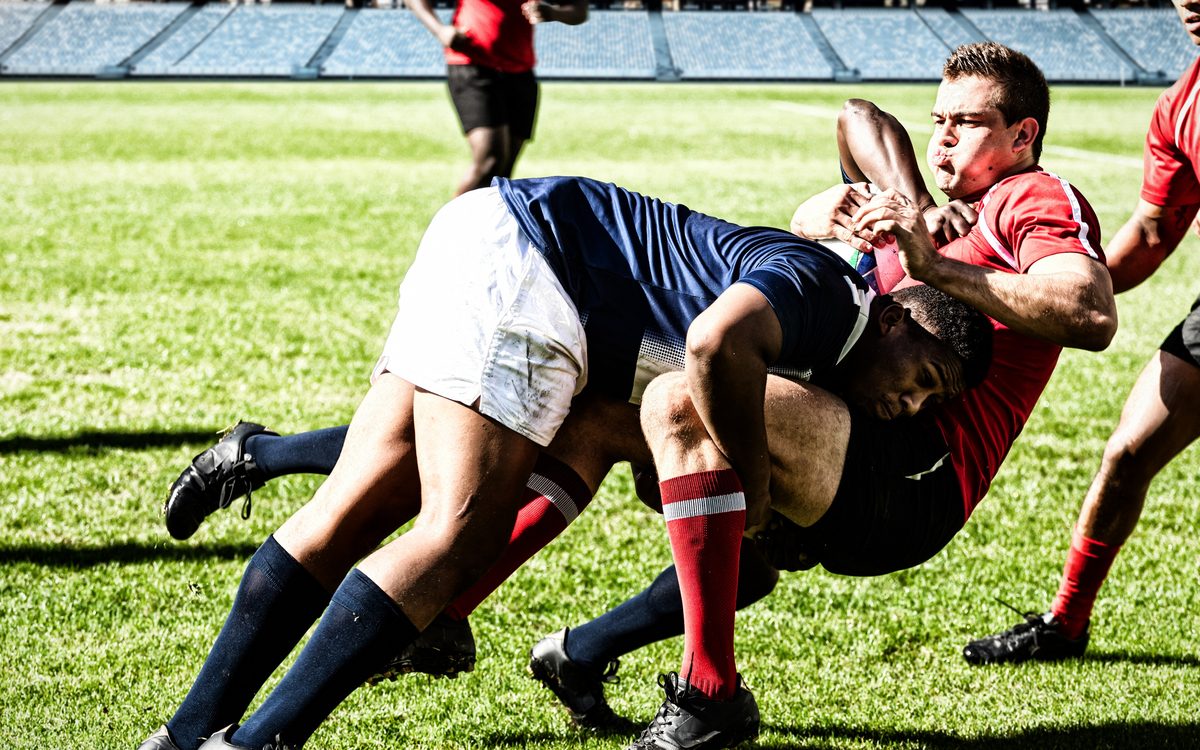
Ten minutes in, a centre takes a shoulder to the head in a tackle, stands up slowly and tells the trainer he is fine. The trainer takes him off anyway for a head injury assessment. That small moment captures the main injury story in rugby league: collisions, the tackle and the head. This page covers what research says about injury patterns, concussion, rehabilitation principles and when to see a professional. To lower risk, see injury prevention; for the sport overall, see the rugby league hub.
How common are injuries?
A 2026 systematic review and meta-analysis by Laaksonen and colleagues pooled 148 rugby reports covering about 8.4 million player hours. For rugby league the pooled incidence was 24.3 time-loss injuries (95 percent confidence interval 9.1 to 64.4) and 61.9 medical-attention injuries (29.9 to 127.9) per 1,000 player hours. Rugby union was 19.9 and 33.6, and sevens higher. Match injuries were consistently higher than training injuries in every format, and professionals had higher rates than amateurs in both league and union. The wide intervals show how much definitions and study quality vary.
Where and what: injury patterns
The same review found that lower-limb injuries were most common, followed by head and upper-limb injuries, and sprains were the most frequent type. For league, the tackle is the main setting: a Super League case-control study of tackles linked to 196 clinically diagnosed concussions (2018 to 2022) concluded that prevention should aim to reduce head impacts by deterring initial contact with the ball carrier’s head and neck. Shoulder injuries are a known concern in rugby; a 2026 meta-analysis of rugby union (Doyle and colleagues) pooled 11.02 match shoulder injuries per 1,000 player hours with very high variation between studies, so treat it as an average, not a prediction, and note it is union data.
Concussion
- How often. A 2026 meta-analysis of 98 studies (De Sousa-De Sousa and colleagues) pooled 9.20 concussions per 1,000 player hours in league and 9.74 in union, with no significant difference. In league, matches were 10.45 per 1,000 against 0.32 in training. Studies using head injury assessment protocols reported nearly double the incidence of those that did not, probably because detection is better.
- In the tackle. In NRL video analysis (Gardner and colleagues, 2021), tacklers had more head injury assessments per tackle than ball carriers. In the NRLW (McLeod and colleagues, 2023), 6 diagnosed concussions occurred in the studied tackles, and head contact above the sternum carried the most risk.
- Rules. The International Laws let a team add an 18th player when two teammates fail head injury assessments (Section 4).
- Signs. CDC HEADS UP lists signs and symptoms that can appear hours or days after a knock: headache, dizziness, balance problems, nausea, sensitivity to light or noise, trouble concentrating, memory problems, irritability, sadness and sleep changes.
- Danger signs. Seizures, repeated vomiting, loss of consciousness, a worsening headache, slurred speech, weakness or numbness, unusual confusion or growing drowsiness need emergency care.
The CDC HEADS UP principle is to recognise the signs and remove the player from play; a health care provider decides about return. Coaches and teammates should not make that call, and a player should not carry on to finish the game.
General principles of rehabilitation
We are giving general principles, not a plan, and none of this is a diagnosis. Common themes in sports medicine, general practice not drawn from a single league source:
- Get it assessed first. A joint that swells, locks, gives way or cannot take weight needs an exam; do not guess.
- Protect early, then load. Clinicians typically move from protecting the injury to controlled movement and then building strength, rather than complete rest or pushing through pain.
- Rehab is progressive. The next stage starts when the clinician judges the previous one is done, not on a date.
- Address the whole player. Strength, balance, running and tackling practice should be restored in steps.
- Previous injury matters. A 2026 systematic review (Parmley and colleagues) listed previous injury among the most commonly studied contributors to negative outcomes in rugby.
There are no universal recovery times: the same diagnosis can take very different times depending on severity, the person and the treatment. Return to play is a decision for the treating clinician, and for head injuries it follows a graded, clinician-led process.
When to see a professional
- Any suspected head, neck or spine injury, or any danger sign above: emergency care.
- Severe pain, visible deformity, or inability to move or bear weight.
- Swelling that does not settle, a joint that clicks, locks or gives way.
- Pain that returns every time you play or wakes you at night.
- Numbness, tingling or weakness.
Ask for a sports medicine doctor, physical therapist or athletic trainer. If you are a parent, check your child’s club has a trained first-aider.
Frequently asked questions
What is the most common injury in rugby league?
In a 2026 pooled review of rugby, lower-limb injuries were most common and sprains the most frequent type. Head injuries and concussions are also prominent in league matches.
How common is concussion in rugby league?
A 2026 meta-analysis pooled about 9.20 concussions per 1,000 player hours in league overall, and 10.45 per 1,000 in matches against 0.32 in training. Rates depend on how studies identified concussion.
Is rugby league more injury-prone than rugby union?
Pooled time-loss injury rates were higher in league (24.3 per 1,000 player hours) than union (19.9), but the intervals overlap widely and study methods differ, so the picture is rough.
How long does an injury take to heal?
There is no universal time. It depends on the injury, its severity and the person; a clinician who has examined you can give an estimate.
When can I go back to playing after a knock to the head?
A health care provider decides, not the player, coach or parent. If symptoms are present or danger signs appear, get medical care.
Do rehab exercises replace seeing a doctor?
No. Exercises suit a diagnosed problem; get it assessed first, then follow the plan from your clinician.
Sources
- Laaksonen et al. 2026, Epidemiology of rugby injuries, PMID 41497830
- De Sousa-De Sousa et al. 2026, A decade of concussion in rugby, PMID 42128596
- Gardner et al. 2021, tackle HIA risk factors in the NRL
- McLeod et al. 2023, tackle head impact events in the NRLW
- Super League tackle characteristics and concussion case-control study (Leeds Beckett repository)
- Doyle et al. 2026, shoulder injuries in rugby union, PMID 42527622
- Parmley et al. 2026, PMID 41835331
- CDC HEADS UP, signs and symptoms
- International Rugby League, Laws of the Game 2026
General information for education only, not medical advice. It does not replace a visit with a sports medicine doctor, physical therapist or athletic trainer. See how we research and write our pages in our editorial policy. More: recovery, training, the rugby league hub and the sports hub.