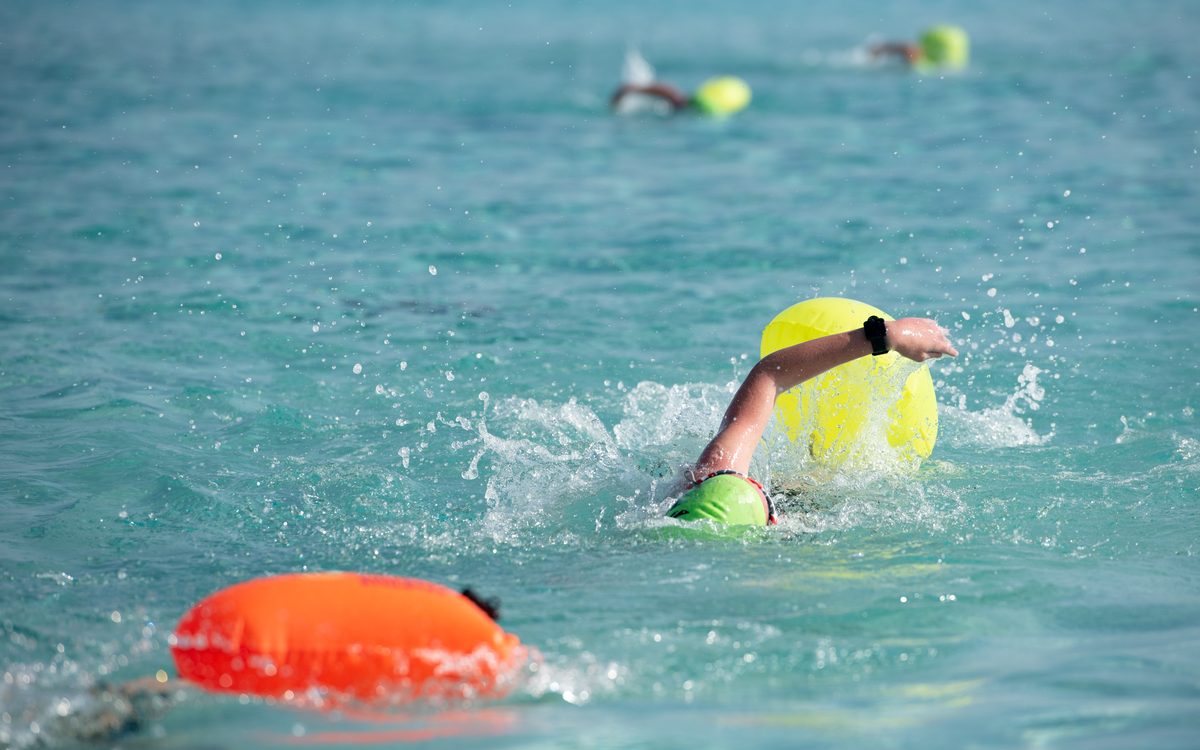
The water looks flat from the beach, so the plan is “just swim out to the second buoy.” Ten minutes in, the water is colder than the lake last week, the wind has picked up and your buddy has gone to the shore with a cramp. Open-water swimming injury prevention is the set of habits that lower the chance of getting hurt or ill in open water: a warm-up, a gradual training load, strength work, respect for temperature and water conditions, visible gear and a buddy. These lower the odds. They cannot promise safety.
Quick answer: The main hazards in open water are cold, heat, rough or polluted water and swimming alone. Swim with a buddy and a tow float, wear a bright cap, check the water and weather, build distance and cold exposure gradually, and get out if you feel breathless, shivering hard or confused. See a sports medicine doctor, physical therapist or athletic trainer for pain that persists, and call emergency services for trouble breathing or confusion.
General information, not medical advice. What each injury looks like is on our open-water injuries page, so we do not repeat it. For pool-specific prevention see swimming injury prevention.
Warm up
We did not find a published injury-prevention warm-up tested in open-water swimmers. General practice: loosen the shoulders and upper back on land with arm circles and band work, and, in cold water, ease in with a few minutes of easy swimming near the shore before heading out. Treat this as common practice, not proven protocol.
Swim with a buddy, a tow float and a bright cap
USMS says to swim with a buddy of similar ability even when a lifeguard is nearby, to use a tow float (an inflatable buoy on a waist belt that makes you easier for boats to see) and to wear a bright cap, not white. The AAOS also advises against swimming alone. A 2021 CDC-data study in Injury Prevention found that US states with more types of regulations for designated open-water swim sites (lifeguards, water quality, rescue equipment, tracking and signage) had lower open-water drowning death rates, which is a reason to prefer supervised sites.
Cold water
Cold is the best-documented risk. World Aquatics requires wetsuits below 18.0 C and holds no races below 16 C, and says new research supports the 16 C limit. A 2019 British Journal of Sports Medicine study of 12 lean swimmers found that, at 16 C, half did not finish two hours in suits and caps and four became or were predicted to become hypothermic, and at 18 C three did not finish. A 2009 study of 12 elite Brazilian swimmers in 21 C water found 83 percent finished the 10 km with core temperature below 35 C, with a bigger drop in women (4.2 vs 2.7 C on average). Practical steps (general practice): enter slowly, limit time while you are getting used to cold, stay near shore, carry warm clothes for after and watch for uncontrolled shivering, clumsiness or confusion. Experienced channel swimmers in a 2026 Sports Medicine Open interview study said that cognitive impairment in the water was recognised only afterwards, so a buddy who watches for it matters.
Heat
Warm water matters too. A 2025 review in the European Journal of Applied Physiology found that water temperatures near the World Aquatics upper limit (31 C) reduce performance and raise health risks, and that cooling strategies are hard to use in events. At the Doha 2024 Masters 3 km, five of 48 swimmers went above a core temperature of 39.0 C even though the water was about 20.5 to 20.9 C, so air temperature and effort matter as well. Drink before and after, wear sun protection and get out if you feel dizzy or unwell.
Water quality and conditions
The CDC advises checking whether a swim area is monitored, under advisory or closed, especially after heavy rain; avoid water that is cloudy, discoloured or smelly, near drains, and do not swim with diarrhoea or an open wound. Do not swallow water. Also check wind, waves, currents and boat traffic, and decide in advance where you will exit. Sighting and swimming a straight line matter more in current.
Breathing and the heart
Swimming-induced pulmonary oedema (fluid in the lungs during swimming) happens to otherwise fit people. A 2026 study of 7,866 endurance athletes at half-ironman and open-water events at moderate altitude confirmed it by ultrasound in 29 of 144 athletes who were checked. A 2026 case-control study in Chest (258 cases, 2,117 controls) found asthma and limited open-water experience were among the risk factors. If you cough, wheeze or feel unusually breathless, stop and seek care. A tight wetsuit can add to the feeling of chest tightness; fit matters.
Strength, load and equipment
- Shoulders. A 2023 systematic review in competitive swimmers found that shoulder strength endurance may be the most clinically relevant modifiable factor, although few high-quality studies exist. Common practice is rotator-cuff and scapular exercises with a physical therapist’s guidance.
- Training load. The same review linked a high acute-to-chronic workload ratio to injury in its best study; raise distance in small steps.
- Equipment. Goggles that fit, a snug cap, and a wetsuit that fits without restricting breathing or shoulder motion. World Aquatics sets the rule (3 to 5 mm thickness, no speed or buoyancy aids); maker claims about speed or buoyancy are not independently verified here.
What prevention cannot do
Even careful swimmers can be caught by a sudden change in weather, cramp or a medical event. A plan, a buddy and honest limits reduce risk but cannot remove it. Children need constant adult supervision in water; the AAP drowning recommendations on HealthyChildren.org apply.
When to see a professional
Get help for shoulder pain lasting more than a couple of weeks or that wakes you, shortness of breath or chest symptoms after a swim, an ear that stays painful or discharges, or prolonged confusion or shivering after cold exposure. Emergency services for breathing trouble, collapse or confusion.
Open-water swimming injury prevention FAQs
Do I need a tow float?
USMS recommends one: it makes you more visible to boaters, and some floats carry keys or a drink. It is not a life jacket and does not replace a buddy.
What water temperature is too cold?
World Aquatics races are not held below 16 C, and wetsuits are compulsory below 18.0 C. For recreational swims there is no single number; cold tolerance varies, so build up gradually and stay close to shore.
Is it safe to swim after rain?
The CDC suggests checking for advisories or closures, especially after heavy rain, because runoff can affect water quality.
How do I avoid a panic attack in open water?
Sighting, calm breathing and starting at the edge of the pack help, and USMS says to roll onto your back and float until you are ready to continue. If panic repeats, consider a coach or a mental performance professional.
Can I get swimming-induced pulmonary oedema?
It is uncommon but documented in fit swimmers. Get out, sit up and seek care if you have unusual cough or breathlessness.
Sources
- USMS: Safety tips for open-water swimming
- USMS: What to do in an open-water emergency
- CDC: How to safely visit oceans, lakes and rivers
- AAOS OrthoInfo: swimming injury prevention
- World Aquatics: 16 C threshold research
- Saycell et al., BJSM 2019 (PMID 30824457)
- Risk of hypothermia in the 10-km marathon swim, Clinics 2009 (PMID 19488594)
- Hyperthermia during open water swimming, Eur J Appl Physiol 2025 (PMID 40888866)
- Doha 2024 Masters 3 km core temperature study (PMID 39500300)
- SIPE at moderate elevations, Wilderness Environ Med 2026 (PMID 42131935)
- SIPE risk factors, Chest 2026 (PMID 41903839)
- Health, risk and adaptation in extreme open water swimming, Sports Med Open 2026 (PMID 43013196)
- Shoulder risk factors in competitive swimmers, 2023 (PMID 37515375)
- Open-water swim-area regulations and drowning rates, Inj Prev 2021 (PMID 31911431)
General information for education only, not medical advice. It does not replace a sports medicine doctor, physical therapist, athletic trainer or registered dietitian who knows you. See how we work in our editorial policy.