This article contains affiliate links: if you buy through them we may earn a commission, at no extra cost to you. Read our affiliate disclosure.
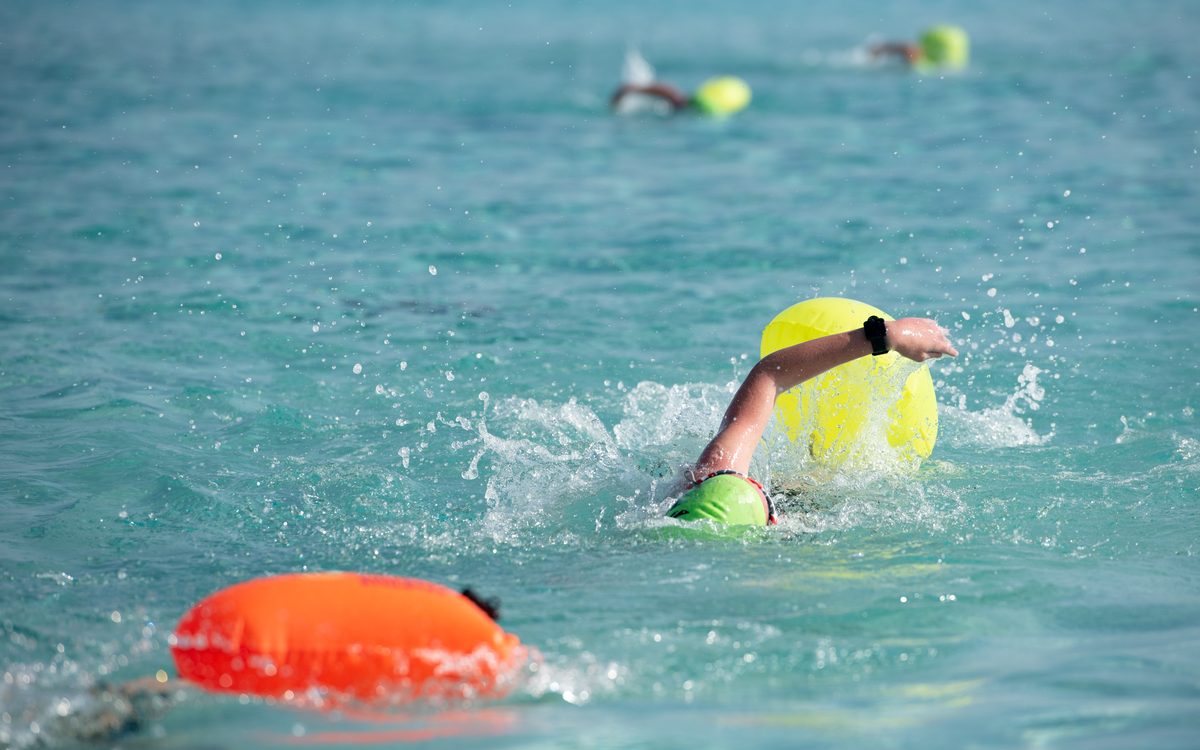
The Olympic 10-kilometre swim is a race you can only really follow from the shore: a pack of caps bobbing in grey water, kayaks and boats alongside, and every so often a swimmer reaching for a bottle on a long pole from a floating platform before sliding back into the pack. It first appeared at the Beijing 2008 Games, where Larisa Ilchenko won the women’s race and Maarten van der Weijden the men’s. For the 2028 Games in Los Angeles, the same two 10 km races are scheduled off Belmont Shore in Long Beach. Open-water swimming, also called marathon swimming or “open water,” is any swimming race held in a river, lake, sea or other open body of water instead of a pool.
Open-Water Swimming guides: what do you need?
New to open-water swimming? Start with the first card. Everything here is general education, not medical advice.
History & Origins of Open Water Swimming
Open water swimming is older than the modern pool. The earliest Olympic swimming races, at Athens 1896, Paris 1900 and St. Louis 1904, were all held in open water, according to Olympedia. Long-distance swims in rivers, lakes and the sea grew into a sport of their own over the 20th century, and the world aquatics federation (formerly FINA, now World Aquatics) added open water to its World Championships in the early 1990s; sources differ on the exact year the 10 km distance joined, so we do not give one.
The big modern milestone came at Beijing 2008, when the 10 km marathon swim made its Olympic debut for both men and women. Those two 10 km races remain the only Olympic open water events as of Paris 2024. Los Angeles 2028 is set to hold them at Belmont Shore in Long Beach. For how races work, see our rules page, and for who runs the sport see leagues and associations.
- 1896, 1900, 1904: Early Olympic swimming races are held in open water (Olympedia).
- Early 1990s (commonly cited): Open water swimming appears at the FINA World Championships; the first race is usually cited as 1991 in Perth.
- 2008: 10 km marathon swim debuts at the Beijing Olympics (women 20 August, men 21 August).
- 2012: Tunisia’s Oussama Mellouli wins the men’s 10 km gold in London (Olympedia, Serpentine, Hyde Park; Éva Risztov won the women’s race).
- 2016: Rio Olympics: Sharon van Rouwendaal (NED) and Ferry Weertman (NED) are the 10 km champions.
- 2020 (held 2021): Tokyo Olympics, Odaiba Marine Park: Ana Marcela Cunha (BRA) and Florian Wellbrock (GER) win.
- 2024: Paris Olympics: van Rouwendaal and Kristóf Rasovszky (HUN) win.
- 2028 (planned): Los Angeles Games, Long Beach.
Sources: Olympedia, marathon swimming (read 2026-11-13) and our hub’s sources (World Aquatics news on LA28).
Recent Olympic Champions
Scope: this table covers the Olympic 10 km marathon swim only, not World Championships, the World Cup circuit or other races. All rows were read on Olympedia on 2026-11-13.
| Games | Women’s 10 km | Men’s 10 km |
|---|---|---|
| Paris 2024 | Sharon van Rouwendaal (NED) | Kristóf Rasovszky (HUN) |
| Tokyo 2020 (held 2021) | Ana Marcela Cunha (BRA) | Florian Wellbrock (GER) |
| Rio 2016 | Sharon van Rouwendaal (NED) | Ferry Weertman (NED) |
| London 2012 | Éva Risztov (HUN) | Oussama Mellouli (TUN) |
| Beijing 2008 | Larisa (Lara) Ilchenko (RUS) | Maarten van der Weijden (NED) |
Source: Olympedia, Paris 2024, Tokyo 2020, Rio 2016, London 2012, Beijing 2008. Results verified through 2026-11-13. Latest completed Olympic event included: Paris 2024 (8 and 9 August 2024).
Legends of the Sport
Olympic marathon swimmers from different Games, listed in no ranking order. Facts are from Olympedia.
- Sharon van Rouwendaal (Netherlands): two Olympic marathon swimming golds (2016 and 2024) and a silver (2020), the most of any competitor.
- Kristóf Rasovszky (Hungary): Olympic 10 km champion in 2024 and silver medallist in 2020.
- Thomas Lurz (Germany): Olympic silver and bronze medallist; with Rasovszky one of two men with two Olympic marathon swimming medals.
- Ana Marcela Cunha (Brazil): women’s 10 km Olympic champion at Tokyo 2020.
- Florian Wellbrock (Germany): men’s 10 km Olympic champion at Tokyo 2020.
- Éva Risztov (Hungary): Olympic marathon swimming gold medallist.
- Oussama Mellouli (Tunisia): Olympic marathon swimming gold medallist.
- Maarten van der Weijden (Netherlands): won the first men’s Olympic 10 km, Beijing 2008.
- Larisa Ilchenko (Russia): won the first women’s Olympic 10 km, Beijing 2008.
Official results and records
- Olympedia: marathon swimming at the Olympics
- Olympics.com: Paris 2024 marathon swimming
- World Aquatics publishes World Championships and World Cup open water results on its own website; check it for the latest.
How we keep this current: we re-check facts after each major championship and update this page. Spot an error? See our editorial policy.
This page is for swimmers curious about leaving the lane lines and anyone who wants to understand the Olympic event. Cold, heat and rough water are the main reason open water has its own rules. For the pool side of the sport, start with our swimming guide.
Open-water swimming at a glance
| What it is | Swimming races in rivers, lakes, seas, oceans or water channels, with a mass start and a course marked by buoys. |
|---|---|
| How it is won | First swimmer to finish the course. Races are timed and ranked by finishing order, not by lane times. |
| Distances | Olympic Games: 10 km for women and men. World Aquatics Championships (World Aquatics rules, 2026): 10 km, 5 km, a 3 km knockout sprint and a 4 x 1500 m mixed team relay. |
| Who competes | Juniors in age groups (World Aquatics Junior Championships: 14-15 years race 5 km, 16-17 race 7.5 km, 18-19 race 10 km), elite swimmers, Masters and recreational swimmers. |
| Governing body | World Aquatics (formerly FINA); national federations such as USA Swimming organise national events. |
| Water temperature rules | Wetsuit required below 18.0 C; races are not held below 16 C; the current upper limit is 31 C and World Aquatics is reviewing it. |
| Season | Mostly northern-hemisphere summer, depending on the water; the Olympic races are scheduled for 17 and 18 July 2028. |
How an open-water race works
There are no lanes and no walls. Swimmers start together, follow a course of buoys and finish at a touchpad. That changes everything about the sport. You swim in a crowd, you draft behind other swimmers, you navigate by lifting your head to spot buoys (called “sighting”), and you live with waves, current and temperature. World Aquatics rules ask organisers to provide floating feeding platforms or stationary feeding stations at least every 2.5 km in races longer than 5 km, which is where those bottles on poles come from. Fins, webbed gloves or anything else that aids speed, buoyancy or endurance is banned.
Discipline is enforced with cards. A first rule breach earns a yellow flag and card with the swimmer’s number, an official warning. A second breach brings a red flag, and the swimmer is disqualified, as is anyone found guilty of unsporting conduct that affects other swimmers.
Who plays it and at what level
Youth and juniors. The World Aquatics Junior Open Water Championships split swimmers into 14-15, 16-17 and 18-19 age groups, with distances that grow with age. Many pool swimmers try their first open-water event through a club or a local race. Adults and Masters. World Aquatics also holds Masters open-water championships, such as the 3 km event in Doha in 2024. Elite. The best swimmers race at the world championships and the Games.
Olympic and Paralympic status (as of 2026). Open-water swimming (called marathon swimming by the Olympic movement) has been on the Olympic program since Beijing 2008. World Aquatics says the 10 km women’s and men’s races are on the LA28 program, with a quota of 22 men and 22 women, held in the Pacific Ocean off Belmont Shore in Long Beach on 17 July (women) and 18 July (men) 2028. Qualification starts at the 2027 World Aquatics Championships in Budapest: the top three men and women in the 10 km qualify, as do the highest-ranked man and woman in the World Aquatics rankings, with the remaining places decided at an Olympic qualification event planned for spring 2028. As at Paris 2024, pool swimmers who qualify in the 800 m or 1500 m freestyle may be added to the field. We could not confirm from an official source whether open-water swimming is currently contested at the Paralympic Games; for para-swimming, see our para-swimming page and check the official programme for the current Games.
What it demands of the body
A two-hour 10 km is mostly aerobic work, with surges when swimmers jostle for position at buoys and starts. Because swimmers cannot push off walls, the swim is continuous, so shoulders, lats and core do steady work in a cold, moving environment. In a lake study of nine male swimmers, stroke rate rose in the last of five 1,000 m swims. In plain words: technique has to hold when you are tired, and you keep lifting your head to find the next buoy.
Health and safety for open-water swimming
This section is general information, not medical advice. If you are hurt or worried about a symptom, see a sports medicine doctor, physical therapist or athletic trainer. For pool injuries such as swimmer’s shoulder, see our swimming injuries page.
Cold water
Cold is the best-studied risk. World Aquatics requires a wetsuit when the water is below 18.0 C and does not hold races below 16 C; if the water is 18 to 20 C and the safety and medical officers judge conditions hazardous, the chief referee can also require wetsuits. A 2019 British Journal of Sports Medicine study had 12 lean competitive swimmers swim up to two hours in suits and caps; at 16 C, half did not finish and four became or were predicted to become hypothermic, and at 18 C three became or were predicted to become hypothermic. A 2026 study of 20 trained swimmers in wetsuits, swimming at race pace in a flume, found the water temperature at which core temperature could no longer be kept was a median of 15.0 C, but some swimmers cooled at 15.5 C or above, so World Aquatics kept the 16 C limit. Body fat and the heat you make while swimming mattered. The authors found no link between how cold swimmers felt and their core temperature, so do not rely on feeling fine. Have warm, dry clothes ready for after, and get help for anyone who is shivering uncontrollably or confused.
Heat
Warm water is a risk too. At the 2024 Masters 3 km championships in Doha, with water around 20.5 to 20.9 C and warm, humid conditions, the average swimmer’s core temperature during the race was 37.8 C, one swimmer had mild hypothermia (core temperature of 35.0 C or below) and five went above 39.0 C, a level linked to heat-related illness. World Aquatics currently sets a maximum water temperature of 31 C and has asked researchers to review the limit.
Breathing trouble and heart health
Swimming-induced pulmonary oedema (fluid in the lungs during exertion in water) is a recognised problem. A 2026 case-control study from Sweden’s largest open-water event compared 258 swimmers diagnosed with it against 2,117 controls and found it was more common in women, older swimmers, people with high blood pressure, heart disease or asthma, and swimmers who had hardly swum in open water that season. If you cough, wheeze or feel unusually breathless, get out and get checked.
Water quality, currents and swimming alone
The CDC says to check whether the swim area is monitored, under advisory or closed, especially after heavy rain, and to stay out if the water is cloudy, discoloured or smells bad (possible harmful algae), if pipes drain into it, or if you have diarrhoea or an open wound. Do not swallow the water. The American Academy of Orthopaedic Surgeons advises against swimming alone. Choose supervised areas and tell someone your plan.
Training, recovery and nutrition pointers
Open-water swimming builds on pool fitness, so the pool programme in our swimming training guide is the base. Add practice in race conditions: sighting, swimming in a group, entering and leaving the water. For longer swims, try your feed-station food and drink in training first. See swimming recovery and swimming nutrition.
Gear for open-water swimming
The rules shape the gear. In warm water (18.0 C or above) swimmers wear one swimsuit and one or two caps; goggles, a nose clip and ear plugs are allowed. In cold water (below 18.0 C) a wetsuit is compulsory, with only one swimsuit under it. World Aquatics also requires approved wetsuits to be between 3 and 5 mm thick (with limited exceptions in small areas), in one piece, covering the torso, back and thighs. Local events set their own rules, so check them first. Useful basics:
- Goggles with a wide view and a snug fit, ideally tried before race day. Tinted or mirrored lenses help in bright sun.
- A bright silicone cap so boat crews and lifeguards can see you. For cold water, two caps are allowed under the rules.
- A wetsuit made for swimming, not diving, where the event or water temperature calls for one. Fit matters more than brand; ask the maker or shop about sizing.
- A GPS swim watch for training. In World Aquatics races, body-data devices need advance approval.

Speedo Vanquisher 2.0 Mirrored Goggles
- Panoramic lens, anti-fog, UV protection
- Cushioned silicone seals
- 4 interchangeable nosepieces

Speedo Silicone Swim Cap
- Elastomeric silicone
- Latex-free
- Does not pull hair

Garmin Swim 2 GPS Swim Watch
- GPS swim smartwatch
- Pool and open water modes
- Estimated wrist heart rate
Related sports and disciplines
- Swimming, the parent sport, and its swimming gear page.
- Artistic swimming, diving and water polo, the other aquatic sports.
- Triathlon, which also has an open-water swim.
- Para swimming.
Open-water swimming FAQs
How far is an Olympic open-water race?
10 kilometres, for both women and men. At LA28 the races are scheduled for 17 July (women) and 18 July (men) 2028 off Belmont Shore in Long Beach, with 22 men and 22 women in the quota.
Do you have to wear a wetsuit?
In World Aquatics competition, yes if the water is below 18.0 C, and optional equipment rules apply above that. Races are not held in water under 16 C. Local events set their own rules.
Is open-water swimming harder than pool swimming?
It is different. There are no walls to push off, so swimming is continuous, and you also deal with waves, temperature, crowds and navigation. Pool fitness helps, but practice in open water matters.
Is it safe to swim in open water on my own?
The AAOS advises against swimming alone. Pick a supervised area, check the water-quality status, tell someone your plan, and stay out if conditions or your health feel wrong.
When did open-water swimming become Olympic?
The 10 km race made its Olympic debut at Beijing 2008, for women and men.
Sources
- World Aquatics, Competition Regulations, Part Three: Open Water Swimming Rules (February 2026).
- World Aquatics, LA28 qualification system principles and LA28 schedule.
- World Aquatics, new research on the 16 C threshold.
- Saycell et al., How cold is too cold? British Journal of Sports Medicine, 2019.
- Safe cold-water thresholds while wearing wetsuits approved for open water swimming competitions (2026).
- Core-temperature responses at the 3-km World Aquatics Masters Open Water Championships, Doha 2024.
- Hyperthermia and exertional heatstroke during running, cycling, open water swimming and triathlon (2024).
- Risk factors for swimming-induced pulmonary edema (2026).
- Open water swimming: kinematical and neuromuscular characterisation in a 5 km swim (2025).
- CDC, How to safely visit oceans, lakes and rivers.
- AAOS OrthoInfo, Swimming injury prevention.
- Olympics.com, Marathon swimming; Olympedia, Marathon swimming at the 2008 Summer Olympics.
Keep exploring: the swimming hub, swimming injuries, our recovery tools guide, massage guns and the sports hub.