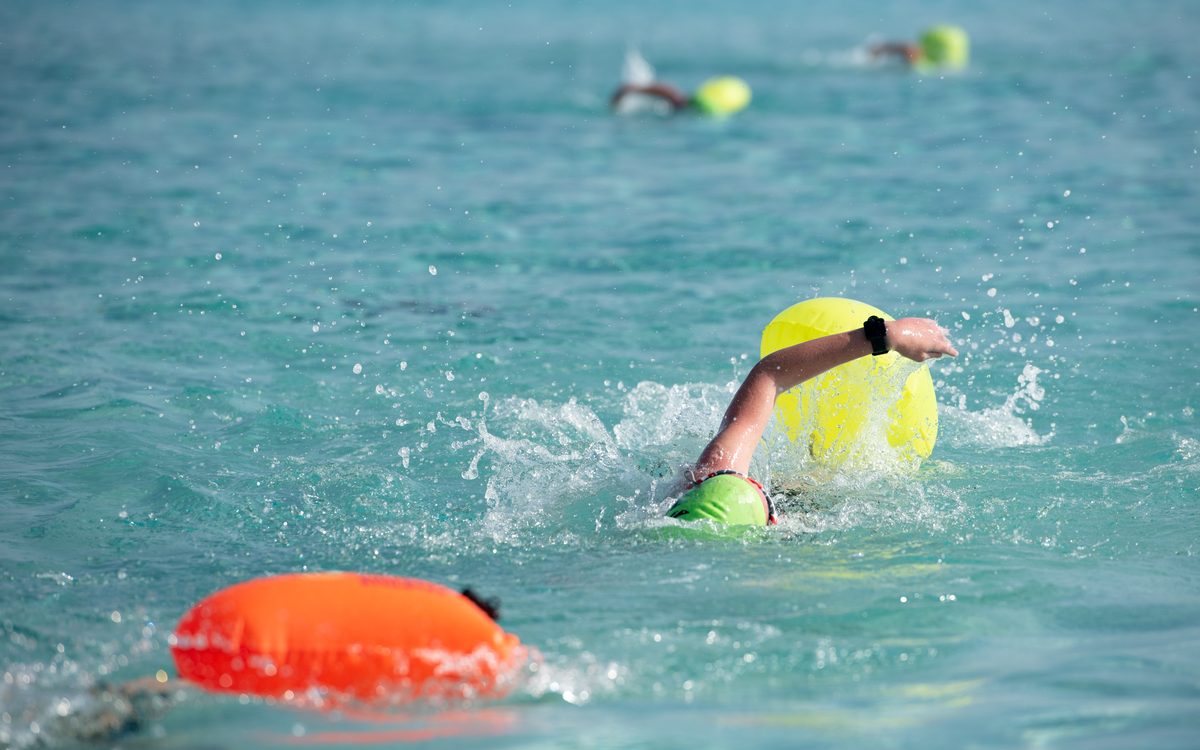
The first time a pool swimmer wades into a lake for a race, the surprise is how much is missing: no lane ropes, no black line, no wall to push off. You line up with a crowd, the horn goes, and the only guide is a string of coloured buoys. Open-water swimming (called marathon swimming by the Olympic movement) is racing or swimming for distance in a river, lake, sea or ocean, with a mass start and a course marked by buoys. This page explains how it works, the skills a beginner needs and how to take a first step.
Quick answer: Races are won by finishing order over a buoyed course, not by lane times. World Aquatics requires a wetsuit when the water is below 18.0 C and does not hold races below 16 C. Beginners usually start by practising in a supervised swim area with a buddy and a tow float, then enter a short local event. Check your event’s own rules first, because local races set their own.
General information, not medical advice. See the open-water swimming hub for the whole picture and the swimming guide for the pool side. Training detail is on the training page.
How scoring and the course work
There is no points system. Swimmers start together, complete the marked course and the first to finish wins; in elite racing the finish is a touchpad, so ranking is by finishing order. World Aquatics lists the formats in its 2026 competition regulations: the Olympic programme has the 10 km for women and men, and the World Aquatics Championships add a 5 km, a 3 km knockout sprint and a mixed 4 x 1500 m relay. At the Junior Championships, 14 to 15 year-olds race 5 km, 16 to 17 year-olds race 7.5 km and 18 to 19 year-olds race 10 km.
In races longer than 5 km, the same regulations call for feeding platforms or stations every 2.5 km, where swimmers take a bottle or gel from a pole or platform. Discipline uses cards: a first breach earns a yellow card (a warning) and a second brings a red card and disqualification. Swimmers may not use anything that gives speed or buoyancy, and any device that records body data needs prior approval.
Water temperature and suits
This is where open water differs most from the pool. Under the World Aquatics rules, a wetsuit is compulsory below 18.0 C. In warm water a swimmer wears one swimsuit and may use one or two caps, goggles, a nose clip and ear plugs. The chief referee can require wetsuits between 18 and 20 C when conditions are judged hazardous. Approved wetsuits are 3 to 5 mm thick (the rules allow limited exceptions). Races are not held when the water is colder than 16 C, a threshold World Aquatics says new research supports, measured two hours before the start at three points. For recreational events, organisers set their own limits, so read the event page.
The basic skills
The following skills are common coaching practice for open water rather than rules, and are worth rehearsing before an event:
- Sighting. Lifting your eyes just far enough to see the next buoy, then rolling to breathe. Many coaches suggest doing it every several strokes and adjusting for chop and sun.
- Breathing to both sides. Waves and glare can make one side unusable on the day.
- Swimming in a pack and drafting. Staying close behind another swimmer reduces effort. A 2026 GPS study of five elite 10 km swimmers (J Sports Sci) found the race winner stayed below critical velocity for most of the race and saved the hard efforts for the end, with drafting and trajectory choices part of the picture.
- Entries, exits and turns at buoys. Practise wading, dolphin-diving and rounding a buoy when others crowd it.
- Staying calm. If your breathing races, the USMS advises rolling onto your back and floating until you are ready to continue.
How a beginner starts
- Get comfortable in the pool first. Our swimming training page covers the base fitness.
- Practise where there are safety people. USMS says to swim with a buddy of similar ability even if a lifeguard is present, and to swim where safety personnel and equipment are on site. A bright cap (not white) and a tow float improve how well boats and other swimmers can see you.
- Find a club or group. Masters swimming clubs, triathlon clubs and local open-water groups often run organised swims. USMS (U.S. Masters Swimming) publishes open-water guides and holds open-water national championships, and USA Swimming runs national open-water meets and a junior open-water pathway.
- Pick a short first event. Many beginners start with a 500 m to 1 km event in a calm lake (typical starter distances, not an official standard) before trying longer ones.
- Check the water. The CDC advises checking whether a swim area is monitored, under advisory or closed, especially after heavy rain.
Levels and where to find the rules
Levels run from recreational and Masters swimmers through age-group and junior swimmers to elite racers. Olympic status as of 2026: marathon swimming has been on the Olympic programme since Beijing 2008, and World Aquatics lists the 10 km races on the LA28 programme (check the official Games programme for the final schedule). The competition regulations are published by World Aquatics, and USA Swimming says Part Seven of its rulebook contains the open-water rules for events it governs.
Related reading: open-water gear, injury prevention and the pool-sport swimming rules page.
Open-water swimming rules and getting started FAQs
Do I need a wetsuit for open-water swimming?
In World Aquatics races, yes when the water is below 18.0 C, and a referee can require one between 18 and 20 C in hazardous conditions. In recreational swims it depends on the organiser and your comfort; ask the event or club.
How far is an open-water race?
The Olympic race is 10 km. World Aquatics Championships also include 5 km, a 3 km knockout sprint and a mixed 4 x 1500 m relay, and junior age groups race 5, 7.5 or 10 km. Local events are often shorter.
Can I swim open water alone?
USMS advises always swimming with a buddy, and the AAOS says not to swim alone. Even in a supervised area, a buddy and a tow float add safety.
Is open-water swimming the same as marathon swimming?
The Olympic movement uses “marathon swimming” for the 10 km race. Elsewhere “marathon swimming” often means very long swims under traditional rules, such as channel crossings without a wetsuit.
Is open-water swimming a Paralympic sport?
We could not confirm it in any Paralympic programme as of 2026; check the official Paralympic programme.
Sources
- World Aquatics Competition Regulations, Part Three (open water), Feb 2026
- World Aquatics: 16 C threshold research
- World Aquatics: LA28 qualification principles
- USMS: Safety tips for open-water swimming
- USMS: Definitive guide to open-water swimming
- USMS: What to do in an open-water emergency
- CDC: How to safely visit oceans, lakes and rivers
- AAOS OrthoInfo: swimming injury prevention
- Exploratory study of pacing and trajectories in elite open-water swimming, J Sports Sci 2026
General information for education only, not medical advice. It does not replace a sports medicine doctor, physical therapist, athletic trainer or registered dietitian who knows you. See how we work in our editorial policy.