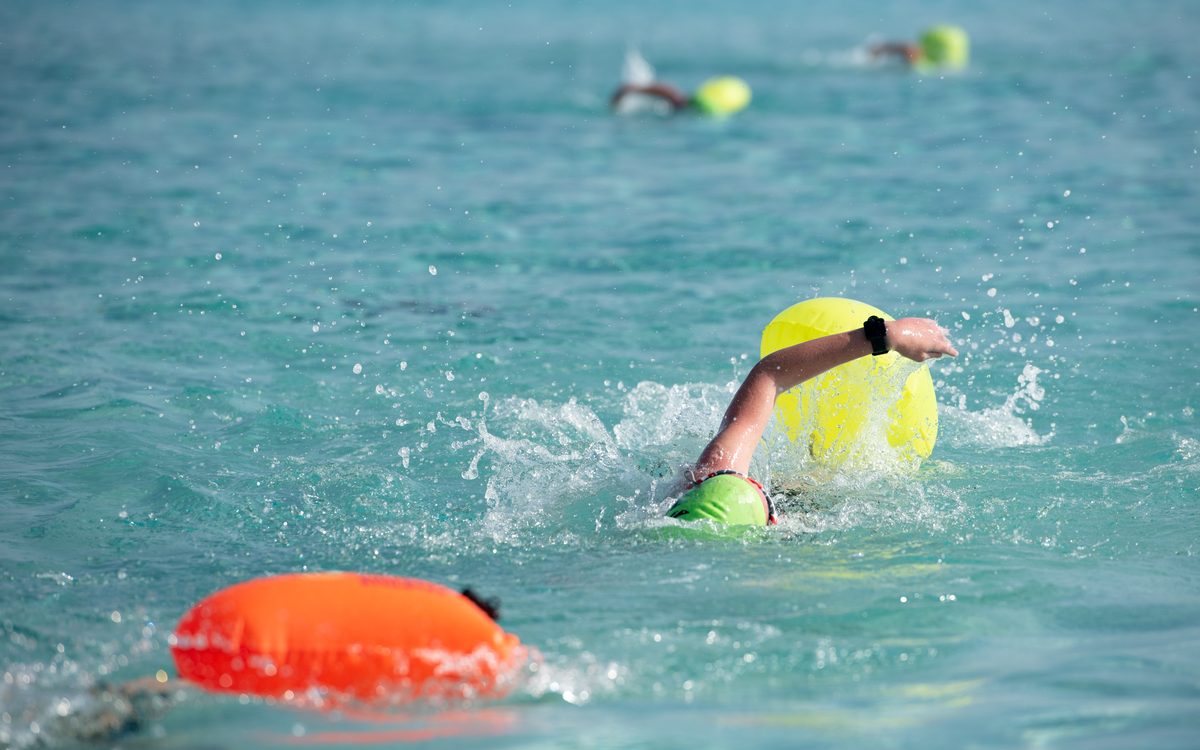
The swim is done, the cap is off, and the shoulders feel hot and heavy on the walk up the beach. For most open-water swimmers that is ordinary tiredness. For some it is the start of a shoulder problem, and for a few a cough or chest tightness after a swim is a sign to see a doctor. Open-water swimming injuries and illnesses are the overuse, temperature and breathing problems that come with long swims in natural water.
Quick answer: We found no injury surveillance numbers specific to open-water swimming. What the research does cover: shoulder pain in competitive swimmers, cold and heat illness, swimming-induced pulmonary oedema and low sodium in very long swims. Stop and get help for breathing trouble, confusion, uncontrolled shivering or chest pain; see a sports medicine doctor, physical therapist or athletic trainer for pain that lasts.
General information, not medical advice. No diagnosis or return-to-swim clearance here. Prevention is on the prevention page; pool injuries are on swimming injuries.
Shoulder pain
The best evidence is from pool swimmers, and open-water swimmers share the same stroke. A 2023 systematic review of 22 studies in competitive swimmers (Scand J Med Sci Sports) found no strong evidence for or against 80 variables. Moderate evidence linked shoulder pain to competitive level and to shoulder muscle activation patterns (such as more serratus anterior activity), while age, sex, training frequency and range of motion had moderate evidence against an association. The best study (201 swimmers) found high acute-to-chronic workload and reduced posterior shoulder strength endurance linked with injury.
Cold-related illness
In the 2019 BJSM study of 12 lean swimmers (water 14 to 20 C), at 16 C half did not finish two hours and four were hypothermic or predicted to become so. A 2009 study of the 10 km marathon swim in 21 C water found 83 percent of 12 elite swimmers finished with core temperature below 35 C. A 2026 case report of a 37 km swim in 13 to 14 C water in Foveaux Strait found a swimmer stayed below 35 C for more than six hours without obvious impairment, which shows how differently people respond; it is a single cold-adapted swimmer, not a guide. Warning signs include uncontrolled shivering, clumsiness, slurred speech and confusion. Get out, get warm and seek care.
Heat illness
At the Doha 2024 Masters 3 km (water around 20.5 to 20.9 C, warm and humid air), 5 of 48 swimmers exceeded a core temperature of 39.0 C. A 2025 review in the European Journal of Applied Physiology reported that hot water impairs heat loss and increases dehydration and cardiovascular strain. Heat illness can progress quickly, so dizziness, nausea or confusion means get out and seek help.
Swimming-induced pulmonary oedema (SIPE)
SIPE is fluid in the lungs that appears during or just after exertion in water. A 2026 prospective study at events at moderate altitude (7,866 endurance athletes; 144 assessed) found ultrasound-confirmed SIPE in 29, and an incidence of 0.68 percent in women and 0.26 percent in men, higher than previously reported for men at lower altitude. Unusual symptoms such as anxiety, a fast heartbeat and a tight wetsuit also appeared. A 2026 case-control study (258 cases, 2,117 controls) found it more common in women, older swimmers, and swimmers with high blood pressure, heart disease, asthma or little open-water experience. Reviews advise stopping, getting out of the water, sitting upright and getting medical help. Anyone who has had SIPE should speak with a doctor before swimming again.
Other problems
- Low blood sodium. In a 26.4 km Lake Zurich swim, 2 of 25 men (8 percent) and 4 of 11 women (36 percent) developed exercise-associated hyponatraemia, one woman with symptoms. Body-mass change, rather than reported fluid intake, tracked sodium levels.
- Swimmer’s ear. The CDC suggests ear plugs or a cap, draining each ear and towel-drying, and never putting objects in the ear canal.
- After-swim problems. In a 2026 interview study of 30 channel swimmers, the most serious consequences (SIPE, pneumonia, prolonged neurological symptoms) sometimes appeared only after the swim, and many described emotional lows afterwards.
- Head knocks. Mass starts involve contact. If a swimmer is struck on the head or feels dazed, the CDC HEADS UP message is to recognise and remove them from the water and have a healthcare provider assess them.
- Chafing, sunburn, cuts from rocks or shells. Common sense items with no published rates we could find; ask a doctor about skin concerns.
Rehabilitation principles
General principles from sources: relative rest rather than complete rest for overuse pain, graded return, and work on strength and control under a clinician’s guidance. The 2023 shoulder review points to posterior shoulder strength endurance as a modifiable factor, so ask a physical therapist about it. We do not give recovery times or return-to-swim clearance; both depend on the person and the problem.
When to see a professional
- Pain that stays in one spot, wakes you at night or limits your stroke.
- Cough, breathlessness, or frothy sputum after a swim.
- Shivering, confusion or slurred speech that does not clear after warming.
- An ear that is painful or draining, or a head knock with any symptoms.
Open-water swimming injuries FAQs
Is swimmer’s shoulder more common in open water?
We found no open-water-specific rate. Evidence comes from competitive pool swimmers, where a 2023 review found no strong evidence for most risk factors and a link between high workload spikes and injury in its best study.
What does hypothermia feel like?
Uncontrolled shivering, clumsy hands, trouble thinking and a feeling of being unable to warm up. In studies, swimmers did not always notice impairment until afterwards, so a buddy should watch you.
Why would I cough after a swim?
Possible reasons include swallowed water, but cough or breathlessness can also be a sign of SIPE. If it is more than mild or does not settle, get medical care.
Can I swim with a cold or ear infection?
Ask your doctor. The CDC advises ear precautions and says not to put objects in the ear canal.
How long will an overuse injury take to heal?
It depends on the person and the problem; a sports medicine doctor or physical therapist can advise after examining you.
Sources
- Shoulder pain and injury risk factors in competitive swimmers, 2023 (PMID 37515375)
- Saycell et al., BJSM 2019 (PMID 30824457)
- Risk of hypothermia in the 10-km marathon swim, 2009 (PMID 19488594)
- Prolonged stable hypothermia during a 10-hour cold open-water swim, Exp Physiol 2026 (PMID 41564305)
- Doha 2024 Masters 3 km (PMID 39500300)
- Hyperthermia during open water swimming, 2025 (PMID 40888866)
- SIPE at moderate elevations, 2026 (PMID 42131935)
- SIPE risk factors, Chest 2026 (PMID 41903839)
- Higher prevalence of exercise-associated hyponatremia in female open-water swimmers, 2012 (PMID 21748367)
- Channel swimmers qualitative study, 2026 (PMID 43013196)
- CDC: Preventing swimmer's ear
- CDC HEADS UP
- AAOS OrthoInfo: swimming injury prevention
General information for education only, not medical advice. It does not replace a sports medicine doctor, physical therapist, athletic trainer or registered dietitian who knows you. See how we work in our editorial policy.