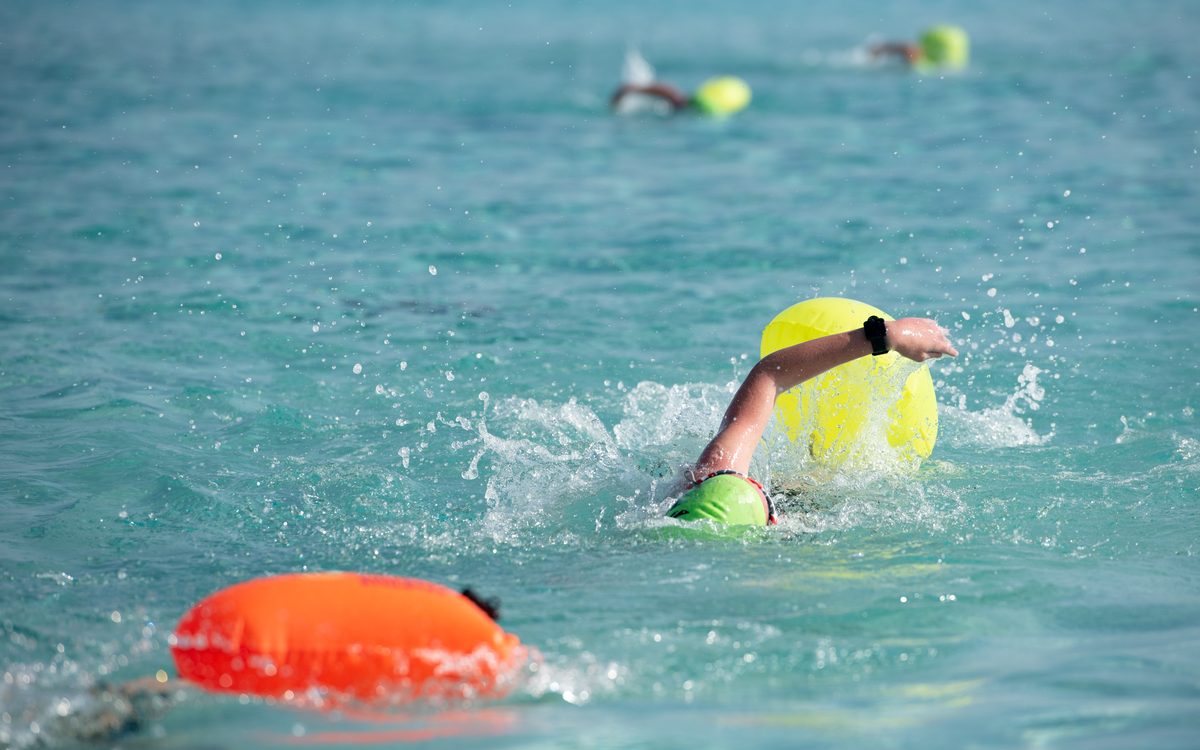
Three hours into a long lake swim, a swimmer treading water at a feed station has about thirty seconds to take a drink, a gel, and get going again, with cold hands and a stomach that has been rolled around by waves. Open-water swimming nutrition is the plan for fuel and fluid before, during and after swims, with attention to the particular problems of cold, heat and no chance to stop.
Quick answer: Eat enough across the day to support your training, practise your race-day fuel and fluids in training, and do not overdrink on very long swims: a Lake Zurich study found low blood sodium in some swimmers whose weight change mattered more than how much they drank. Supplements are optional; if you use any, choose products tested by a third party for sport and check with a doctor or registered dietitian.
General information, not medical advice. Personal needs differ. A registered dietitian, especially a Certified Specialist in Sports Dietetics, can build a plan. See the open-water swimming hub for the whole picture and the swimming guide for the pool side. Day-to-day fuelling for swimmers is also on swimming nutrition.
Daily eating and energy
A 2014 expert review of nutrition for swimming (Shaw, Boyd, Burke and Koivisto, Int J Sport Nutr Exerc Metab) puts carbohydrate between 3 and 10 g per kg of body weight per day depending on training load, and advises a rhythm of protein after key sessions. The 2016 joint position of the Academy of Nutrition and Dietetics, Dietitians of Canada and ACSM says well-chosen nutrition strategies enhance performance and recovery and that athletes should see a registered dietitian for a personal plan. Long swims burn a lot of energy: a 2026 case study of a 200 km swim over three days used doubly labelled water to measure extreme energy expenditure, an example of how demanding ultra-distance swimming can be (a single case, not a guide).
Fuel on race day
Races longer than 5 km have feeding platforms every 2.5 km under World Aquatics rules, so swimmers can drink and eat only at set points. A 2009 study of 12 elite Brazilian swimmers in a 10 km race in 21 C water found that most took maltodextrin (a carbohydrate drink) during the race and blood glucose rose slightly, while 83 percent still finished with core temperature below 35 C. Practical steps (general practice, not studied protocols): try your drink and gels in training swims, keep the products in the form the event allows, and plan what you will do if a feed is missed. For short events of under about an hour, most people do not need to feed during the swim.
Hydration and sodium
A 2012 study of 36 swimmers in a 26.4 km Lake Zurich race found exercise-associated hyponatraemia (low blood sodium) in two of 25 men (8 percent) and four of 11 women (36 percent); one woman had symptoms. Weight change during the race was linked to blood sodium, while reported fluid intake and sodium intake were not, which means drinking more is not always safer. The practical lesson: drink to a plan you have tested, not as much as you can, and ask for medical help if you have headache, nausea, confusion or swelling after a long swim.
Cold and heat
Cold and heat both add stress (general physiology, not a studied feeding plan). A 2025 review in the European Journal of Applied Physiology reports that water near World Aquatics’ 31 C upper limit impairs thermoregulation, raising dehydration, core temperature and cardiovascular strain. Always check the water temperature before an event, and see the prevention page.
Relative energy deficiency (REDs)
The 2023 IOC consensus statement defines REDs as a syndrome in female and male athletes caused by low energy availability, which can affect reproductive function, bone, immunity, sleep, mental health and performance. A 2023 study of 30 NCAA Division III swimmers recorded 43 percent with low energy availability before the season, which shows it is not only an elite problem. Open-water swimmers who train long hours for cold-water tolerance should not diet or chase a “lean” look; the IOC advises against emphasising weight and body composition, especially in young athletes. Eating less than your training needs, missed periods, frequent illness, stress fractures or constant tiredness are reasons to see a sports medicine doctor and a dietitian. If you have an unhealthy relationship with food, see a professional; our mental training page lists help.
Supplements, carefully
Following our editorial rules, we only describe supplements in general terms. The IOC 2018 consensus statement says nutrition usually makes a small but valuable contribution and that supplements make a minor one; only a few, including caffeine and creatine, have good evidence of benefit, and some products can harm health or lead to an anti-doping violation. It recommends a nutritional assessment before supplementing. Practical points:
- Third-party testing. Prefer products certified for sport, such as NSF Certified for Sport or Informed Sport; supplements are not required to be tested for banned substances, and a swimmer who competes in World Aquatics or USA Swimming events is responsible for what is in their body.
- Caffeine. The 2021 ISSN position stand says caffeine can improve endurance exercise performance in many studies but effects vary between people, and high doses cause side effects. It is not for everyone (sensitivity, heart conditions, pregnancy); check with a doctor and follow the label.
- Electrolytes. Sodium products are sold for long swims; the Lake Zurich study found no link between sodium intake and blood sodium, so do not rely on them to prevent low sodium. See our electrolyte powder guide.
- Other products. Anything that promises to “boost” or “burn” is a red flag. Do not use products containing stimulants like DMAA, prohormones or SARMs, which are banned.
Cautions
- Never swim alone while testing a new fuel or drink.
- Teen swimmers need food to grow; see a doctor or dietitian before restricting.
- If you are taking medication or have a medical condition, ask your doctor about supplements.
Open-water swimming nutrition FAQs
What should I eat before an open-water swim?
There is no single rule. Common practice is a familiar, carbohydrate-based meal a few hours before and a light snack closer to the start. Test it in training and ask a dietitian for a personal plan.
Can I drink too much on a long swim?
Yes. A 2012 Lake Zurich study found low blood sodium in some swimmers, and weight change, not reported fluid intake, tracked their blood sodium.
Do I need gels or sports drinks?
For short swims most people do not. For long swims, carbohydrate drinks are commonly used; the 2009 Brazilian study saw swimmers take maltodextrin during a 10 km race. Practise first.
Is caffeine safe before racing?
The ISSN says caffeine helps endurance performance in many people but affects people differently. Check with a doctor, follow product labels and do not try it first on race day.
What is REDs?
Relative energy deficiency in sport, from the IOC, is a set of health and performance problems linked to not eating enough for training, in women and men.
Sources
- IOC consensus statement on REDs, 2023 (PMID 37752011)
- IOC consensus statement: dietary supplements and the high-performance athlete, 2018 (PMID 29589768)
- ACSM/AND/DC joint position: Nutrition and athletic performance, 2016 (PMID 26891166)
- ISSN position stand: caffeine and exercise performance, 2021 (PMID 33388079)
- Nutrition for swimming, Shaw et al., 2014 (PMID 24903758)
- Hyponatremia in Lake Zurich Marathon-Swim, 2012 (PMID 21748367)
- Risk of hypothermia in the 10-km marathon swim, 2009 (PMID 19488594)
- Hyperthermia during open water swimming, 2025 (PMID 40888866)
- Energy expenditure during a 200 km open-water swim, J Exerc Sci Fit 2026 (PMID 42835519)
- Low energy availability in NCAA Division III swimmers, 2023 (PMID 37447154)
- World Aquatics Competition Regulations, Part Three (open water), Feb 2026
General information for education only, not medical advice. It does not replace a sports medicine doctor, physical therapist, athletic trainer or registered dietitian who knows you. See how we work in our editorial policy.