The first time a beginner stands at the top of a tiny hill, the “ramp” is barely taller than a kitchen table, the skis are ordinary alpine skis, and the only goal is to slide down, pop up at the lip and land on both feet. Everything bigger in ski jumping grows out of that moment. This page explains how a jump is scored, the basic skills, how newcomers usually begin, and where the official rules live. For a short overview of the sport, see the ski jumping hub.
Quick answer: A ski jump is scored on distance plus style, with adjustments for gate and wind. Beginners start on the smallest hill, often with alpine skis, and move to bigger hills only when a coach says they are ready. The way in is a local club: USA Ski Jumping keeps a club directory. Equipment rules, hill sizes and scoring change, so check the current FIS rules before you rely on any number here.
How a jump is scored
Per NBC Olympics’ competition guide, jumpers are scored on distance and style, with points added or taken away to compensate for changes in wind and start gate. The K-point is the place where the landing slope starts to flatten, and jumpers earn points for every metre beyond it at a rate that differs by hill type. A normal hill has a K-point of 85 to 99 metres and a large hill 100 to 180 metres. At the 2026 Games the normal hill was a 107-metre hill with a 98-metre K-point, and the large hill was a 141-metre hill with a 128-metre K-point (NBC Olympics).
Our ski jumping hub gives the fuller scoring recipe (five style judges, the highest and lowest dropped), which comes from a secondary source, so confirm it in the FIS rules. In plain words: land far, land clean, and look balanced doing it.
The four phases and the basic skills
- In-run. A tucked crouch down the ramp. The skill is holding a still, compact position as speed builds.
- Take-off. A fast, strong push off the edge of the table. Researchers describe take-off as the moment where vertical lift is created while horizontal speed is kept; more on that in our training page.
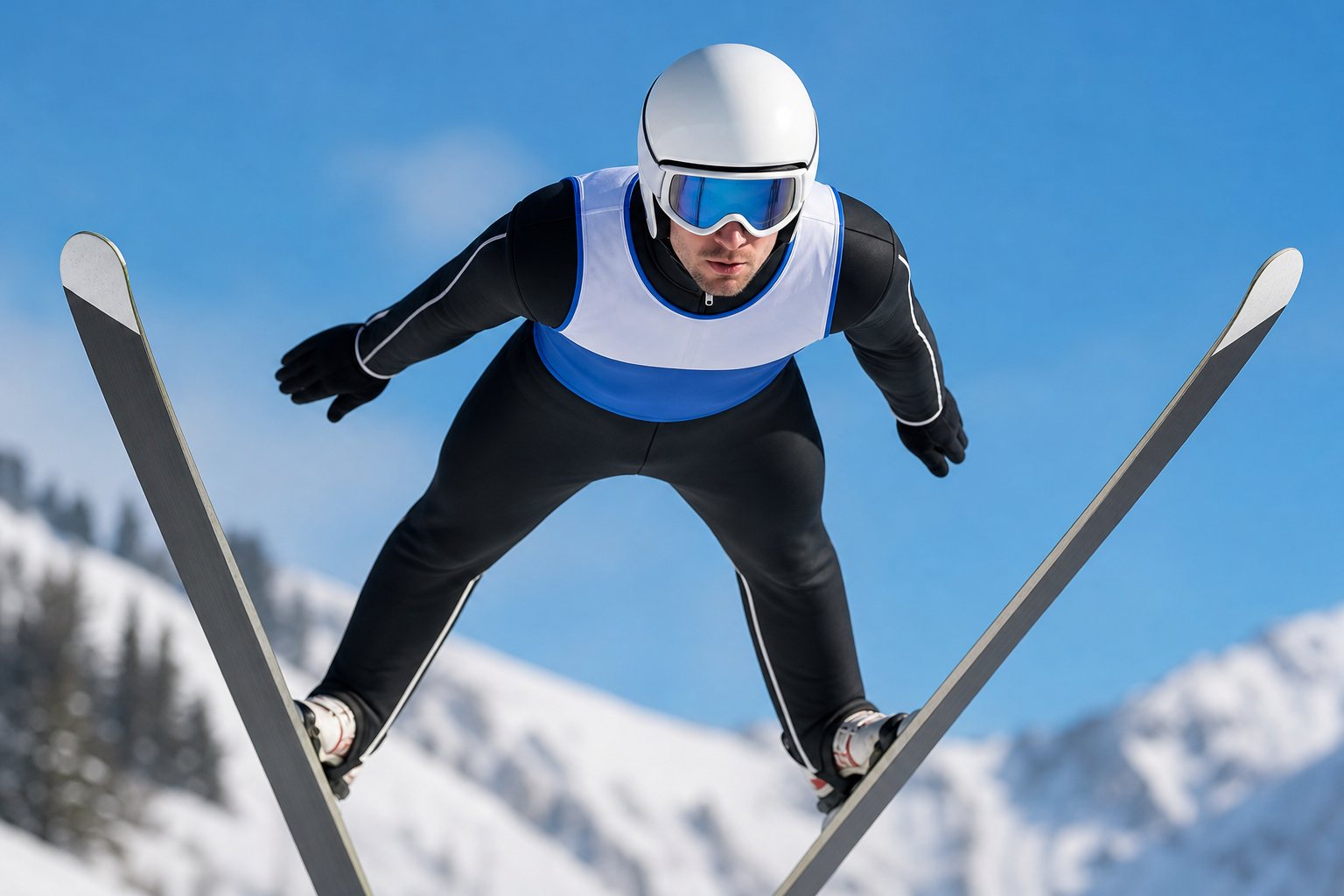
- Flight. Skis spread in a V and the body leans forward over them. The V style has been standard since the 1980s (secondary source).
- Landing. Usually the telemark position, one foot slightly ahead of the other, which judges score for style. Soft knees and balance matter more than anything else here.
How a beginner starts
USA Ski Jumping’s “Ski Jumping 101” page says newcomers start on the smallest hill, using alpine skis, and move up when ready, with hills ranging from about 5 metres to ski-flying hills of roughly 240 metres. Its equipment page says beginners on small hills can use their alpine equipment, that jumping-specific gear is needed on larger hills, and that jumping skis are not sold in ordinary retail shops. Many clubs run rental programs, and clubs often buy junior-size boots and skis. We did not find a published minimum age; Steamboat Springs Winter Sports Club says its jumping and Nordic combined program starts at age 4 (club-reported).
- Find a club. Use the club directory on usaskijumping.com or ask a local Nordic or ski club.
- Ask about a first visit. Many clubs run learn-to-jump days; ask what to bring and what they lend.
- Wear what the club requires. Ask about helmet rules before you buy anything. Our gear page explains fit and standards.
- Progress with a coach. Hill size is a coaching decision, not a personal one.
Summer jumping is possible too: USA Ski Jumping says plastic-surfaced hills allow near-identical conditions to winter, with the same equipment and techniques.
Levels and events
Above club level are junior competitions, the FIS Continental Cup and World Cup, and the World Championships; FIS counts ski jumping among its six Olympic disciplines. According to NBC Olympics, the Milano Cortina 2026 program had six ski jumping events: men’s normal hill, large hill and super team; women’s normal hill and large hill; and a mixed team event. Individual events use a qualification round (top 30 advance) and a final with two scored rounds. Ski jumping is not on the Paralympic program (FIS lists para alpine, para cross-country and para snowboard as its Paralympic disciplines). Check the official programme for later Games.
Official rules
The authority is FIS, which publishes the ski jumping competition rules and equipment specifications on fis-ski.com. National bodies such as USA Ski Jumping and U.S. Ski & Snowboard publish their own club and competition rules. Equipment limits (ski length, suit tolerance, body mass index) are updated by FIS, so treat any number you read on a general website as a starting point. Our gear page covers what the NBC Olympics guide says.
Related reading: our injury prevention and mental training pages, the skiing hub, and the neighbouring Nordic combined page.
Ski jumping FAQs
Do I need to be a good skier to try ski jumping?
USA Ski Jumping says jumpers begin on the smallest hill with alpine skis. A club coach decides what skills you need first, so ask at your local club.
How big are ski jumping hills?
USA Ski Jumping says hills range from small hills of about 5 metres up to ski-flying hills of about 240 metres. Olympic individual events use the normal and large hills.
Is ski jumping judged by distance only?
No. According to NBC Olympics, jumpers are scored on distance and style, with points added or subtracted for wind and start gate.
Can I ski jump in summer?
USA Ski Jumping says training on plastic-surfaced hills can happen in summer with near-identical conditions. Availability depends on your region and club.
Where do I find the official rulebook?
On the FIS website (fis-ski.com), which publishes the competition rules and equipment specifications. Your national federation and club can tell you which rules apply to your age group.
Sources
- USA Ski Jumping, Ski Jumping 101
- USA Ski Jumping, ski jumping equipment
- USA Ski Jumping, sport development and club directory
- NBC Olympics, Ski jumping 101: competition format
- NBC Olympics, ski jumping equipment
- FIS, facts and figures
General information for education only, not medical advice. It does not replace a visit with a sports medicine doctor, physical therapist or athletic trainer. See how we write and check our pages in our editorial policy.