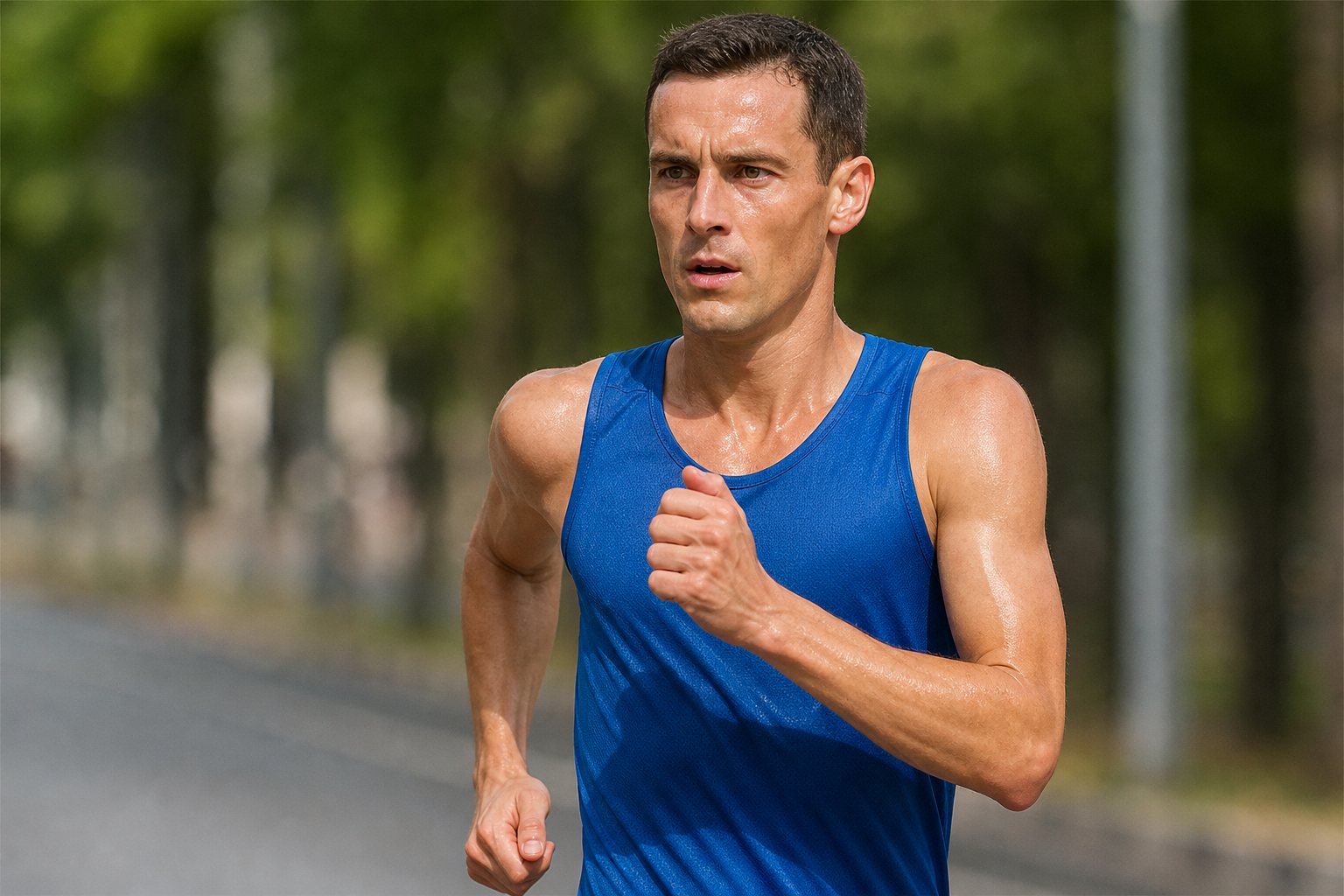
Gel in one hand, bottle in the other, a walker takes a loop of road at high effort and tries to drink without breaking stride. Fuelling a long walk in the heat is its own skill. This page covers fuel and fluid for race walkers, the research done on elite walkers, heat and hydration, relative energy deficiency (REDs) awareness, and what to know about supplements.
Quick answer: Elite race walkers in a 25-day study did better on a high-carbohydrate diet than on a ketogenic one: the ketogenic group walked 10,000 m 2.3% slower. Heat, hydration and eating enough for your training matter too. Supplements carry contamination and anti-doping risks; talk to a sports dietitian or doctor first, and prefer third-party tested products.
General information, not medical advice or a diet plan. Part of the race walking hub. For broader track and field fuelling see track and field nutrition.
Fuel for training and racing
The 2019 IAAF consensus statement on nutrition for athletics (Burke and colleagues) calls for a personalised, periodised and practical nutrition plan built with the coach and accredited sports nutrition experts, with a food-first approach. The ACSM, Academy of Nutrition and Dietetics and Dietitians of Canada joint position says carbohydrate needs rise with training load (about 5 to 7 grams per kilogram a day for about an hour of moderate exercise a day) and protein is generally 1.2 to 2.0 grams per kilogram a day. Those ranges are for general athletes, so ask a dietitian for your own numbers. Walkers who train twice a day should treat refuelling as part of the session.
What research on elite walkers found
- Carbohydrate and ketogenic diets. In a 25-day supervised study of elite race walkers (Burke and colleagues, 2020), a high-carbohydrate group (about 8.6 g per kg per day) improved 10,000 m performance by 4.8%, a periodised-carbohydrate group showed a trend towards improvement, and a ketogenic low-carbohydrate group was 2.3% slower, with a higher oxygen cost of walking at race speeds. After 2.5 weeks back on carbohydrate, there was no evidence of a rebound benefit over 20 km. It is a small study of elite walkers and does not tell you what to eat.
- Fluid and carbohydrate in a relay-style effort. A 2026 exploratory study (Martinez-Noguera and colleagues) had walkers take 50 g of carbohydrate in 500 ml in each exercise phase plus a 45 g gel during recovery; dehydration did not exceed 2% of body mass. The authors stress it is a small pilot with high variability and no cause-and-effect conclusions.
- Glycerol. In a 2024 crossover trial of eight international male walkers at about 28 degrees C, pre-exercise glycerol did not improve dehydration or other measures (body mass loss was 2.23 kg with placebo and 2.48 kg with glycerol).
Heat and hydration
The IOC 2023 heat consensus recommends heat acclimation, a hydration plan and cooling for athletes in hot events, and says exertional heat stroke is preventable and treatable with proper risk mitigation and medical response. In the Australian Tokyo 2021 account (Carr and colleagues), six walkers used 6 to 7 weeks of intermittent heat acclimation, hyperhydration with sodium and glycerol, and cooling methods. The authors say these may have contributed to results but, with six athletes and no comparison group, it cannot show cause. Do not try hyperhydration or glycerol without medical advice. Fluid needs differ between people, and a body-weight check before and after long sessions is a common general-practice way to learn your own pattern.
Energy availability and REDs
Race walking has long hours of training and a culture where a lean body can feel like an advantage. The IOC 2023 consensus on Relative Energy Deficiency in Sport (REDs) describes health and performance problems that can follow low energy availability, and it can affect many body systems. The Carr paper mentions that a low energy availability intervention was used with two of six athletes to periodise race body composition. That describes what happened in an elite programme and is not advice, and we do not recommend it. Warning signs include persistent fatigue, repeated injury or illness, and, in female athletes, missed periods. Take any of these to a sports medicine doctor or sports dietitian. AAOS lists low energy intake and low vitamin D among stress-fracture risk factors.
Supplements: what to know
We cover supplements by the standards in our editorial notes: no dosage advice beyond a product label and no health claims. The IOC consensus on dietary supplements (2018) says only a few supplements have good evidence and that contamination is a risk. A UEFA expert statement (Collins and colleagues, 2021) reports that around 15% of 634 supplements in a study from 13 countries contained undeclared prohormones, says third-party testing programmes reduce but do not eliminate risk, and notes that athletes are strictly liable for what is in their body. Look for NSF Certified for Sport or Informed Sport labels and check the registry. Caffeine, one of the better-evidenced supplements, can cause anxiety, nausea, insomnia, tremor and a fast heart rate, and is not for everyone. Speak to a doctor or dietitian first, especially if you have a heart condition or are pregnant.
Race walking nutrition FAQs
Should race walkers eat low-carb?
In the Burke 2020 study, elite walkers on a ketogenic diet had a higher oxygen cost of walking and slower 10,000 m times than a high-carbohydrate group. Talk to a sports dietitian before changing how you eat.
How much should I drink during a race?
Needs vary. Athletes in a 2026 pilot study drank 500 ml with 50 g of carbohydrate per phase; that is one small study, not advice. A dietitian can help you plan.
Is glycerol worth trying?
A 2024 trial in eight international walkers found no benefit at about 28 degrees C. Do not use it without medical advice.
What is REDs?
Relative Energy Deficiency in Sport: health and performance problems from not eating enough for your training, as described in the IOC 2023 consensus. See a professional if you notice warning signs.
How do I choose a safer supplement?
Prefer products tested by NSF Certified for Sport or Informed Sport, check the registry, and ask a doctor or dietitian.
Sources
- Burke et al. 2019, IAAF consensus statement: nutrition for athletics (PubMed 30952204)
- Burke et al. 2020, ketogenic LCHF diet impairs economy and performance in elite race walkers, PLoS One (PubMed 32497061)
- Martinez-Noguera et al. 2026, fluid and carbohydrate intake during mixed racewalking (PubMed 42491185)
- Martinez-Noguera et al. 2024, pre-exercise glycerol in international race walkers (PubMed 38676933)
- Carr et al. 2022, competing in hot conditions at Tokyo: Australian race walkers (PubMed 35399272)
- IOC consensus statement on sport events in the heat, Racinais et al. 2023 (PubMed 36150754)
- IOC 2023 consensus statement on Relative Energy Deficiency in Sport (REDs), Mountjoy et al., BJSM
- IOC consensus on dietary supplements, Maughan, Burke et al. 2018
- Collins et al. 2021, UEFA expert group statement on nutrition (PubMed 33097528; supplement contamination and caffeine)
- ACSM / Academy of Nutrition and Dietetics / Dietitians of Canada 2016 joint position (PubMed 26891166)
- AAOS OrthoInfo, Stress fractures
General information for education only, not medical advice. It does not replace a visit with a sports medicine doctor, physical therapist or athletic trainer. See how we write and check our pages in our editorial policy.