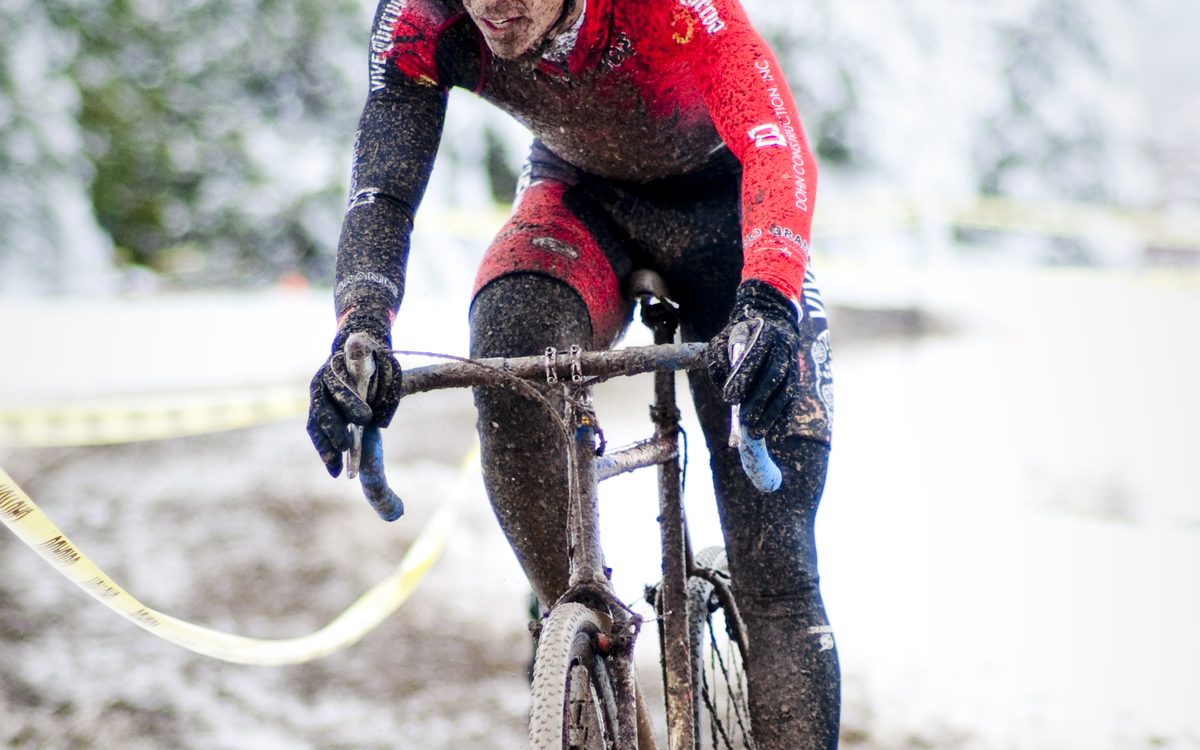
Grid call-up: your name, a front-row slot you did not expect, a field of faster riders, and a heart rate already at 150 while you stand still. Then the first corner arrives and someone slides across your line. Cyclocross mental training is the set of skills, focus, confidence, goal setting, imagery, pre-race routines and a calm response to mistakes, that help a rider perform their best when the pressure is on and the mud is flying. It is a separate matter from mental health, which this page treats in its own section. See the cyclocross hub for the sport.
Quick answer: Mental skills such as confidence, goal setting, imagery and routines are trainable. A 2022 review of 30 meta-analyses (Lochbaum and colleagues) found that psychological variables thought to help performance had a moderate beneficial effect overall, but no technique guarantees a result. For cyclocross, the practical wins are a start-line routine, a plan for mistakes, and clear tactics. Anxiety, low mood, disordered eating or burnout are health matters: talk to a qualified professional, and in the US call or text 988 in a crisis.
Confidence built on preparation
Confidence comes more from evidence than from slogans: training you completed, skills you have practised, courses you have walked. Keep a short log of sessions and good rides, and look at it before a race. Confidence was one of the variables the 2022 review (Lochbaum, Stoner, Hefner, Cooper, Lane and Terry, PLoS One) counted among those linked with better performance, with cohesion and mindfulness. General coaching practice is to build confidence on specific, controllable things, like a clean dismount, rather than on results.
Focus in a noisy, fast race
A cross lap asks for repeated switches of attention: look ahead at the line, think about gears, notice the rider on your wheel, then hear the cowbells. A simple approach, from general sport-psychology practice, is to pick one cue per section of the lap, such as “eyes up” at the barriers and “smooth” in the sand, and to return to it after a mistake. Practise it in training laps so it is automatic.
Motivation and goals
Season-long goals can be a first race, a podium in a local series, or just finishing a muddy round with a smile. Break them into process goals you control, like “practise remounts twice a week” and “arrive early to walk the course”, along with outcome goals such as a result. Review them every few weeks. If the sport stops being fun for weeks, that is worth noticing; see the health section below.
Imagery and course previews
Imagery means rehearsing a skill in your mind: the dismount at the barrier, the line through a corner, the first 30 seconds from the grid. Many riders pair it with a course walk. Imagery is a common technique in sport psychology, and the 2022 review included many such techniques, but effects vary and it complements practice rather than replacing it. Five minutes the night before is plenty.
Start-line and pre-race routines
- Arrive with time to register, pin on numbers and warm up, and avoid a rush. The USA Cycling rulebook says riders gather in the roll-call zone no more than 10 minutes before the start.
- Use a short routine: same warm-up, a few deep breaths, a cue word, one look at the first corner.
- Choose your start position strategy ahead of time, because the early laps are where most rank changes happen. A study of 329 elite riders at five UCI Cyclo-Cross World Championships found rankings changed most in the first laps (Bossi and colleagues, 2018).
For race logistics, see skills, rules and getting started.
Handling pressure and mistakes
Everyone crashes, misses a pedal or slides in the mud. The mental skill is how fast you recover. Have a plan: breathe out, check your body and bike, remount and ride the next section calmly. General coaching practice is to treat a mistake as one item on the lap, not the whole race, and to ask “what is my next job?” The 2022 review found variables that hurt performance, such as cognitive anxiety, had a small negative effect, so managing nerves is worth practice but it is not a cure-all.
Tactics and decisions
A cross race is timed and rank-based, so decisions come constantly: ride or run a section, push in the first lap or save energy, change a bike in the pit (the rules say the pit is the only place to change wheels or bikes, and riders cannot swap equipment with each other). Positive pacing, a faster start that slows, was highly probable in elite races, so riders use the early laps to take position, but this is for elites; your best pacing is something to test in training and local races. A coach or experienced club mate can help you review a race.
Youth riders
We did not find cyclocross-specific youth psychology research. General guidance is to keep it fun, praise effort and learning, and let young riders set their own goals. Parents and coaches should watch for stress, disordered eating or loss of enjoyment, and respond by talking and, if needed, seeing a professional.
Mental performance is not mental health
Routines, cue words and imagery are performance tools. Anxiety that will not settle, low mood, loss of joy in riding, restricting food, panic before races or exhaustion are health matters. The 2026 International Olympic Committee consensus statement on mental health in elite athletes (Reardon and colleagues) says mental health symptoms and disorders are common in elite athletes and affect performance and well-being. Take these concerns to a doctor or licensed mental health professional, not only to a coach. In the United States, call or text the 988 Suicide and Crisis Lifeline at 988 any time; for eating concerns the ANAD helpline offers free support. The Association for Applied Sport Psychology publishes resources for finding a sport psychology professional. In an emergency, call your local emergency number.
Cyclocross mental training FAQs
How do I stop getting nervous before a cross race?
Some nerves are normal. A routine, slow breathing and a clear first-lap plan help many riders. If anxiety is constant or overwhelming, speak to a doctor or licensed mental health professional.
Does visualisation really work?
Imagery is widely used in sport psychology and is among the techniques studied in meta-analyses, but results vary and it supports, not replaces, practice.
How do I recover mentally from a crash?
Check your body first. If you are hurt, stop; do not race after a hit to the head. If you are fine, use a cue such as “next job” and ride the next section smoothly.
Should I go out hard at the start?
Elite data show rankings change most in early laps and positive pacing is common, but the best plan for you comes from training and experience. Ask a coach.
When should I see a sport psychologist?
When nerves, low mood, eating concerns or burnout affect your life or riding. The AASP resources page can help you find someone, and 988 is available in the US in a crisis.
Related: training, recovery, nutrition and athlete health and the cycling hub.
Sources
- Lochbaum et al. 2022: Sport psychology and performance meta-analyses, a systematic review (PubMed)
- Bossi et al. 2018: Pacing strategy and tactical positioning during cyclo-cross races (PubMed)
- USA Cycling Rule Book, July 2025 (roll-call zone, pits)
- IOC consensus statement on mental health in elite athletes, 2026 (PubMed)
- 988 Suicide and Crisis Lifeline
- ANAD eating disorders helpline
- Association for Applied Sport Psychology: resources
General information for education only, not medical advice. It cannot diagnose or treat anything or replace a sports medicine doctor, physical therapist, athletic trainer or registered dietitian. See our editorial policy for how we research and write.