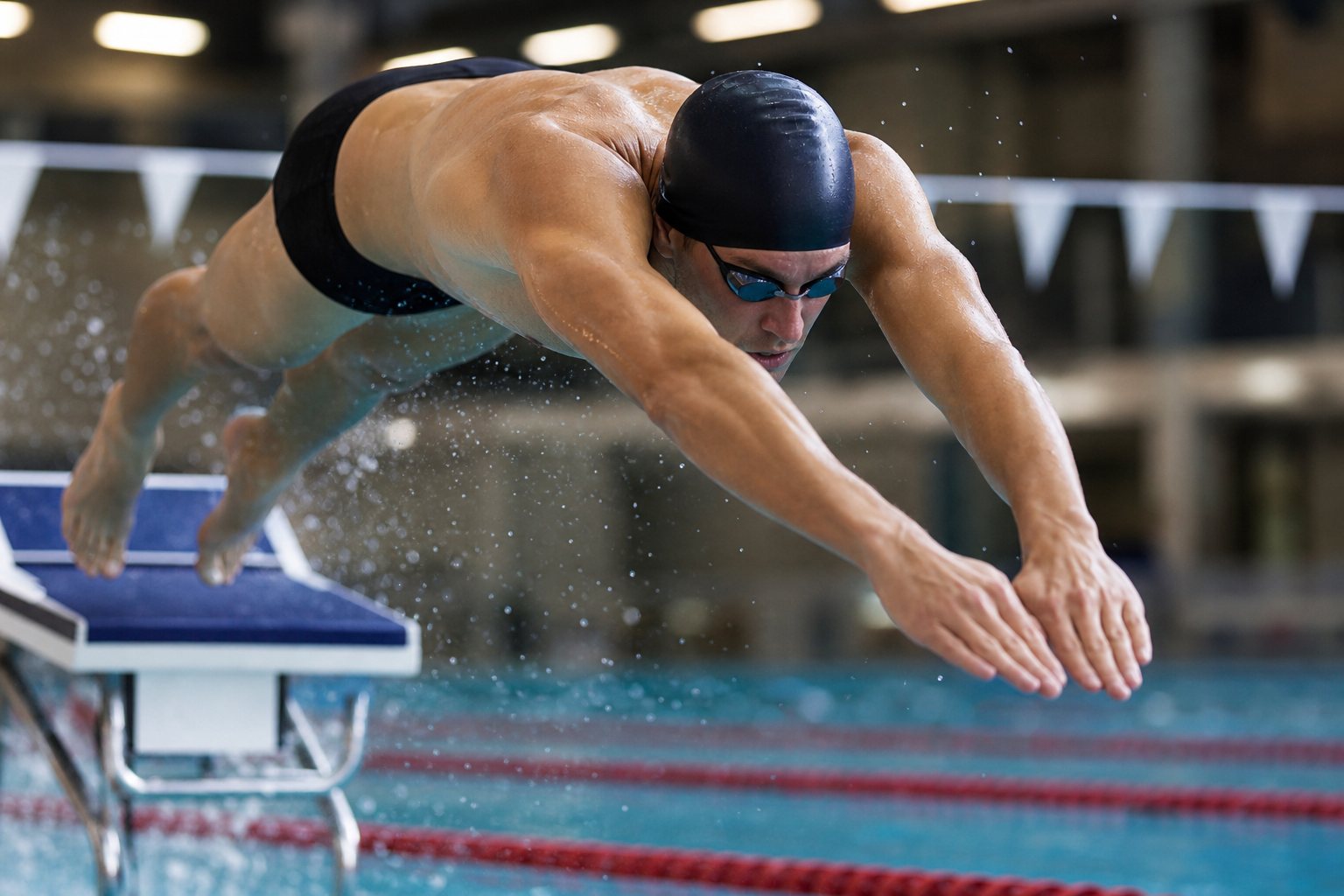
The alarm went off at 4:45, the practice ran two hours, and by third-period class the swimmer’s arms feel like wet rope. Down the hall a diver is rolling out sore hip flexors and a water polo player is wondering whether the ice bath she saw online is worth it. Aquatic recovery means everything that helps an athlete absorb training: sleep, food and fluid, rest days, easy movement and mobility. Some recovery tools have decent evidence, some do not, and this page says which is which.
Quick answer: The basics carry the most weight: enough sleep, food and fluid after hard sessions, easy days and at least one day off a week. Cool-downs, massage and cold water have modest or mixed evidence, and cold-water immersion after strength work can blunt strength gains. Soreness that fades in a day or two is normal; pain that stays in one spot or changes how you move is a reason to see a sports medicine doctor, physical therapist or athletic trainer.
Sleep
Early practices are the hardest part of swimming life. A study of 70 nationally ranked athletes in seven sports found they slept about 6.5 hours a night on average and less before training days than rest days, with early starts shortening sleep and raising fatigue before training (Sargent et al., PMID 25222347). Suggested countermeasures were strategic napping and good sleep habits. In a 2026 trial, 27 national-level swimmers (average age 15.6) trained in two 8-day camps with 7:00 and 9:00 starts; the later start added about an hour of sleep but made no significant difference in recovery measures or 100 m and 800 m performance (PMID 42518003). The CDC recommends 9 to 12 hours of sleep for children ages 6 to 12, 8 to 10 for teens and at least 7 for adults. Practical steps, labelled as general sleep advice: a regular bedtime that matches the alarm, a dark cool room, and screens and caffeine away from bedtime.
Food and fluid after training
The 2016 joint position of the American College of Sports Medicine, the Academy of Nutrition and Dietetics and Dietitians of Canada describes rapid refuelling as about 1.0 to 1.2 g of carbohydrate per kg of body weight each hour for the first 4 hours, with 0.25 to 0.3 g of protein per kg (about 15 to 25 g) in the first two hours and 1.25 to 1.5 litres of fluid per kg of body weight lost (PMID 26891166). An expert review on swimming nutrition suggests about 0.3 g/kg of high-quality protein soon after key sessions (Shaw et al., PMID 24903758). Those are guideposts for athletes training hard more than once a day; most recreational swimmers can simply eat a normal meal. Details live on our nutrition page.
Swim-down and cool-down
Many swimmers finish with easy laps. One small study found that 10 minutes of self-paced active recovery after a 200 m freestyle cleared lactate faster than passive rest (4.30 against 1.76 mmol/L; PMC5499938). A broader 2018 review of cool-downs concluded they appear largely ineffective for same-day and next-day performance, do not seem to prevent injury and mostly do not reduce soreness, though they may help the heart and breathing settle (Van Hooren and Peake, PMID 29663142). Reasonable reading: an easy swim is pleasant and safe, but do not count on it to prevent soreness. Five to ten minutes of easy swimming is a general coaching habit, not a research-set dose.
Load management and rest days
Recovery starts in the plan. The AAP advises 1 to 2 days off a week and about 3 months off a year from a single sport for young athletes, in 1-month blocks (Brenner 2016, PMID 27573090). Signs that load may be too high are general coaching and medical warning signs: heavy legs and arms that do not lift in a few days, poor sleep, mood changes, getting sick often and slower times. Eating too little for the training load is a separate and serious problem; the IOC consensus on relative energy deficiency in sport (REDs) links low energy availability with illness, sleep problems and injury risk (PMID 37752011).
Mobility and flexibility
Aquatic sports ask a lot of shoulders, hips, ankles and the spine, and divers and artistic swimmers need large ranges. AAOS recommends gentle stretching after a light warm-up and holding stretches for 30 seconds. Mobility work should feel like a stretch, not sharp pain. Research on stretching’s effect on injury or soreness is mixed, so think of mobility as helpful for comfort and range, not a guarantee. For sport-specific ideas, ask a coach or physical therapist.
Recovery tools: what the evidence says
- Massage. A 2018 review of 99 studies found massage the most effective of the methods compared for delayed-onset muscle soreness and perceived fatigue (Dupuy et al., PMID 29755363). Massage guns and foam rollers are cheaper versions; we compare them in our massage gun guide and foam roller guide.
- Cold-water immersion. A 2016 review found it slightly better than passive rest for soreness, using 10 to 15 °C for 10 to 15 minutes (Machado et al., PMID 26581833). But a 2015 study of 12 weeks of training found cold-water immersion after strength sessions led to smaller strength and muscle gains (Roberts et al., PMID 26174323). Use it sparingly after strength training.
- Compression, sleep trackers and other gadgets. We do not make claims about them on this page; see our recovery tools guide for how we judge them.
Soreness or injury?
Muscle soreness usually appears within a day, is spread across a muscle, and eases with movement over a couple of days. Warning signs are different: sharp or pinpoint pain, pain that returns at the same point of a stroke or takeoff, night pain, swelling, numbness or weakness, or pain that lasts more than a couple of weeks. See a sports medicine doctor, physical therapist or athletic trainer for those, and read our injuries page. For sport pages, see swimming recovery, diving recovery, water polo recovery and artistic swimming recovery.
Frequently asked questions
Is a swim-down necessary?
Not for performance or injury prevention, according to a broad cool-down review, though a small swimming study showed faster lactate clearance with easy swimming. It is optional and many swimmers like it.
How much sleep do swimmers need?
The CDC recommends 9 to 12 hours for ages 6 to 12, 8 to 10 for teens and at least 7 for adults. Early practices make that harder, so bedtime planning matters.
Should I take ice baths after practice?
Evidence is mixed: modest benefit for soreness in one review, but smaller strength gains in a 12-week study when used after strength sessions. Ask a coach or sports medicine professional what fits your goals.
How many rest days do young athletes need?
The AAP advises 1 to 2 days off a week and about 3 months off a year from a single sport, in 1-month blocks.
Do foam rollers and massage guns work?
Massage ranked best for soreness in a large review; rollers and guns are related tools, but we do not claim they treat injuries. Stop if anything hurts sharply.
Sources
- Sargent et al., sleep and fatigue in elite athletes
- Delayed morning practice in swimmers, Sports Med Open 2026
- CDC: sleep
- ACSM, AND and DC: nutrition and athletic performance, 2016
- Shaw et al., nutrition for swimming, 2014
- Active recovery after 200 m freestyle, 2017
- Van Hooren and Peake, do we need a cool-down?
- Brenner (AAP), overuse injuries and burnout
- Mountjoy et al., IOC REDs consensus, 2023
- AAOS OrthoInfo: swimming injury prevention
- Dupuy et al., recovery methods review, 2018
- Machado et al., cold-water immersion review, 2016
- Roberts et al., cold water and training adaptations, 2015
General information for education only, not medical advice. It does not replace a visit with a doctor, physical therapist or athletic trainer. See how we write and check our pages in our editorial policy.