This article contains affiliate links: if you buy through them we may earn a commission, at no extra cost to you. Learn more.
The clack of a tail hitting concrete on a warm evening at the local park. A ten-year-old rolling in on a mini ramp for the first time while three older kids bang their boards on the coping to cheer him on. A crowd in an arena holding its breath as a street skater steps up for her last trick attempt. And, since Tokyo 2020, Olympic medals. Skateboarding is a sport, an art form and a way of getting around, and the research reviews put the number of American skateboarders somewhere between 6 and 15 million.
Skateboarding, page by page
- Rules: how the game works at every level
- Leagues & associations: pro, college, high school and youth
- Youth & high school: ages, safety and recruiting, for players and parents
- Injuries & sports health: prevention, concussion, when to see a pro
- Training & conditioning: before: off-season to in-season
- Game day: during: fueling, hydration, heat
- Recovery: after: games, tournaments, sleep
- Nutrition & supplements: what to eat, tested supplements
- Best wearables: trackers and watches for the sport
- Gear: the complete equipment list
Buying guide · Our Skateboarding buying guide compares the gear we'd pick, with prices and sizing:
This page is skateboarding for skaters and the people who look after them: how it works across street, park and vert, how contests are judged, what it looks like from a first push to the Olympics, and, most of all, how to keep skating for years. Sports health is the heart of it: the skateboarding injuries that send skaters to the doctor most, the protective gear with real evidence behind it, how to spot a concussion after a slam, and when to see a professional. Then training, recovery and the gear that matters.
Skateboarding at a glance
| Main disciplines | Street (stairs, rails, ledges and gaps, like a city plaza), park (bowls and transitions, like an empty swimming pool) and vert (a big halfpipe with vertical walls). Plus cruising, longboarding and downhill. |
|---|---|
| How contests are scored | Judges score runs, and in street also single tricks, on a 0–100 scale (World Skate). Street finals: best run + two best tricks, out of 300. Park: the best run counts. |
| Governing bodies | World Skate worldwide (and for the Olympics). In the US, the US Olympic & Paralympic Committee (USOPC) runs the Olympic program directly since 2023. |
| Biggest events | The Olympic Games (park and street), the World Skateboarding Tour and world championships, Street League Skateboarding (SLS) and its Super Crown, and the X Games. |
| Olympic events | Four: men’s and women’s street and park, at Tokyo 2020, Paris 2024 and planned for LA 2028. Vert is not an Olympic event. |
| Most common injuries | Wrist and forearm fractures, ankle sprains, cuts and bruises, and head and face injuries, including concussions. |
How skateboarding works
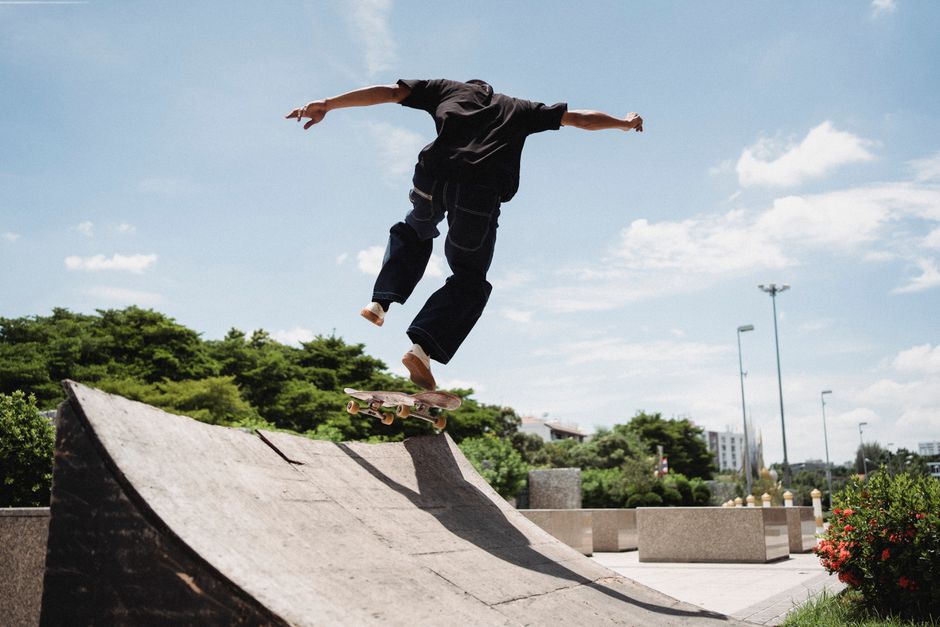
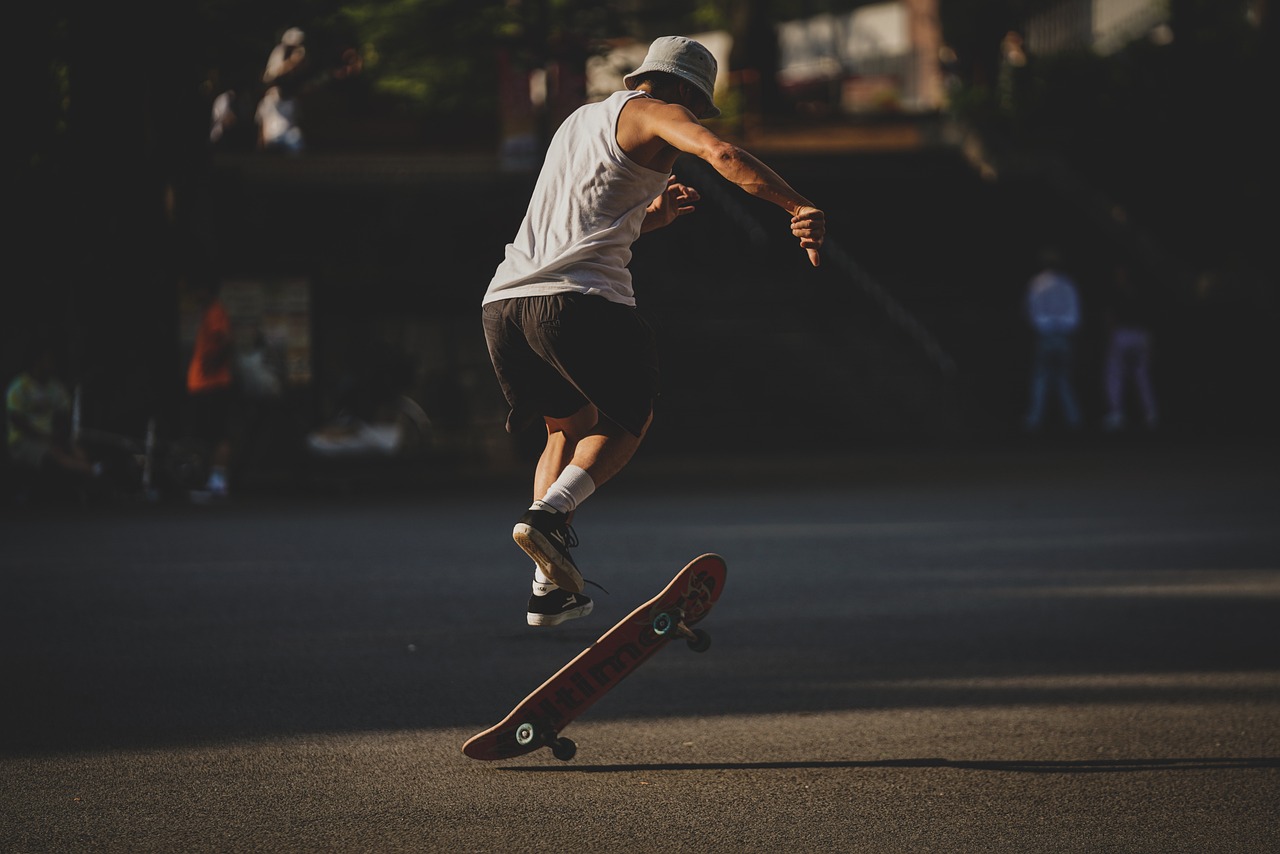
A skateboard is a deck (usually layered maple or birch) with two trucks, four urethane wheels and eight bearings. Riders push with one foot and steer by leaning; the basic jump, the ollie, pops the tail and drags the front foot up the grip tape to lift the board. Almost every trick grows from there: flip tricks, grinds and slides on ledges and rails, airs and lip tricks on ramps and in bowls.
There is no opponent and no ball. In everyday skating, you skate to land tricks, link lines and have fun with friends. In contests, a panel of judges ranks skaters on what World Skate calls difficulty, variety, execution, use of the course, consistency and flow, with repeated tricks scoring less. Our skateboarding rules page explains the formats and the skatepark etiquette every skater should know.
- Street: runs of 45–60 seconds on a course built like a city plaza, plus single trick attempts in most finals.
- Park: runs of 30 to 50 seconds through bowls and transitions, scored on speed, height, flow and difficulty; only the best run counts.
- Vert: back-and-forth runs on a halfpipe with vertical walls, famous for big airs; today mostly seen at the X Games, including vert best-trick contests.
Skateboarding at every level
Kids and beginners
The American Academy of Pediatrics (AAP) says children younger than 5 should not ride skateboards, and children aged 6 to 10 need close adult supervision. Lessons are worth it: according to the AAP, one-third of skateboard injuries happen in the first week of learning. Most kids start at a local skatepark, a skate camp or a lesson program; public skateparks are free in most towns, and The Skatepark Project, the nonprofit Tony Hawk founded in 2002, helps communities build new ones. Our youth skateboarding guide has the details for parents.
Teens, high school and college
Unlike soccer or basketball, skateboarding has no high school league under the NFHS and is not an NCAA sport. Teens progress through local contests, regional series, sponsorship by skate shops and brands, and filming video parts. Many colleges have skate clubs. World Skate’s age floor for its senior events rises one year at a time: 12 in 2026, 13 in 2027 and 14 from 2028 on.
Pro, Olympic and international
Skateboarding joined the Olympics at Tokyo 2020 and returned at Paris 2024. Los Angeles 2028 again has four events, men’s and women’s park and street, with 22 skaters per event (88 in all), qualified through the World Skateboarding Ranking between June 11, 2026, and June 11, 2028, and with at least one place per event for the United States as host. To compete at LA28, skaters must be born on or before December 31, 2014. The pro calendar also includes the World Skateboarding Tour, Street League Skateboarding (SLS), with its 2026 Super Crown world championship in São Paulo on December 12–13, and the X Games, which launched the team-based X Games League for skateboarding and BMX in summer 2026. Our leagues and associations page goes deeper.
Adult skaters
Plenty of skaters keep rolling into their 40s, 50s and beyond, and plenty of parents learn alongside their kids. Adult bodies take longer to heal, so pads and a helmet make even more sense, along with a proper warm-up and a slower build-up of new tricks. Many adults ride transition and bowls, cruise or longboard as a way to stay fit.
Sports health for skateboarders
Falling is part of learning to skate, so injuries come with the sport. The American Academy of Orthopaedic Surgeons (AAOS) counts about 70,000 skateboarding injuries a year treated in US emergency departments, about half of them in children under 15. The good news: most are minor, and the right gear and habits lower the risk. This section is general information, not medical advice. If you’re hurt, see a professional.
The most common skateboarding injuries
- Wrist and forearm fractures: skaters reach out to catch a fall. In a pediatric fracture clinic study, the forearm made up 48.2% of skateboarding fractures, and open forearm fractures (where the bone breaks the skin) were far more likely from skateboarding than from other causes.
- Arms and legs overall: in US emergency department data on 5- to 19-year-olds (1990–2008), 44.1% of skateboarding injuries were to the arms and 31.7% to the legs, and fractures and dislocations were the most common diagnosis (32.1%). Nearly 97% of patients went home without being admitted.
- Ankle sprains: the AAP calls them a common skateboarding injury, from awkward landings and rolling an ankle off the board.
- Head and face injuries: a review of the research found head trauma in about 3.5–13.1% of skateboarding injuries, and the few deaths reported mostly came from head injuries in collisions with motor vehicles.
- Cuts, scrapes and bruises, plus overuse problems in knees and ankles for skaters who session hard several days a week.
Protective gear with evidence behind it
The AAOS recommends a properly fitting helmet, wrist guards, knee and elbow pads, closed-toe shoes with slip-resistant soles and, for some, goggles or glasses. The AAP’s skating safety advice says wrist guards can reduce injuries by almost 90%, elbow pads by 80% and knee pads by 30%. For helmets, the Consumer Product Safety Commission (CPSC) points skaters to helmets certified to ASTM F1492, the skateboard standard, which are built to take more than one moderate impact. Many skate helmets are dual-certified to that and to the CPSC bike helmet standard. In World Skate contests, helmets are compulsory for all park skaters and for street skaters under 18. More on choosing them on our skateboarding gear page.
Where to skate
The AAP notes that most young skateboarders are injured on public roads, sidewalks and parking lots, so a skatepark is usually the safer choice, although injuries still happen there, especially in ramp and rail areas. The AAOS adds: skip wet, icy or uneven surfaces, crowded areas and skating after dark, and never “skitch” (hold on to a moving vehicle). Learn to stop, slow down and turn before trying tricks, and practice falling: crouch low so you have less distance to fall, and try to roll rather than land on your hands.
Concussion: recognize and remove
The CDC’s HEADS UP program asks skaters, parents and coaches to watch for someone who looks dazed or confused or is slow to react after a fall, and to listen for headache, dizziness, balance problems, sensitivity to light or noise, trouble concentrating or feeling “off.”
- Stop skating right away if you see signs after a knock to the head or a hard slam.
- Stay off the board for the rest of the day and until a healthcare provider says it’s OK. World Skate’s contest protocol goes further: a skater with a suspected concussion is out for 14 days and needs medical clearance.
- Come back in steps, as your doctor advises.
- Call 911 for danger signs: a seizure, passing out, growing drowsiness, a headache that gets worse, repeated vomiting, or one pupil larger than the other.
Heat and sun
Concrete parks get hot in summer. The National Athletic Trainers’ Association (NATA) recommends easing into hot-weather activity over 7–14 days. Bring water, take shade breaks, and skate early or late on the hottest days. Call 911 for confusion, collapse or a very high body temperature.
When to see a doctor, physical therapist or athletic trainer
See a professional for a wrist that’s swollen or painful to move after a fall (wrist fractures can feel like sprains), an ankle you can’t put weight on, a joint that looks out of shape, pain that doesn’t settle, or any concussion signs. A sports medicine physician manages most injuries without surgery (the American Medical Society for Sports Medicine says about 90% of sports injuries are non-surgical) and refers on when needed. A physical therapist guides rehab and the return to skating. Athletic trainers are licensed or regulated health care professionals in all 50 states. Our skateboarding injuries page goes deeper.
Training and conditioning for skateboarding
Most skaters train by skating, and that’s fine. But a little work off the board pays off, especially for ankles, knees and wrists that take the landings. In a 2024 study of 45 skaters, balance, lower-body strength and endurance were the fitness measures most linked to higher skateboarding skill. Useful pieces: balance work on one leg, squats and lunges for landing strength, jumping and landing practice, core strength, and hip and ankle mobility. Warm up before a session with easy rolling and a few basic tricks before the big ones. See our skateboarding training page and resistance bands for athletes for simple home work.
On a contest day or a long session, eat a carb-based meal of familiar foods 1–4 hours before, as the American College of Sports Medicine’s sports-nutrition position statement recommends, and drink before you get thirsty. On hot days, many skaters add electrolytes (see our electrolyte powder guide).
Recovery after a session
Sleep comes first: the CDC, citing the American Academy of Sleep Medicine, recommends 9–12 hours for children 6–12, 8–10 hours for teens and 7 or more for adults. Then food and fluids after skating, and a rest day after a hard session or a contest weekend. Many skaters use a foam roller or massage gun for tight calves, quads and hips, and soft recovery slides after a day in flat skate shoes. They’re about comfort, not treatment; pain or swelling that doesn’t go away needs a professional. See our skateboarding recovery page and the recovery tools guide.
Gear for skateboarding
- Board: beginners do well with a ready-made “complete” from a skate brand. Deck width is mostly about foot size and style.
- Helmet: certified to ASTM F1492 for skateboarding (CPSC); a dual-certified skate and bike helmet covers both.
- Pads: wrist guards, elbow pads and knee pads, especially while learning and in bowls and ramps.
- Shoes: closed-toe, flat, grippy soles (AAOS). Skate shoes are built for it.
Prices change often. The prices below are what we saw on Amazon in October 2026; check the current price before you buy.
A simple starter kit: the Pro-Tec Classic Certified helmet, which the maker says is certified to the CPSC bike standard, ASTM F1447 and ASTM F1492 (about $63); the Triple Eight Saver Series 3-Pack of knee pads, elbow pads and wrist guards (about $50); the Krown Rookie 7.75″ complete, a ready-to-ride beginner board with 52 mm wheels (about $45); and the OOFOS OOahh Slide for after the session.
Pro-Tec Classic Certified Helmet
- CPSC, ASTM F1447 and F1492 (maker)
- ABS shell, EPS liner
- Sizes XS-XL
Triple Eight Saver Series 3-Pack
- Knee, elbow pads and wrist guards
- Junior to Large
- About $50
Krown Rookie 7.75 Complete Skateboard
- 7.75 in, 7-ply maple
- 52 mm 99A wheels
- Ready to ride
OOFOS OOahh Slide
- OOfoam slide
- APMA Seal of Acceptance
- Machine washable
Decks, trucks, wheels, bearings, shoes and how to choose each are on our skateboarding gear page.
Skateboarding FAQs
What is the most common skateboarding injury?
Injuries to the arms, especially the wrist and forearm, from reaching out to break a fall. Ankle sprains, cuts and bruises, and head and face injuries are also common. Wrist guards are the simplest protection, and the AAP says they can reduce injuries by almost 90%.
What age can a child start skateboarding?
The AAP says children younger than 5 should not ride skateboards, and children 6 to 10 need close adult supervision. A helmet and pads from day one, and lessons, help kids get through the first, most injury-prone week.
Do I need a special helmet for skateboarding?
The CPSC lists ASTM F1492 as the helmet standard for skateboarding. Those helmets are designed for more than one moderate impact, but should still be replaced when cracked or crushed or when the maker says so. Dual-certified helmets (ASTM F1492 plus the CPSC bike standard) work for skating and biking.
Is skateboarding in the Olympics?
Yes. It debuted at Tokyo 2020, was held again at Paris 2024 and is on the program for Los Angeles 2028, with men’s and women’s street and park. Vert is not an Olympic event.
How are skateboarding contests judged?
Five judges score each run or trick from 0 to 100; the highest and lowest are dropped and the other three averaged. Judges look at difficulty, variety, execution, use of the course, consistency and flow. In street finals the best run plus the two best single tricks count; in park, the best run.
Is a skatepark safer than the street?
Generally, yes: the AAP notes most young skaters are hurt on roads, sidewalks and parking lots, and the worst injuries in the research involve cars. Skateparks still have falls and collisions, so wear the gear and follow park etiquette.
Skateboarding gives back friends, creativity and a lifetime of trying “one more.” The skaters who keep going wear the gear while they learn, pick their spots, build up gradually and listen to their bodies. Keep exploring: our recovery tools guide, the cycling guide if you ride BMX too, and every other sport on our sports hub.