This article contains affiliate links: if you buy through them we may earn a commission, at no extra cost to you. Learn more.
A Tuesday night at a strip-mall club: a row of metal strips, the hum of the scoring boxes, a dozen kids in white jackets learning to lunge while their parents watch through the glass. A Saturday regional tournament, pools of six fencers in a convention hall, the beep and the red or green light when a touch lands. And the Olympic final, where a single touch at 14–14 decides a gold medal. Fencing is one of only five sports contested at every modern Olympic Games since 1896, and in the US it’s growing fast: USA Fencing reached a record 45,157 members and 752 affiliated clubs in the 2024-25 season.
Fencing, page by page
- Rules: how the game works at every level
- Leagues & associations: pro, college, high school and youth
- Youth & high school: ages, safety and recruiting, for players and parents
- Injuries & sports health: prevention, concussion, when to see a pro
- Training & conditioning: before: off-season to in-season
- Game day: during: fueling, hydration, heat
- Recovery: after: games, tournaments, sleep
- Nutrition & supplements: what to eat, tested supplements
- Best wearables: trackers and watches for the sport
- Gear: the complete equipment list
Buying guide · Our Fencing buying guide compares the gear we'd pick, with prices and sizing:
This page is fencing for athletes and the people who look after them: the three weapons and how bouts work, what the sport looks like from kids’ classes to the Olympics and Paralympics, and, most of all, how to stay healthy doing it. Sports health runs through all of it: the injuries fencers actually get (it’s not the ones people imagine), the gear that keeps a sword sport safe, concussion, heat in full kit, and when to see a professional. Then training, recovery and the equipment you need. It’s general information, not medical advice.
Fencing at a glance
| Weapons | Foil (point only, torso target, right of way), épée (point only, whole body, no right of way) and sabre (point and edge, everything above the hips, right of way). |
|---|---|
| Bout length | Pools: 5 touches or 3 minutes. Direct elimination: 15 touches or three 3-minute periods with 1-minute breaks (in sabre, the first break comes at 8 touches). Veterans’ elimination bouts: 10 touches. Team matches: relays to 45. |
| Field of play | The strip (piste) is 14 meters long (about 46 feet) and 1.5 meters wide; fencers start 4 meters apart, each 2 meters from the center line. |
| Governing bodies | FIE (International Fencing Federation) worldwide; USA Fencing in the US; the NCAA for varsity college fencing; World Para Fencing for wheelchair fencing. |
| Main physical demands | Explosive lunges and footwork, quick reactions, leg strength and endurance across long tournament days, and a lot of thinking: feints, timing and reading the opponent. |
| Most common injuries | Ankle and knee sprains, thigh and hip strains, overuse problems of the front knee and hip, bruises and blisters; cuts and punctures are rare and mostly prevented by gear in good condition. |
How fencing works
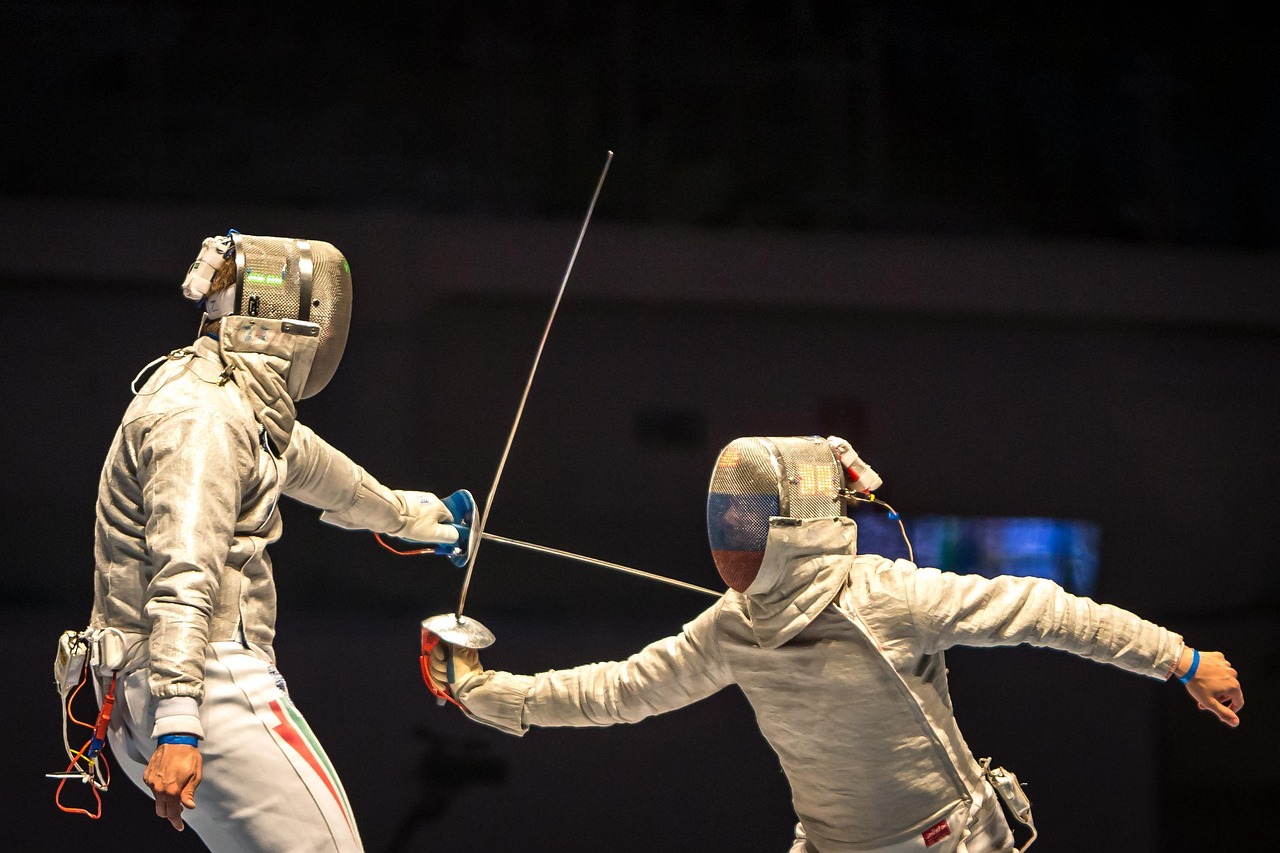
Two fencers face each other on the strip. The referee calls “En garde! Prêts? Allez!” and they fence until someone lands a touch, which an electric scoring box registers through wires running from the weapon, up the sleeve and to the reel at each end of the strip. Each valid touch is a point. In foil and sabre, if both fencers hit at the same time, the referee decides who had the right of way (priority): broadly, the fencer who started a correct attack first, unless it was parried or missed. In épée there’s no right of way: if both hit within a fraction of a second, both score.
Most tournaments start with round-robin pools of five to seven fencers, bouts to 5 touches. The pool results seed a direct elimination bracket of 15-touch bouts. Referees use yellow cards (a warning), red cards (a penalty touch to the opponent) and black cards (exclusion). Our fencing rules page explains the weapons, targets, right of way and cards in detail.
Fencing at every level
Kids and youth
Most fencers start at a club, with beginner classes where the club lends the gear. USA Fencing’s youth categories are Y8, Y10, Y12 and Y14 (8 and under up to 14 and under); for the 2026-27 season, Y8 means born 2018–2020. Y8 events now use a developmental format of two rounds of pools with no elimination bracket, and Y8 and Y10 fence with shorter blades (32.5 inches at most). Kids collect regional points at Regional Youth Circuit (RYC) and Super Youth Circuit (SYC) tournaments, and the strongest go to the March North American Cup and Summer Nationals. Our youth fencing page covers ages, clubs, safety gear and parents’ questions.
High school, Cadet and Junior
Teen fencers mostly compete through their club in USA Fencing’s Cadet (under 17) and Junior (under 20) events, building toward Junior Olympics and the national North American Cups (NACs). Some states and schools also run interscholastic fencing teams, so ask your school. A new USA Fencing points and events structure for Cadet, Junior and Senior fencers took effect on August 1, 2026 as a two-year trial, so check the current qualification rules each season.
College
As of August 2024, 45 NCAA schools in 16 states sponsored fencing, across all three divisions, with one national championship for all of them. In March 2026 at Notre Dame, 144 fencers from 26 schools fenced six events in five-touch round robins, the top four in each going on to 15-touch semifinals and finals. For the first time since 1990, separate men’s and women’s team titles were awarded. Many more colleges have club teams. See fencing leagues and associations.
International, Olympic and Paralympic
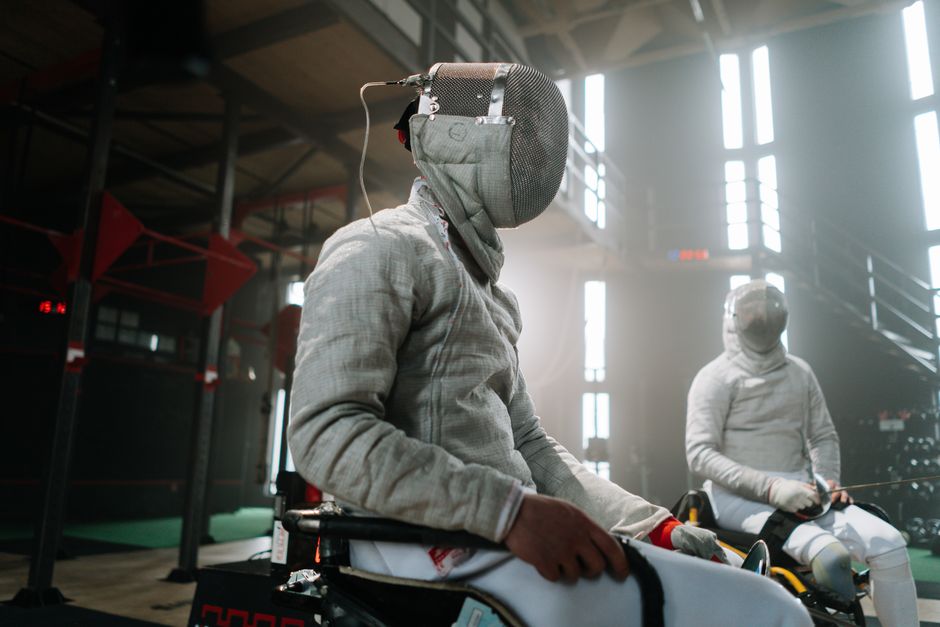
The FIE, founded in Paris in 1913 and based in Lausanne, has 156 member federations and runs international fencing, from the World Cup circuit to the Senior, Junior, Cadet and Veteran World Championships. At the Los Angeles 2028 Olympics, fencing runs July 15–23 at the LA Convention Center: 12 medal events, an individual and a team event in each weapon for women and men (team matches are relays to 45 touches). Wheelchair fencing has been on the Paralympic program since the first Games in Rome in 1960; fencers sit in chairs fixed to a frame, in categories by impairment, and LA 2028 adds mixed team épée and foil. Team USA won four fencing medals across the Paris 2024 Olympic and Paralympic Games.
Adult and veteran
Fencing is a sport people start at 30, 50 or 70. USA Fencing runs Division II and III events by rating, an Adult category and Veteran age groups from 40-49 up to 80 and older, with 10-touch elimination bouts. Many clubs run adult beginner classes. If you’re new or coming back, build up slowly: lunging and footwork are hard on legs that aren’t used to them.
Sports health for fencers
People expect sword injuries. The research says otherwise: fencing has one of the lowest rates of time-loss injury in sport, and most injuries are the sprains and strains of any stop-and-go, change-of-direction sport. The American Medical Society for Sports Medicine (AMSSM) says about 90% of sports injuries are non-surgical. This section is general information, not medical advice. If you’re hurt, see a professional.
The most common fencing injuries
- Low injury rates: at USA Fencing national events over five seasons (78,223 competitors aged 8 to over 70), there were 0.3 time-loss injuries per 1,000 athlete-exposures. In FIE competitions from 2010 to 2014 the rate was 0.28 per 1,000, with men at higher risk than women and épée at lower risk than foil or sabre.
- Ankles, knees and thighs: at US national events the knee (19.6%), thigh (15.2%) and ankle (13%) were the most injured areas, and 60% of injuries were in the legs. Internationally, ankle sprains were the single most common injury (25.3%), most injuries happened without contact, and the median time away was four weeks.
- Front knee and hip: in a survey of US national team members and Olympians, fencers reported 71 injuries to the front (lunging) knee and 28 to the back knee, and saber fencers reported the most hip and knee injuries. Lunging is repetitive and one-sided.
- Cuts and fingers: among fencers seen in US emergency rooms (2003–2022), strains and sprains came first (28%), then cuts (16.8%), and the finger was the most common location. Cuts were relatively more common at lower levels, a reminder to keep gear and weapons in good shape.
- Practice counts: in a college team followed for a year, 87.5% of injuries happened in practice, and three in four injured fencers were back within two weeks.
Safety gear and broken blades
Fencing is safe because of its rules and gear. Researchers note that serious punctures, usually from a broken blade, are extremely rare but possible, which is why the rules are strict: at USA Fencing tournaments anyone warming up or training with another fencer must wear full regulation clothing, and every fencer needs a mask, a jacket, an underarm protector (plastron), a glove covering half the forearm, knickers and long socks. Women must wear a chest protector. After a run of penetrating hand injuries in sabre, the FIE made stronger sabre gloves compulsory in 2014, and USA Fencing now requires 800N sabre gloves at every level. Check your mask, replace a blade with a kink or crack, and never fence in a torn jacket. See fencing gear.
Concussion: recognize and remove
Fencing has no intentional body contact, but collisions, falls and a hard hit to the mask happen. The CDC’s HEADS UP program asks coaches and parents to watch for a fencer who looks dazed or confused, and to listen for headache, dizziness or balance problems, sensitivity to light or noise, or trouble concentrating.
- Remove the fencer from the bout right away if you see signs after a knock to the head or body.
- Keep them out for the rest of the day and until a healthcare provider clears them.
- Return slowly, in steps that usually take a week or more.
- Call 911 for danger signs: seizures, passing out, a headache that gets worse, repeated vomiting, or one pupil larger than the other.
Heat, hydration and long tournament days
A fencing uniform is layers of tough cloth plus a mask, and a tournament can run all day: a review in Sports Medicine found international events last 9 to 11 hours, with bouts taking only about 18% of that time. Drink between bouts, take the mask off whenever you can, and eat small familiar snacks. The National Athletic Trainers’ Association (NATA) recommends easing into heat over 7–14 days. Call 911 for confusion, collapse or a very high body temperature. Our fencing tournament day page has the full routine.
When to see a doctor, physical therapist or athletic trainer
Don’t fence through pain. See a professional for an ankle or knee that swells or gives way, hip or knee pain that keeps coming back after lunging, any cut from a blade, or any concussion signs. A sports medicine physician manages most sports injuries without surgery, a physical therapist guides rehab and return to fencing, and athletic trainers, licensed or regulated health care professionals in all 50 states, often staff tournaments. More on our fencing injuries page.
Training and conditioning for fencing
Fencing taxes both quick bursts and endurance: the same review describes high demands on the aerobic and anaerobic energy systems, plus a typical asymmetry, because fencers lunge with the same leg and hold the weapon in the same hand for years. Most fencing improvement happens in lessons and bouting at the club, but off-strip work helps: leg strength and power for the lunge, footwork and agility (see our speed training equipment guide), balance and ankle work, core strength, and some training for the back leg and the non-fencing side. The mental side is huge in a sport of feints and second intentions; see mental training tools for athletes. Our fencing training page has more.
On tournament days, the sports-nutrition position statement from the American College of Sports Medicine and two dietitians’ groups recommends a pre-exercise meal that’s high in carbohydrate, moderate in protein, low in fat and fiber, made of familiar foods and eaten about 1–4 hours before. Many fencers carry an electrolyte drink for long days. See fencing nutrition and supplements.
Recovery after bouts and tournaments
Sleep comes first: the CDC recommends 9–12 hours a night for children 6–12, 8–10 for teens and 7 or more for adults. After a tournament, refuel with real food and fluids, then keep the next day easy. Many fencers use a foam roller or a massage gun for tight quads, calves and hips, and slip into soft recovery shoes after a day on a hard strip. They’re comfort tools, not treatment. Our fencing recovery page and recovery tools guide go further.
Gear for fencing
- Mask: a CE 350N mask is fine for club and USA Fencing events; FIE-homologated masks (1600N) are required at FIE events. Foil masks need a conductive bib, and foil or sabre masks with a metal bib aren’t allowed in épée.
- Jacket, plastron and knickers: standard 350N gear works in USA Fencing events (FIE labels aren’t required); FIE events require 800N.
- Chest protector: required for women, optional for men, worn under the jacket.
- Glove, weapon and body cord: plus a lamé (conductive jacket) for foil and sabre, and a mask cord for foil and sabre.
- Shoes: fencing shoes or flat-soled court shoes with good grip, and knee-high socks.
A few picks to start: the LEONARK foil mask, CE 350N certified with an adjustable back; the LEONARK padded fencing glove with a long forearm sleeve; the ASO EVO ankle stabilizer, a lace-up brace from our ankle brace guide, for fencers coming back from a sprain; and the OOFOS OOahh Slide for after the last bout. The full list is on our fencing gear page.
LEONARK Fencing Foil Mask (CE 350N)
- CE 350N certified
- Adjustable back strap
- Foil, about $75
LEONARK Padded Fencing Glove
- Foil, épée and sabre practice
- Padded back of hand
- Long forearm sleeve
ASO EVO Ankle Stabilizer
- Lace-up brace
- Fits in athletic shoes
- Left or right
OOFOS OOahh Slide
- OOfoam slide
- APMA Seal of Acceptance
- Machine washable
Fencing FAQs
Is fencing safe?
Yes, by sports standards. Studies of USA Fencing and FIE competitions found about 0.3 time-loss injuries per 1,000 athlete-exposures, mostly sprains and strains in the legs. Serious blade injuries are very rare, and the rules on masks, jackets, plastrons, gloves and chest protectors exist to keep it that way.
What’s the difference between foil, épée and sabre?
Foil scores with the point on the torso and uses right of way. Épée scores with the point anywhere on the body and has no right of way, so both fencers can score at once. Sabre scores with the point or the edge anywhere above the hips, including arms and head, and uses right of way.
What age can kids start fencing?
USA Fencing’s youngest competitive category is Y8 (8 and under; born 2018–2020 for 2026-27), and many clubs offer youth classes before that. Ask your local club about its beginner program; most lend gear at first.
How long is a fencing bout?
Pool bouts go to 5 touches or 3 minutes. Direct elimination bouts go to 15 touches or three 3-minute periods with 1-minute breaks. Veterans’ elimination bouts go to 10 touches.
What are the most common fencing injuries?
Ankle and knee sprains and thigh strains, plus overuse pain in the front knee and hip from lunging. Warm up well, build leg and ankle strength, and see a sports medicine doctor, physical therapist or athletic trainer for pain or swelling that doesn’t settle.
Can you fence in college?
Yes. As of August 2024, 45 NCAA schools sponsored varsity fencing across Divisions I, II and III, with one national championship, and many other colleges have club teams.
Fencing rewards patience, footwork and a quick mind, and the fencers who last are the ones who keep their gear in shape, look after their knees and ankles, and rest between long days. Keep exploring: fencing rules, fencing gear, our recovery tools guide, Whoop vs Oura vs Garmin for tracking training load, and every other sport on our sports hub.