This article contains affiliate links: if you buy through them we may earn a commission, at no extra cost to you. Learn more.
A summer morning at the community sailing center: a row of little Optimist dinghies on the dock, kids in life jackets that look too big for them, and an instructor in a motorboat calling “Ready about!” across the water. That evening, at the yacht club down the shore, a dozen keelboats circle behind the start line as the committee boat sounds the five-minute signal. Far away, a SailGP catamaran lifts onto its foils and flies across a harbor. Sailing is all of these, and it’s a sport you can start as a kid and keep for life.

Sailing, page by page
- Rules: how the game works at every level
- Leagues & associations: pro, college, high school and youth
- Youth & high school: ages, safety and recruiting, for players and parents
- Injuries & sports health: prevention, concussion, when to see a pro
- Training & conditioning: before: off-season to in-season
- Game day: during: fueling, hydration, heat
- Recovery: after: games, tournaments, sleep
- Nutrition & supplements: what to eat, tested supplements
- Best wearables: trackers and watches for the sport
- Gear: the complete equipment list
Buying guide · Our Sailing buying guide compares the gear we'd pick, with prices and sizing:
This page is sailing for athletes and the people who look after them: how the sport works, from dinghies to keelboats, cruising and boards, every level from learn-to-sail to the Olympics, and, most of all, how to stay healthy doing it. Sailing safety is the heart of it: boom strikes, cold water and the 1-10-1 rule, what the Coast Guard’s numbers say about life jackets, sun and seasickness. Then training, recovery and the gear you really need.
Sailing at a glance
| Kinds of sailing | Dinghies (small boats, one or two sailors, that you hike out to keep flat), keelboats (a weighted keel, a crew, often a cabin), multihulls, and boards: windsurfers and kites, many of them now on foils. |
|---|---|
| How races work | Mostly fleet racing around marks after a five-minute starting sequence; also team racing and match racing (one boat against one, as in the America’s Cup). Lowest total score over a series wins. |
| Rules | The Racing Rules of Sailing (2025–2028 edition, from World Sailing) on the racecourse; the Coast Guard’s Navigation Rules and equipment rules everywhere else. |
| Governing bodies | World Sailing worldwide; US Sailing in the US; ISSA for high school and ICSA for college sailing. |
| Olympics | 10 events at LA28 (July 16–28, 2028), from foiling kites and windsurfers to the ILCA dinghy, 49er skiffs, the mixed 470 and the Nacra 17 catamaran. |
| Main physical demands | Hiking (long holds for thighs, core and back), pulling on sheets and grinding winches, balance, and long days in sun, wind and cold water. |
How sailing works
A sail works like a wing. You can’t sail straight into the wind, so to go upwind you sail at an angle to it, zigzagging from one side to the other. Turning the bow through the wind is a tack; turning the stern through the wind is a jibe (or gybe), and on a jibe the boom swings across the boat, fast. When the wind comes over the right side of the boat you’re on starboard tack; over the left, port tack.
Dinghies, keelboats and cruising
Most racers learn in dinghies: the Optimist for kids, the two-person Club 420 for teens, the ILCA (the boat many know as the Laser) for single-handers. A dinghy has no heavy keel, so the crew keeps it flat with their own weight, hiking out over the side with their feet under the toe straps. Capsizing is part of learning. Keelboats have a weighted keel and a crew in set jobs; they race in Wednesday-night series and offshore, and they’re the boats people cruise, daysail and charter. Plenty of sailors never race at all.
Windsurfing and kitefoiling, briefly
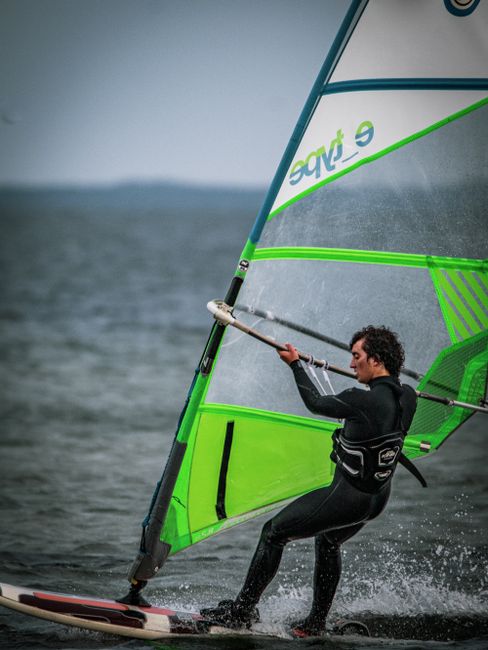
Boards are part of the sailing family. At LA28, the men’s and women’s iQFOiL (foiling windsurfers) and Formula Kite (foiling kiteboards) are two of the 10 Olympic sailing events, and they race first. Federal rules don’t require sailboards to carry a life jacket, but racing rules, local laws and common sense often call for a life jacket or impact vest anyway, especially on foils and kites, where speeds are high and falls are hard.
The racing rules in one paragraph
A race starts with a five-minute sequence of flags and sounds from the committee boat. On the course, port tack keeps clear of starboard tack (Rule 10), the windward boat keeps clear of the leeward boat (Rule 11), and everyone must avoid contact if reasonably possible (Rule 14). At the marks, a zone of three hull lengths decides who gets room. Break a rule and you can take a two-turns penalty on the water. Our sailing rules page explains it in plain words, plus the Coast Guard’s Navigation Rules for when you’re not racing.
Sailing at every level
Kids and learn-to-sail
Most kids start at a yacht club junior program or a community sailing center. Charleston Community Sailing, for example, puts ages 8 to 15 in Optis and ages 12 to 18 in Club 420s. US Sailing’s sample beginner syllabus starts on day one with a swim test, life jacket fitting and capsize practice. Ask whether instructors are US Sailing certified (a Level 1 instructor has a safe boating course and First Aid/CPR). Our youth sailing page covers swimming, life jacket sizing and parents’ questions.
High school sailing (ISSA)
The Interscholastic Sailing Association (ISSA) governs high school sailing at public and independent schools, in seven districts across the country. Teams race short races close to shore, mostly in Club 420s, and ISSA’s national championships are the Mallory (fleet racing, high school sailing’s oldest trophy), the Baker (team racing) and the Cressy (singlehanded).
College sailing (ICSA)
The Inter-Collegiate Sailing Association (ICSA) has run organized college racing since 1928 and has more than 230 active colleges in seven conferences. It isn’t an NCAA championship sport, though some schools count women’s sailing toward NCAA sponsorship and Title IX. And there are no sailing scholarships: ICSA rules bar financial aid based on sailing ability.
Club racing and adult sailing
Most adult racers sail club series and regattas, in one-design fleets (all the same boat) or handicap fleets, where different boats are rated against each other.
Olympic, SailGP and the America’s Cup
World Sailing runs Olympic sailing and writes the rulebook; US Sailing runs the US Sailing Team. The LA28 regatta runs July 16 to 28, 2028: the boards at Belmont Shore in Long Beach and the other events at the Port of Los Angeles. As of the 2026 season, SailGP’s sixth, 13 national teams, including the United States, race identical F50 foiling catamarans that can reach about 100 km/h, ending with a Grand Final in Abu Dhabi. The 38th America’s Cup is in Naples, Italy, in 2027, with the Match opening July 10. Our sailing leagues and associations page maps the whole pathway.
Sailing safety and sports health
Day to day, sailing is a fairly gentle sport: a 2019 research review found injury rates of 0.29 to 5.7 per 1,000 hours of sailing, lower than many land sports. But the same review called its death rate “relatively high,” mostly because of drowning. So sailing health has two halves: everyday bruises, hands, knees and backs, and rare emergencies where a life jacket decides everything. This section is general information, not medical advice. If you’re hurt, see a sports medicine doctor, physical therapist or athletic trainer; in an emergency on the water, call on VHF channel 16 or 911.
Boom strikes and concussion
For beginners and casual sailors, most injuries are bruises and scrapes from the boom or other gear during tacks and jibes. Some are worse: in a survey of 1,188 sailors, 14% of the severe injuries were concussions. An accidental jibe in strong wind is the moment to fear. Call every maneuver (“Ready about,” “Jibe-ho”) and wait for the answer, keep your head low downwind, and on keelboats rig a preventer. If someone takes a hit to the head, follow the CDC’s HEADS UP rule: “When in doubt, sit them out.” They stay off the water for the day and until a health care provider clears them. Danger signs such as a worsening headache, repeated vomiting, a seizure or unequal pupils mean emergency care now.
Hands, knees and backs
- Hands: at the 2014 Sailing World Championships, hands and fingers were 22% of all injuries; in a 2023 survey of offshore sailors the hand was the most injured body part (28%). Wear grippy sailing gloves, never wrap a loaded line around your hand, and keep fingers clear of blocks and winches.
- Knees and back from hiking: the thigh muscles work at about 30–40% of their maximum for long periods while hiking, sometimes at full effort. Over the year before the 2014 Worlds, 29% of sailors reported a lower-back injury and 13% a knee injury, and 58% of those injuries were overuse. Build strength on land and ramp up slowly.
- Trips and falls: on keelboats, trips, falls and getting caught in lines cause many injuries, often in heavy weather. Non-slip boots help.
The details, with when to see a professional, are on our sailing injuries page.
Cold water and the 1-10-1 rule
The National Weather Service calls water of 70°F or lower “cold water,” and in spring and fall most lakes and coasts qualify even on warm days. Physiologist Gordon Giesbrecht’s 1-10-1 principle is the easy way to remember what happens when you go in:
- 1 minute, cold shock: a sudden gasp and fast, heavy breathing. If your face is under water then, you can breathe in water.
- 10 minutes, cold incapacitation: over roughly the next 10 minutes you lose useful movement of your fingers, arms and legs. Use it to get back aboard.
- 1 hour, hypothermia: even in ice water, losing consciousness from hypothermia can take about an hour, but only if you’re floating.
Treat the numbers as a memory aid, not a promise: the National Center for Cold Water Safety notes cold shock can kill within seconds to two minutes. What protects you is a life jacket, which keeps you breathing through the gasp and floating when your arms quit, and a wetsuit or drysuit chosen for the water temperature, not the air. Stay with a capsized dinghy; it floats. After a rescue, watch for hypothermia (shivering, confusion, fumbling hands, slurred speech, drowsiness) and warm the core first; the CDC treats a body temperature below 95°F as an emergency.
Life jackets: what the Coast Guard data show
The US Coast Guard’s 2024 Recreational Boating Statistics counted 556 boating deaths, the fewest in more than 50 years of record keeping. Where the cause was known, 76% of victims drowned, and where life jacket use was known, 87% of them weren’t wearing one. “Person falls overboard” caused 138 deaths, the most of any of the top five incident types, and sailboats were involved in 10 deaths, eight of them drownings. Yet in one survey, sailors’ median life jacket use was just 30%.
- The law: one Coast Guard-approved wearable life jacket per person, the right size and readily accessible; boats 16 feet and longer also carry a throwable. Children under 13 must wear one while underway unless below deck or in an enclosed cabin, or as your state’s rule requires.
- Racing: US Sailing requires every competitor at its youth, junior and adult dinghy championships to wear a USCG-approved, 100% foam life jacket at all times on the water. And under the Racing Rules, when the race committee flies flag Y, everyone wears one.
- Foam or inflatable: the Coast Guard doesn’t recommend inflatables for anyone under 16 or for non-swimmers. Many dinghy sailors choose foam because it floats without being triggered; many keelboat sailors wear an automatic inflatable. Either way, it should fit snug.
- Be findable: offshore, a personal AIS man-overboard beacon or a personal locator beacon on your life jacket helps your boat and rescuers find you. See our sailing wearables page.
Sun, heat and lightning
Sailors spend hours in open sun with UV reflecting back up off the water. In the sailors’ survey, 16% reported a sunburn in the past year even though most said they used sunscreen. The American Academy of Dermatology recommends a broad-spectrum, water-resistant sunscreen of SPF 30 or higher, reapplied every two hours and after swimming or sweating, plus a hat and a long-sleeve top. On hot, windless days, confusion or collapse could be heat stroke: the National Athletic Trainers’ Association says to cool the person right away, ideally in cold water, and call for help. For storms, NATA’s rule applies on the water too: “When thunder roars, go indoors.”
Seasickness
The CDC’s travel guidance says the best defense is getting used to it over time (“habituation”), more effective than any medication but slow. Meanwhile: watch the horizon, stay in fresh air on deck, don’t read below, sleep well the night before, and skip alcohol. If you use a motion sickness medicine, take it before you go out and try it on a day ashore first, because drowsiness is the most common side effect, and that matters on a moving boat. More on our regatta day page.
Training and conditioning for sailing
Time on the water is the best training, but dinghy racing is harder than it looks. Studies tie hiking performance to maximal quadriceps strength, and top Laser sailors sailing upwind worked at about 74% of their maximum heart rate, with anaerobic effort rising as the wind built. A good land week has three parts:
- Hiking strength: squats, split squats, wall sits and long trunk holds (planks, side planks, back extensions).
- Pulling and grip: rows, pull-ups or hangs, and forearm work for sheets and grinding.
- Engine and balance: two or three easy cardio sessions plus one harder one, and balance work; many sailors use a balance board.
One caution: in a year-long study of dinghy sailors, 30% of injuries happened during physical training, more than during sailing, so build up gradually. Full routines are on our sailing fitness page.
Fuel, hydration and recovery
Collegiate dinghy sailors at a training camp, on the water about seven hours a day, burned about 4,130 calories a day. Yet club sailors studied at a regatta drank and ate too little: most finished in negative fluid balance, with carbohydrate intake below recommendations. Tie a bottle into the boat and eat and drink between races. Our sailing nutrition page covers daily eating, boat weight and supplements with third-party testing.
Coaches describe fatigue building up across a multi-day regatta, so eat, rehydrate, get warm and sleep well between days. Many sailors use a foam roller like the TriggerPoint GRID 1.0 (about $40) on quads and back after a hiking day; that’s for comfort, not treatment. More on our sailing recovery page and in our athlete recovery routine.
Gear for sailing
Prices change often. The prices below are what we saw at the maker or a major retailer in October 2026; check the current price before you buy.
Start with the life jacket you’ll actually wear. For dinghies, a foam vest you can move in, like the Onyx MoveVent Dynamic (about $69, Coast Guard and Transport Canada approved, SOLAS reflective trim). For adults on keelboats where inflatables are allowed, the Mustang Survival HIT inflatable PFD (about $380) inflates automatically with a hydrostatic inflator and gives 38 lb of buoyancy. Add gloves such as the Gill Championship short-finger gloves (about $35, Dura-Grip palm, UV 50+ back) and a water-resistant mineral sunscreen like Blue Lizard Sport SPF 50 (about $9). Racers often add a watch with a regatta timer, such as the Garmin quatix 8 (about $1,100). Boots, foul-weather gear, sunglasses and kids’ sizes are on our sailing gear page.
Onyx MoveVent Dynamic Life Jacket
- USCG and Transport Canada approved
- Foam, mesh lower back
- SOLAS reflective trim
Mustang Survival HIT Inflatable PFD
- Automatic hydrostatic inflator
- 38 lb buoyancy
- USCG approved, 30-52 in chest
Gill Championship Sailing Gloves, Short Finger
- Dura-Grip palm
- UV 50+ back of hand
- 3/4-length fingers
Blue Lizard Sport Mineral SPF 50
- Zinc oxide and titanium dioxide
- 80 min water resistant
- 3 fl oz
Sailing FAQs
Is sailing dangerous?
Everyday injuries are relatively uncommon, at 0.29 to 5.7 per 1,000 hours in research, lower than many land sports. The serious risk is drowning after a fall overboard or capsize, especially in cold water. Wearing a life jacket, dressing for the water temperature and sailing within your skill level cut that risk the most.
Do you have to wear a life jacket on a sailboat?
Federal law requires one approved life jacket per person aboard, and children under 13 must wear one while underway unless below deck or in an enclosed cabin (or as your state requires). US Sailing requires foam life jackets at all times at its youth and dinghy championships. Whatever the rule, the Coast Guard’s 2024 data show 87% of boaters who drowned weren’t wearing one.
What does 1-10-1 mean in cold water?
It’s a memory aid from physiologist Gordon Giesbrecht: about 1 minute to get your breathing under control after cold shock, about 10 minutes of useful movement before your arms and legs stop working, and up to about 1 hour before hypothermia makes you unconscious. Real times can be shorter, which is why a life jacket matters so much.
What age can kids start sailing?
Many programs put kids in Optimist dinghies from about age 8, and some community centers take younger kids out on small keelboats with an instructor. What matters more than age: comfort in the water, a well-fitted life jacket and certified instructors with a safety boat.
Is college sailing an NCAA sport?
No. The Inter-Collegiate Sailing Association runs college sailing, with more than 230 active colleges. Some schools count women’s sailing toward NCAA sponsorship, but there’s no NCAA championship, and ICSA rules don’t allow financial aid based on sailing ability.
Sailing gives back for a lifetime: first solo sails, Wednesday-night races, a long reach on a summer evening. Wear the life jacket, respect cold water and look after your hands, knees and skin. Next: sailing rules, youth sailing, sailing injuries, sailing gear, or compare with our surfing and soccer sections.