This article contains affiliate links: if you buy through them we may earn a commission, at no extra cost to you. Learn more.
A Saturday-morning club session at the local rink: kids in helmets and bright neck guards tucked in a line behind the coach, hands on their backs, swinging through the corners together. A two-person pair on the 400-meter oval in Kearns, Utah, crossing lanes on the back straight while the clock does the judging. Five short track skaters elbow to elbow in an Olympic final, one wrong edge from a pile-up in the pads. Speed skating is all of those things, and it’s one of the oldest Olympic sports: men’s long track has been on the program since the first Winter Games in 1924, and short track speed skating joined in 1992.
Speed Skating, page by page
- Rules: how the game works at every level
- Leagues & associations: pro, college, high school and youth
- Youth & high school: ages, safety and recruiting, for players and parents
- Injuries & sports health: prevention, concussion, when to see a pro
- Training & conditioning: before: off-season to in-season
- Game day: during: fueling, hydration, heat
- Recovery: after: games, tournaments, sleep
- Nutrition & supplements: what to eat, tested supplements
- Best wearables: trackers and watches for the sport
- Gear: the complete equipment list
Buying guide · Our Speed Skating buying guide compares the gear we'd pick, with prices and sizing:
This page is speed skating for athletes and the people around them: how long track and short track work, a quick look at inline speed skating, what the sport looks like from a first Learn to Skate class to the Olympics, and, most of all, how to stay healthy doing it. Sports health is the heart of it: the falls and blade cuts short track is known for, the low-back strain that comes with the crouch, concussion, and the cut-resistant gear the rules require. Then training, recovery and the equipment you really need.
Speed skating at a glance
| Disciplines | Long track (a 400 m oval, skaters race in pairs against the clock), short track (a 111.12 m oval on a hockey-size rink, a small pack races head to head) and inline speed skating on wheels. |
|---|---|
| Olympic events | Long track: 500 m, 1000 m, 1500 m, 5000 m and mass start for both, 3000 m for women, 10,000 m for men, plus team pursuit (6 laps women, 8 laps men). Short track: 500 m, 1000 m, 1500 m, women’s 3000 m relay, men’s 5000 m relay and a 2000 m mixed team relay. |
| Direction | Always counterclockwise: the inside of the track is on the skater’s left. |
| Governing bodies | The International Skating Union (ISU) worldwide; US Speedskating in the US (headquartered at the Utah Olympic Oval in Kearns); World Skate and USA Roller Sports for inline. |
| Main physical demands | Powerful sideways pushes from a deep, bent-over crouch; sprint speed and long-distance endurance depending on the distance; in short track, tight corners at high speed in a pack. |
| Common health issues | Low-back pain, knee and ankle injuries, groin strains, falls into the pads, lacerations from blades (mostly below the knee) and concussion. |
How speed skating works
Long track: you against the clock
US Speedskating calls long track “the fastest, human powered, non-mechanical sport in the world.” Two skaters start together, one in the inner lane and one in the outer, and swap lanes on the back straight every lap so both skate the same distance. Whoever wins the pair doesn’t matter much; the fastest time across all pairs wins. ISU championships, World Cups and the Olympics are raced on a standard 400 m track with two competition lanes. Racing distances run from 500 m to 10,000 m, plus team pursuit (three skaters, timed on the third one across the line), team sprint and the mass start, a 16-lap pack race with sprint points after laps 4, 8 and 12 and big points at the finish.
Long track skaters use clap skates: the blade is hinged to the boot near the front, so it stays on the ice while the heel lifts at the end of each push. In a study of ten elite skaters, clap skates raised skating speed about 5% compared with conventional skates. Our speed skating rules guide explains lane changes, starts and the mass start in detail.
Short track: racing in a pack
US Speedskating describes short track as “often referred to as NASCAR on ice.” Skaters race on a 111.12 m oval laid out on a hockey-size rink, with seven rubber blocks marking each corner and soft pads around the boards. A 500 m race is 4½ laps. There are no lanes after the start and passing is allowed at any time, but the skater overtaking is responsible for any contact until they’re alongside. Referees watching video can give a penalty for impeding, cutting inside the blocks (off-track), assisting another skater, kicking out a skate, or exaggerating contact to draw a call. A penalty means disqualification from that race. At the Olympics, finals have 5 skaters in the 500 m and 1000 m and 7 in the 1500 m.
Short track video analysis of 16 international competitions from 2021 to 2023 counted 1,505 falls, about 94 per competition, at speeds that often top 50 km/h (31 mph). That’s why short track has the strictest equipment rules in skating: an ASTM short track helmet, cut-resistant gloves, cut-resistant neck protection, shin and knee protection, long-sleeved and long-legged clothing, eye protection and rounded blade ends.
Inline speed skating, briefly
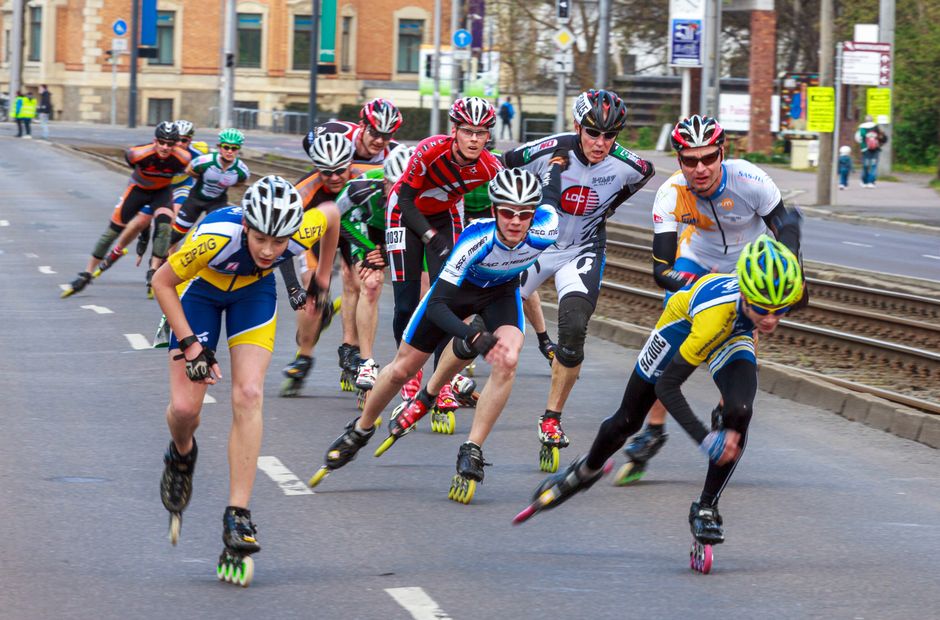
Speed skating on wheels is governed by World Skate internationally and USA Roller Sports in the US. According to USA Roller Sports, US indoor racing uses a 100 m oval, while outdoor racing, the international standard, splits into road races and track races on banked ovals, usually 200 m, almost always on inline skates; inline skates made their World Championships debut in 1992. Many Olympians started on wheels: US Speedskating names Apolo Ohno, Jen Rodriguez and Eddy Alvarez. If there’s no ice rink near you, an inline club is a real path into the sport.
Speed skating shares the ice, and plenty of skills, with figure skating and ice hockey, and many kids try all three in Learn to Skate classes before choosing.
Speed skating at every level
Kids and beginners
Most skaters start in group classes. US Speedskating points families to two doors: its Find a Club map (just over 60 ice speed skating clubs in the US) and Learn to Skate USA, the program endorsed by US Speedskating, U.S. Figure Skating and USA Hockey. Clubs offer both recreational and competitive skating. US Speedskating’s age divisions put youth under 13 in local and regional meets that focus on fun; in short track the youngest racing division, Junior E, is ages 7 to 10, and US Speedskating’s shorter “Devo track” keeps races for that age about skills, racing and fun rather than times. Our youth speed skating guide covers ages, costs, safety gear and parents’ questions.
Juniors and the national pathway
Juniors (13 to 19 in US Speedskating’s divisions) train more consistently and aim for Age Group Nationals, the usual entry into national competition, and the US Junior Championships. Long track adds the AmCup series. From there, selection races pick US teams for ISU Junior World Cups, the World Junior Championships and the Youth Olympic Games. Speed skating isn’t a high school or NCAA sport in the US; the pathway runs through clubs, regional training groups and national teams, many of them based at the Utah Olympic Oval, Utah’s only 400 m oval.
Elite, World Cup and Olympic
Elite long track skaters race the ISU World Cup, six stops in 2026/27 from Beijing (November 13–15, 2026) to Salt Lake City and Calgary, plus World Championships. Short track’s ISU World Tour opens its third season in Vancouver on October 23–25, 2026, with seven events. At the Milano Cortina 2026 Olympics, Jordan Stolz won the 500 m and 1000 m in Olympic-record times and silver in the 1500 m, the first American since Eric Heiden in 1980 to win two speed skating golds at one Games. Mia Manganello took bronze in the mass start, Team USA’s first medal in that event, and Corinne Stoddard won bronze in the short track 1500 m. US Speedskating says its athletes have won 97 Olympic medals, more than any other US winter sport. More in our guide to speed skating organizations and competitions.
Adults and masters
Masters skating starts at 30 in US Speedskating’s divisions, with masters races and, in short track, five-year age groups. Adults can race at club and local meets with a recreational membership, and many clubs welcome grown-ups who just want to skate fast for fitness. Coming back after years away, or switching from hockey or inline? Build up time on the ice gradually and take a few lessons on the crouch and crossovers before racing.
Sports health for speed skaters
Speed skating is a power sport on a knife edge, literally. A 2024 scoping review of 32 studies found that research on injury prevention in speed skating is still limited, but the patterns are clear enough to act on. This section is general information, not medical advice. If you’re hurt, see a sports medicine doctor, physical therapist or athletic trainer. Our speed skating injuries page goes deeper.
The most common problems
- Low-back pain: the scoping review found seasonal back-pain complaints in up to 84% of long and short track skaters, which makes sense given hours spent in a deep, bent-over crouch.
- Knee, ankle and groin injuries: in a survey of 95 elite short track skaters, 64% reported at least one injury in a season, most often to the knee, ankle, spine, leg and groin. In German national short track athletes followed from 2009 to 2020, about 70% of injuries affected the legs, mainly the knee and ankle, and most happened in training rather than racing.
- Falls and blade cuts: the same elite short track survey found the most common earlier on-ice injuries were lacerations from the knee down and ankle fractures. In the fall analysis, most falls involved more than one skater, and the Canadian team’s injuries from falls were mainly spinal strains and bruises to the lower legs.
- Head injuries: two studies in the review found that short track helmets performed poorly compared with helmets used in other sports, one more reason to fit a helmet carefully and never treat a hard fall lightly.
Cut protection: the rule that matters most
Every US Speedskating member skating short track is required to wear full-body cut-resistant protection, built into the skinsuit or worn as separate underwear. For 2025-26, US Speedskating requires at least a Level 2 cut-resistant suit at Age Group Nationals and a Level 3 suit and gloves at selection races, and highly recommends at least Level 2 at club and regional meets. Add a cut-resistant neck guard that covers the whole neck, shin and knee protection, cut-resistant gloves and shatter-resistant glasses or a visor. Long track skaters may wear the same protection, and mass start races require the safety equipment specified for the event.
Concussion: recognize and remove
The CDC’s HEADS UP program asks coaches and parents to watch for a skater who looks dazed or confused or is slow to react after a fall, and to listen for headache, dizziness or balance problems, sensitivity to light or noise, feeling slowed down, trouble concentrating, irritability or sleep changes. A skater with any of these signs comes off the ice that day and doesn’t return until a health care provider who knows concussion says it’s OK. Get emergency care for a headache that gets worse, repeated vomiting, a seizure, slurred speech, weakness or numbness, or a skater who can’t be woken.
When to see a professional
Any cut that gapes, keeps bleeding or is deep needs medical care the same day. See a sports medicine doctor or physical therapist for back pain that lasts or travels down a leg, a knee or ankle that swells or gives way, groin pain that keeps returning, or any pain that changes how you skate. Athletic trainers, licensed health care professionals who work with physicians, are often the first stop at bigger clubs and training centers.
Training and conditioning for speed skating
Speed skaters train off the ice as much as on it, and the national teams keep skating through the summer: US Speedskating’s 2026-27 long track national team trains at the Utah Olympic Oval with access to Olympic-quality ice during the summer season. Off the ice, the work usually centers on leg and hip strength for the push, core and back strength to hold the crouch, endurance work, and “dryland” drills that copy the skating position and the sideways push. A SPRI slide board (71 by 20 inches, about $49, with booties and a bag) lets you practice the side-to-side push at home. With one study linking long track injuries to training load, build volume gradually and plan easier weeks. Our speed skating training page and speed training equipment guide have more.
Recovery for speed skaters
A race weekend can mean several rounds a day in short track, or a 10,000 m that empties the legs in long track. Recovery starts with the basics: an easy cool-down skate or spin, food and fluids soon after, and sleep. The CDC, based on sleep medicine guidance, recommends 9 to 12 hours for children 6 to 12, 8 to 10 hours for teens and at least 7 for adults. Many skaters add a foam roller like the TriggerPoint GRID 1.0 for quads and glutes, and some use compression boots such as Normatec Go after long sessions. These are comfort tools, not treatment. See the speed skating recovery page and our compression boots guide.
Gear for speed skating
Ask your club about loaner skates and helmets before you buy. Once you’re hooked, the list looks like this: skates (clap skates for long track; short track skates with blades set for tight corners), a helmet that meets the ASTM short track standard, a cut-resistant suit or base layer, cut-resistant gloves, a cut-resistant neck guard, shin and knee protection, eye protection and blade guards. The LAND Glacier youth short track helmet (about $95) is listed as tested to ASTM F1849, and the Bauer NLP21 cut-resistant neck guard (about $20) comes in youth and senior sizes. Check with your club that any helmet or suit meets the level your races require. Full details in our speed skating gear guide.
LAND Glacier Youth Short Track Helmet
- Tested to ASTM F1849-23
- EPS liner, adjustable fit
- About $95
Bauer NLP21 Cut Resistant Neck Guard
- Thin cut-resistant collar
- Youth 10-14 in, senior 13.5-17 in
- About $20
SPRI Slide Board
- 71 x 20 in, 4 lb
- Booties and bag included
- About $49
Speed skating FAQs
What is the difference between long track and short track speed skating?
Long track is raced on a 400 m oval, mostly in pairs with separate lanes, and the fastest time wins. Short track is raced on a 111.12 m oval on a hockey-size rink, with a small pack racing head to head in heats (up to 5 or 7 per race in Olympic finals), and the top finishers move on. Short track has stricter protective-gear rules because of falls and blade contact.
How fast do speed skaters go?
Short track skaters often exceed 50 km/h (about 31 mph) according to a 2025 study of international races, and US Speedskating calls long track the fastest human-powered, non-mechanical sport in the world.
What age can kids start speed skating?
Kids can start in Learn to Skate classes as soon as they’re ready for group lessons, and many clubs take young beginners. US Speedskating’s youngest short track racing division, Junior E, is ages 7 to 10.
What are clap skates?
Long track skates with a hinge near the front of the blade, so the blade stays on the ice while the heel lifts at the end of the push. They first appeared at the Olympics in 1998 and are now standard in long track.
Is short track speed skating dangerous?
Falls are common and blades are sharp, which is why the rules require helmets, cut-resistant gloves, neck guards, shin and knee protection and cut-resistant clothing. With proper gear, padded boards and good coaching, many kids and adults race safely. A skater with any concussion signs should come off the ice right away.
Can I learn speed skating on inline skates?
Yes. USA Roller Sports runs inline speed skating clubs and races, and US Speedskating points to inline clubs when there’s no ice nearby. Several US Olympians, including Apolo Ohno, began on inline skates.
Ready for more? Start with the rules, find your way into the sport with the youth guide, and get kitted out with the gear guide. For more winter sports, see all our sports guides.