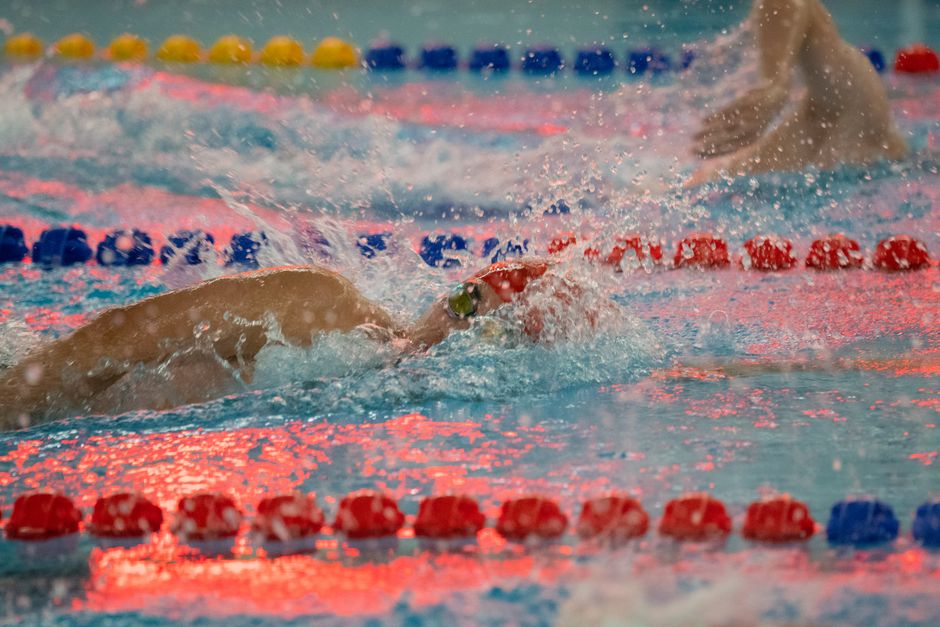
You are behind the blocks, the hall is loud, and the 400 free you have swum a hundred times in training suddenly feels like a different race. Or you are standing on a beach at dawn, looking at a cold, choppy course and a long way to the first buoy. Every swimmer knows some version of that moment, from a club meet to an open-water start. Swimming mental training means practicing the skills between your ears (focus, confidence, routines, pacing decisions, handling nerves) the way you practice your turns. This page is for swimmers, parents and coaches. It is about mental performance, which is different from mental health; there is a clear section on that difference below.
Quick answer: Mental skills are trainable habits: a short routine behind the blocks, simple imagery of the race, small goals you control, and a plan for what you do after a bad swim. Research on these tools is promising but not settled, and none of them guarantees a faster time. If worry, low mood, or trouble eating or sleeping lasts more than a couple of weeks or gets in the way of daily life, see a doctor, licensed psychologist or other qualified professional, and in a crisis call or text 988 (US).
Confidence: built from sets, not slogans
Sport psychologists often call confidence self-efficacy: your belief that you can do a specific thing, such as hold your pace through the third 100. It grows mostly from evidence you can point to, like completed main sets, race-pace repeats and personal bests. A 2026 study of 147 trained youth swimmers in Spain (López-Hernández and colleagues, Frontiers in Psychology) found that higher self-confidence before meets went with lower perceived fatigue, and that both confidence and perceived fatigue predicted how satisfied swimmers were afterward. Anxiety added little on its own. It was an observational study, so it shows a link, not a cause.
A practical habit: after every session or meet, write down two things that went well, even after a bad swim. It gives your confidence something real to stand on the next time a taper feels flat.
Focus and attention: stay in your own lane
Swimming is unusual: your eyes see a black line, your ears are full of water, and you spend minutes with your own thoughts. Focus can mean counting strokes, feeling the catch, or holding a tempo, and it can wander to the clock, to the swimmer next to you, or to how much is left. In a 2026 study of 280 adult swimmers whose main event included the 400 m freestyle (Luo and Xu, Frontiers in Psychology), swimmers with higher trait mindfulness tended to report better attentional control and more “flow” in the race, with attention accounting for about 43% of that link. The study did not find that flow predicted how evenly swimmers paced, and it was not a trial, so treat it as a clue about how attention and race experience fit together.
A simple version for training: pick one cue per set (long stroke, quick turn, relaxed kick) and return to it each time your mind drifts. Drifting is normal. Noticing and coming back is the skill.
Motivation and goal setting
Swimmers stay motivated through long seasons of early mornings when goals feel like their own. A common approach is to split goals into three kinds: outcome (make the final or hit a qualifying time), performance (go a certain split in a practice 200) and process (hold my streamline off every wall, breathe to both sides). Process goals are fully in your control, so they hold up on a day when the watch disappoints. Write down one process goal per session and check it off afterward. Training load, sleep and recovery matter too; see our swimming training guide and swimming recovery guide.
Visualization and imagery
Imagery means rehearsing a swim in your mind, using as many senses as you can: the shock of the water at the start, the rhythm of your breathing, the feel of the wall under your feet at the turn. A 2023 systematic review and meta-analysis of psychological interventions across sports (Reinebo and colleagues, Sports Medicine) found moderate effects for imagery, multimodal psychological skills training and mindfulness-based approaches compared with controls. But the authors report that the effects were not stable: when non-randomized trials and subjective outcomes were removed, they were no longer significant. Imagery is best seen as a low-cost add-on to real swimming, not a replacement for it.
- Try 3 to 5 minutes before bed or on the pool deck: see and feel yourself swimming your race, from the dive through the finish touch.
- Rehearse the hard moments too: a fast opponent on your outside lane, a bad turn, choppy water at an open-water swim, and then your calm response.
- Not everyone sees vivid pictures in their mind. If yours are faint, try feelings and sounds instead.
Pre-race routines
Watch good swimmers behind the blocks: the same shake-out, the same goggle check, the same breath. A pre-performance routine is a short, fixed sequence that gets you ready and shuts out noise. A 2026 position statement from Exercise and Sports Science Australia on performance under pressure (Schweickle and colleagues, Sports Medicine) lists pre-performance routines among the evidence-based strategies, along with psychological skills training and mindfulness-based approaches.
- Behind the blocks: two or three steps you can repeat in the time the officials allow, for example shake out, goggles, one slow breath, one cue word. Use it at every practice start, not just at meets.
- Meet-day routine: the same warm-up order, the same music or quiet time. For food, fluids and meet logistics, see our swimming meet day guide.
- Open-water start: a plan for the first 200 m (where to line up, when to settle into rhythm) rehearsed in practice. Safety and course details are in our open-water swimming guide.
Handling pressure and nerves
Nerves before a race are normal. The same ESSA position statement says pressure can have both helpful and harmful effects on performance, and that training environments which add some pressure can help prepare athletes. In the pool that might mean a timed set with teammates watching, a mock “final” with lanes seeded, or racing a faster lane partner. Keep it safe and fair so it builds readiness rather than fear.
Mindfulness and breathing are popular tools. In a 2026 randomized trial of 30 elite swimmers in China (Su and colleagues, Behavioral Sciences), an 8-week mindfulness-acceptance program was linked to lower psychological strain and salivary cortisol and better self-reported sleep than usual practice. It is a small trial from a single program, so the results may not carry over to every swimmer. Together with the broader review above, they suggest these tools may help some swimmers; they do not show they work for everyone.
After a bad swim, a missed cut or a loss
Every swimmer has a swim that goes wrong. The useful skill is how fast you come back. Many coaches teach three steps: acknowledge it (a slow breath), learn one thing (“I went out too hard”), and move to the next job (the next event or the cool-down). Talk to yourself the way you would to a teammate. Review splits and video for lessons, not punishment.
A big goal can also leave a gap afterward. In a 2026 interview study of 30 experienced channel swimmers (Levačić and Hren, Sports Medicine – Open), swimmers described emotional lows after a swim that were linked to losing a defining goal rather than to failure, and some noticed in-swim cognitive impairment only afterward. Plan your next small goal before the big one ends, and tell a coach or friend how you are really doing.
Pacing, decisions and relays
Swimming has fewer split-second tactics than a ball sport, but decisions still matter: how fast to go out, when to move in a distance race, how to sight and draft in open water. Good decisions come from rehearsed plans: negative-split sets, race-pace practice and open-water sessions in conditions like race day. Relays add a team side: clear roles, encouraging words on the deck, and calm exchanges. For the rules behind these choices, see our swimming rules guide.
Preparing for competition
Put the mental pieces into the week before a meet: one or two imagery sessions, a practice of your behind-the-blocks routine, a clear race plan with one or two process goals, and enough sleep. Physical preparation sits in our training guide, and meals, fluids and warm-up timing in the meet day guide. If an injury is part of why you feel anxious about racing, read our swimming injuries guide, and talk to a sports medicine doctor, physical therapist or athletic trainer.
Young swimmers
Keep it light for kids: fun routines, effort goals and praise for trying. Adolescent swimmers face early mornings and heavy schedules. In a 2026 randomized crossover trial of 27 national-level swimmers aged about 15 (Brandts and colleagues, Sports Medicine – Open), starting morning sessions two hours later gave about an hour more sleep per night, though it did not significantly change recovery scores or time-trial results. Sleep is a worry for young swimmers, but one study cannot say how to schedule a team. See our youth swimming guide for age-based guidance.
Mental performance is not the same as mental health
Everything above is about performance skills. Anxiety disorders, depression, disordered eating and burnout are health matters, not mindset problems, and they are not fixed by a better routine. The 2026 International Olympic Committee consensus statement on mental health in elite athletes (Reardon and colleagues, British Journal of Sports Medicine) treats them as medical and psychological care issues. Signs to take seriously include worry or low mood lasting weeks, panic before practice, withdrawing from friends, big changes in eating or sleep, or dreading training you used to enjoy.
Start with your doctor, a licensed psychologist or other qualified mental health professional. In the US, you can call or text 988 (Suicide & Crisis Lifeline) at any time. For disordered eating, the nutrition side is in our nutrition and supplements guide, but a clinician should lead care.
Frequently asked questions
Does visualization really help swimmers?
A 2023 review across sports found moderate benefits for imagery, but the effects were not stable once weaker studies were removed. It works best alongside real swimming.
How do I stop dwelling on a bad swim?
Pick a reset cue, such as a slow breath or one word, and rehearse it in practice. Then take one lesson from the swim and turn to your next event or set.
Is meet-day anxiety normal?
Some nerves are common, and the ESSA statement says pressure can have helpful as well as harmful effects. If worry is constant, causes panic, or disrupts sleep or eating, talk to a doctor or licensed mental health professional.
How do I stay focused in a long open-water swim?
Many swimmers use a simple cue, like counting strokes or checking breathing rhythm, and return to it when attention drifts. Research on mindfulness and attention in pool swimmers is encouraging but early. Safety comes first; see our open-water guide.
Should my young swimmer see a sport psychologist?
Most kids need fun, supportive coaching, not a specialist. If a child shows lasting distress, start with their pediatrician or a licensed mental health professional.
Sources
- Reinebo G et al. Effects of Psychological Interventions to Enhance Athletic Performance: A Systematic Review and Meta-Analysis. Sports Medicine, 2023. PMID 37812334
- Luo L, Xu B. Trait mindfulness and competitive-race flow in swimmers: the mediating role of attentional control. Frontiers in Psychology, 2026. PMID 42898157
- López-Hernández A et al. Self-confidence and perceived fatigue as predictors of performance satisfaction in trained swimmers. Frontiers in Psychology, 2026. PMID 42111596
- Su N et al. Effects of Mindfulness-Acceptance-Insight-Commitment (MAIC) Training on Stress and Sleep Quality in Elite Swimmers. Behavioral Sciences, 2026. PMID 42510189
- Levačić D, Hren D. Health, Risk and Adaptation in Extreme Open Water Swimming: A Qualitative Study of Channel Swimmers. Sports Medicine – Open, 2026. PMID 43013196
- Brandts MME et al. Delaying Early Morning Training Time in Swimmers: Effects on Sleep, Recovery and Performance. Sports Medicine – Open, 2026. PMID 42518003
- Schweickle MJ et al. Performance Under Pressure in Sport: A Position Statement from Exercise and Sports Science Australia. Sports Medicine, 2026. PMID 42271117
- Reardon CL et al. Mental health in elite athletes: International Olympic Committee consensus statement (2026). British Journal of Sports Medicine. PMID 42580854
- 988 Suicide & Crisis Lifeline
General information for education only, not medical advice. It does not replace a doctor, psychologist or other qualified professional. See how we work in our editorial policy. Back to the swimming hub.