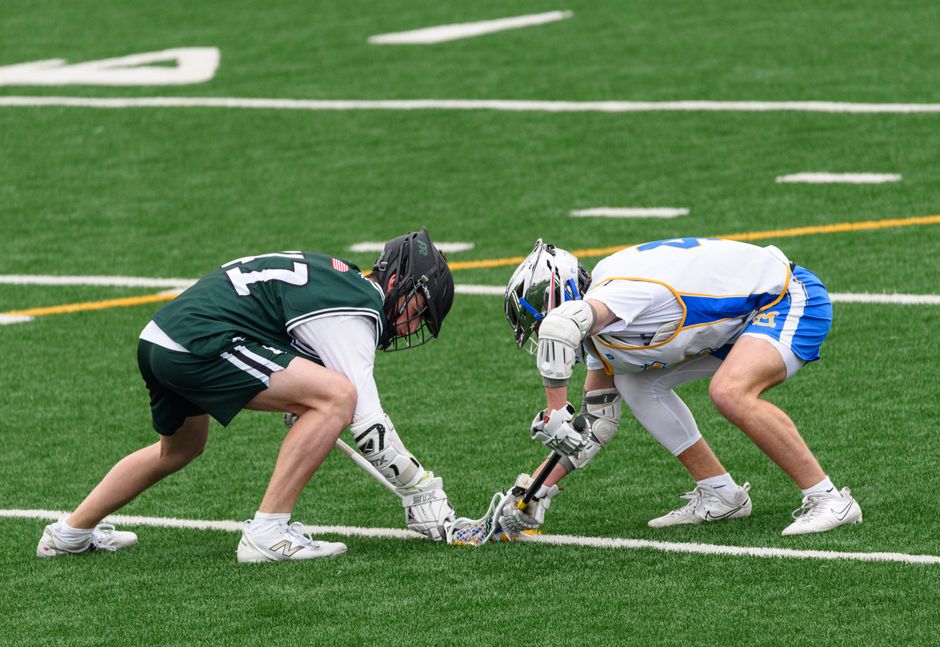
Eight seconds left, down by one, and the ball is on your stick at the top of the box. A slide is coming from your left, a teammate is cutting on the crease, and the goalie is already shifting. Whatever you do next gets decided in a fraction of a second, long before you have time to think it through. Lacrosse mental training means practicing the thinking side of the game (where to look, how to choose, how to settle after a bad pass) the way you practice cradling and shooting. This page is about mental performance. Mental health is a different subject and has its own section below.
Quick answer: Mental skills in lacrosse are habits you can practice: a steady routine before a shot or a clear, a quick scan before you catch, short calls with teammates, and a one-breath reset after a mistake. The research on tools such as imagery, routines and perceptual training is small and mixed, and very little of it is on lacrosse players, so none of it guarantees a better result. See a doctor, licensed psychologist or other qualified professional if worry, low mood, or problems with sleep or eating last more than a couple of weeks or get in the way of daily life, and call or text 988 in a crisis (US).
Focus under pace
Lacrosse is an open-field, invasion sport, and a 2025 study of Division III men’s players (Moore and colleagues, International Journal of Exercise Science) tracked how much ground players cover and how hard they work in games. Defensive players showed higher total distance and work rate against stronger opponents, while attack, midfield and the goalie and face-off specialists did not. That is a physical finding, but it points at a mental one: as fatigue builds, the job of staying locked in gets harder, and it does so unevenly by position.
Speed also changes accuracy. In a 2025 study of 22 female university players (Tomioka and colleagues, Journal of Functional Morphology and Kinesiology), passes to a small target from 11 meters got less accurate and less consistent as players moved from warm-up speed to game intensity to full effort, and skilled players showed smaller errors than unskilled players. It is a small sample, but it fits a practical idea: practice passing and shooting at game speed, and know that your fastest effort is not always your best one.
The ESSA position statement on performance under pressure (Schweickle and colleagues, Sports Medicine, 2026) lists four strategies with evidence behind them: pre-performance routines, implicit attentional strategies, psychological skills training and mindfulness-based approaches. It also says pressure can help or hurt, depending on the person and the moment. A simple routine for lacrosse is a set cue before each faceoff, free position or clear: a breath, one look at where you want the ball to go, then go. Build it in practice so it is automatic when the game is loud.
Decision-making when the game is fast
A 2024 systematic review and meta-analysis of 22 studies in team sports (Zhu and colleagues, Behavioral Sciences) found that perceptual-cognitive training, the kind that trains anticipation and decisions with video or screen drills, improved elite athletes’ anticipation and decision-making. The gain carried over to real-game performance, but by less than it showed in the lab. The authors suggested that training works better when the player responds with sport-specific movements. The review covered team sports in general, so it says nothing specific about lacrosse.
Coaches commonly suggest, as practice rather than a studied recipe, building decisions into small-sided drills: a 3-on-2 or 4-on-3 fast break, a ground-ball scrap that turns into a clear, a man-up set where the first look is decided before the pass arrives. Fewer players means more touches and more decisions per minute than a long line drill. A useful habit is to scan before the ball reaches your stick, so your next move is already half-chosen when you catch.
Imagery and shooting
One lacrosse-specific study (Hirao and Masaki, Frontiers in Psychology, 2020) split 33 male players into three groups. The authors report that combining computer-based attention tasks with motor imagery training could effectively increase players’ scoring ability on a shooting test. It was a small trial with five sessions and a lab-style task, so treat it as an interesting lead, not a plan.
If you want to try imagery, keep it short and concrete: a few minutes before practice, picture the cradle, the dodge, the release and where the ball ends up, from your own eyes, at the speed you would really play. Combine it with physical reps, not instead of them.
Goalie mindset
The goalie is the one player who is judged most visibly by single moments, and also the player who sees the whole field. We did not find lacrosse-specific research on goalie mental skills, so this section is general and says so. The ESSA statement’s tools (a routine before each restart, focus on the next shot rather than the last, practice under mild pressure) apply to any position, and coaches commonly build them into goalie sessions.
- Short memory, long view. A goal against is one event. A reset cue (breath, tap the stick, name your next job) belongs to the goalie as much as the field player.
- Use your view of the field. Calling out slides and where the ball is going is both a team job and a way of staying engaged during quiet stretches.
- Practice under pressure. Scoring games in practice, where every save counts, give a goalie the kind of mild pressure the ESSA statement says can prepare athletes for competition.
Resetting after a mistake
A 2026 analysis of more than 270,000 passes by professional soccer players (Wilson and Park, Frontiers in Psychology) found that a player’s chance of an unforced passing error was higher right after an earlier error, and that teammates taking the next pass also erred slightly more often. Most of the escalation came from riskier pass choices rather than worse technique. It was soccer, not lacrosse, but it hints at a lacrosse habit: after a turnover or a missed shot, the next decision is the risky one, so slow down, take the simple option and let the next play be easy.
- Pick one reset cue and use it in scrimmages first, so it is there on the field.
- Name your next job in a few words, such as “ride,” “pick up the ball,” or “next clear.”
- Review the mistake later, in the film room or on the drive home, not in the middle of the game.
Teamwork and communication
We found no lacrosse-specific study of team cohesion or communication that we could use here. The soccer data above does suggest mistakes can spread to teammates, which is a reason to keep talk about the next play, not the last one. Common coaching practice is to agree on short calls in advance (a slide call, a ball call, a clear call) and to make sure every player, including the goalie and the bench, knows what each call means.
Preparing for competition
Preparation is partly mental and partly logistics. Keep your pre-game routine the same in practice and in games: same warm-up order, same cue before the first draw, same few minutes to yourself. Eating, drinking, heat and tournament weekends are covered on our lacrosse game day page, so we do not repeat them here. For the training side, see lacrosse training, and for rest between games, lacrosse recovery. For parents and coaches working with younger players, our youth lacrosse page covers how the youth game is set up; we found no lacrosse-specific research on mental-skills training by age, so this page gives no age rules.
Mental performance is not mental health
Routines, imagery and focus cues are performance skills. Anxiety, depression, disordered eating and burnout are health matters, and they are not fixed by a better pre-game routine. The 2026 IOC consensus statement on mental health in elite athletes (Reardon and colleagues, British Journal of Sports Medicine) says mental health symptoms and disorders are common among elite athletes, can affect performance, and can be treated, and that many athletes can keep competing with appropriate support. If worry, low mood, loss of interest, or problems with sleep or eating last more than a couple of weeks or get in the way of school, work or relationships, talk to a doctor, a licensed psychologist or another qualified professional, or to your school or team’s athletic trainer or counselor.
In the US, you can call or text 988 (the 988 Suicide & Crisis Lifeline) at any time if you or someone you know is in crisis. Outside the US, use your local emergency number or crisis line. For other conditions that affect athletes, see our lacrosse injuries page.
Lacrosse mental training FAQs
How do I stay focused when the game is fast?
Use a simple routine before each restart, scan before you catch, and practice at game speed. The ESSA position statement lists routines, attentional strategies, skills training and mindfulness as options with some support, but none is a guarantee.
How do I shake off a bad turnover?
Pick one reset cue, name your next job, and take the simple play next. A 2026 soccer study found errors were more likely right after an earlier error, mostly through riskier choices, so slowing the next decision is a sensible habit.
Does imagery help lacrosse shooting?
One small 2020 study of 33 male players found imagery plus an attention task was linked with better shooting scores. It is early evidence, so treat imagery as an extra to physical practice.
What mental skills matter most for a lacrosse goalie?
We found no lacrosse-specific goalie research. General tools, such as a reset cue after goals, focus on the next shot and practice under mild pressure, are used by coaches and fit the ESSA statement’s advice.
Is feeling nervous before a game a sign something is wrong?
Nerves before a big game are common. If worry is constant, comes with low mood, sleep or eating problems, or does not ease, see a doctor or qualified mental health professional. That is a health question, not a performance tip.
Can mental training guarantee I will play better?
No. No technique guarantees results, and studies on these tools are often small or mixed. Treat them as habits to try and keep what works for you.
Sources
- Schweickle MJ et al. Performance Under Pressure in Sport: position statement, Exercise and Sports Science Australia. Sports Medicine, 2026. PMID 42271117
- Moore PM et al. External loads in Division III men’s lacrosse, high versus low competition matches. International Journal of Exercise Science, 2025. PMID 39917057
- Tomioka S et al. Directional and skill-level differences in the speed-accuracy trade-off during lacrosse passing. Journal of Functional Morphology and Kinesiology, 2025. PMID 41562727
- Zhu R et al. Effects of perceptual-cognitive training on anticipation and decision-making in team sports: systematic review and meta-analysis. Behavioral Sciences, 2024. PMID 39457791
- Hirao T, Masaki H. Computer-based and motor-imagery training and scoring ability in lacrosse. Frontiers in Psychology, 2020. PMID 32848992
- Wilson MR, Park SH. Error sequences, contagion and individual vulnerability in professional football. Frontiers in Psychology, 2026. PMID 43005041
- Reardon CL et al. Mental health in elite athletes: IOC consensus statement (2026). British Journal of Sports Medicine. PMID 42580854
- 988 Suicide & Crisis Lifeline
General information for education only, not medical advice. It does not replace a doctor, psychologist or other qualified professional. See how we work in our editorial policy. Back to the lacrosse hub.