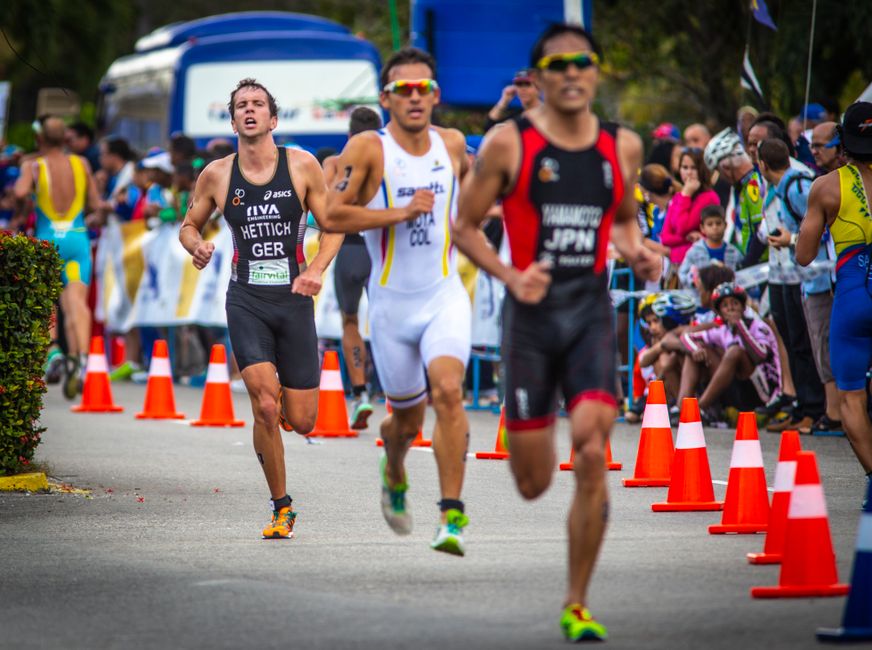
The horn goes, forty arms hit the water at once, and somewhere around the first buoy your breathing stops feeling like yours. Many triathletes know that moment, and others meet a different one hours later, when the run begins and the legs feel like someone else’s. Mental training for triathletes is the practice of using attention, self-talk, routines and planning to manage nerves and effort across three sports in one race, from a sprint to a long-course day. It does not replace fitness or open-water skill, and it cannot promise a faster finish.
Quick answer: The best-supported mental tools for triathletes are a pacing plan built on effort, short positive self-talk, goals you can adjust, and a simple routine for the hour before the start. Research on triathletes is mostly surveys and small studies, so none of this guarantees a result. See a doctor or a licensed mental health professional, not only a coach, if anxiety, low mood, disordered eating or exhaustion are affecting daily life, and stop and signal for help in the water if something feels wrong.
General information for triathletes. Back to the triathlon hub. Fueling, heat and race morning logistics are on our race day page, and the physical side of preparation is on the triathlon training page.
What triathletes say they actually do
A survey of 401 triathletes (Dolan and colleagues, 2011, Journal of Sports Sciences) found that most set training and competition goals and used mental preparation strategies in training and in the hour before racing, with positive self-talk the most commonly used. Women were more likely than men to use mental strategies and to report feeling anxious before competitions, and the athletes were more likely to consult a triathlon coach than a sport psychology professional. Surveys describe habits, not what works, but they show that nerves are a normal part of the sport.
Race nerves and the open-water swim
Pre-race tension is common. In a study of 592 age-group triathletes (Parsons-Smith and colleagues, 2022, Frontiers in Psychology), average Tension scores before a race were somewhat above general population norms, women scored higher than men, and the 18 to 35 age bands scored higher than the 46 to 55 band. Pre-race mood did not predict finish time against the athlete’s own time goal. An older study of 175 male triathletes (Lane and colleagues, 1995, Perceptual and Motor Skills) found that anxiety scores did not predict performance either, while recent form did. In plain words: feeling nervous does not mean the race will go badly.
We did not find a published study that tests a specific method for open-water swim panic, so what follows rests on the rules of the sport and on common coaching practice, which we label as such.
- You are allowed to rest. USA Triathlon’s competition rules (2026) say swimmers may use any stroke, tread water, float, or rest while holding a buoy or a stationary boat, and in an emergency should raise an arm and call for assistance. Knowing that before the start can lower the pressure to “never stop.”
- Start wide or at the back if crowds unsettle you. This is common coaching advice, not a tested intervention. Many races use wave or rolling starts, which can also help.
- Practise the conditions in training: cold water, a wetsuit, swimming alongside others, sighting. Familiarity is the idea, and our triathlon gear page covers wetsuits and safety equipment.
- Use a slow, steady breathing cue such as a long exhale, and a short phrase such as “easy, long, smooth.” Both are widely taught, not proven for open water.
One firm point about safety: nerves and a medical problem can feel alike. A 2017 case series in Annals of Internal Medicine (Harris and colleagues) of deaths and cardiac arrests in US triathlons found that most sudden deaths and cardiac arrests happened during the swim. Unusual chest pain, dizziness, or breathlessness that does not settle is a reason to stop, signal and get help, not to push through. The triathlon injuries page covers swim safety in more detail.
Pacing across three disciplines
A 2014 review in Open Access Journal of Sports Medicine (Wu and colleagues) explains that triathlon asks athletes to spread effort within each discipline and across the whole event, and that pacing is shaped by many internal and outside factors, with most research on Olympic distance and much less on sprint, half and full Ironman distances. The mental part is following the plan when the first discipline feels easy and the crowd is moving fast.
- Decide your opening rule per discipline before the start, for example “the swim should feel controlled” and “the first run kilometres will feel too slow.” Our triathlon wearables guide compares tools for checking effort.
- Expect the first run minutes to feel strange. A review by Millet and Vleck (2000, British Journal of Sports Medicine) describes that cycling to running changes breathing, heart rate and running cost, with a forward-leaning posture the most notable change. It is normal, and it settles for many athletes.
- Start the run a little conservatively. In a small laboratory study of ten highly trained men (Hausswirth and colleagues, 2010, European Journal of Applied Physiology) running the first kilometre of an Olympic-distance triathlon run about 5% slower than their control 10-km pace gave faster overall run times than starting 5% faster or 10% slower. Ten highly trained men is a small sample, so treat it as a reason to hold back early, not as a formula.
- Check effort, not only speed. Ross Tucker’s review (2009, British Journal of Sports Medicine) describes how the brain regulates self-paced exercise using perceived exertion, setting effort in anticipation of how much remains. Wind, current, hills and heat change speed without changing what your body is doing.
Transitions: a routine, not a rush
Millet and Vleck note that technical skill in the transition area is very important, and that the higher an athlete is placed at the end of the bike, the more a quick transition matters. We found no study of mental routines for transitions, so the rest is common practice. Many athletes walk through the transition area the day before, rehearse the order of tasks (helmet, shoes, rack, go), and use a single cue word at each switch to clear the previous leg from their mind. Mistakes in transition, such as a missed helmet strap, can cost penalties, so the triathlon rules page is worth a read. Calm and accurate usually beats fast and flustered.
Self-talk, focus and goals
A 2011 meta-analysis of 32 studies (Hatzigeorgiadis and colleagues, Perspectives on Psychological Science) found a moderate positive effect of self-talk on sports performance, with more benefit for fine skills and new tasks than for well-learned, gross movements. Endurance pacing is closer to the second kind, so keep expectations modest. Pick two or three short phrases in training and use them on tired sessions so they feel natural on race day.
For goals, an expert statement for Exercise and Sports Science Australia (Swann and colleagues, Sports Medicine, 2026) cautions against relying on the SMART acronym alone and says goal setting needs awareness of its risks and pitfalls. A common coaching idea is a goal ladder: an A goal if everything goes right, a B goal for a solid day, and a C goal to finish safe and healthy. This suits triathlon, where cold water, heat, a flat tyre or a rough swim can change the plan.
Mental toughness, flow and the long-race mindset
In 114 high-performing Ironman and standard distance triathletes (Meggs and colleagues, 2019, Perceptual and Motor Skills), higher mental toughness scores went with higher self-rated performance and with more dispositional flow, the absorbed, in-the-zone state. This was a correlation in a small group, not proof that building mental toughness causes better results.
For races lasting many hours, common coaching practice is to break the day into chunks (the next aid station, the next feed, the next lap), to plan when you will eat and drink so that fuelling is a job and not a decision (see our nutrition page), and to expect a low patch and a recovery after it. These are widely used ideas that we could not tie to a triathlon study. Training your body to handle the day, covered on the training page, is the base of a steady head.
After the finish line, feelings can swing. A 2024 interview study of 16 recreational endurance athletes (Augustsson and colleagues, BMC Sports Science, Medicine and Rehabilitation) described both a “high on life” feeling and loss of energy, ambivalence and melancholy afterwards, and suggested that setting future goals before an event may reduce the risk of post-race blues. Plan something small to look forward to, and see our recovery page for the physical side.
Imagery and a pre-race routine
Mental imagery means rehearsing the race in your mind: the swim start, the first buoy, the dismount line, the first run kilometre. A 2026 scoping review in Frontiers in Psychology (Zhao and colleagues) looked at imagery for stress management in athletes, found it widely used, and noted that the term covers several different things. It is popular and plausible, but the evidence is still being mapped. Five minutes picturing the course and how you will respond to problems, such as a kicked goggle or a dropped chain, is a low-cost extra. Keep the routine short and the same every race.
Youth considerations
For young athletes, a 2025 paper in the British Journal of Sports Medicine (Goddard and colleagues) asks whether goal setting in youth sport may unintentionally contribute to dropout, which is a reason to favor effort and enjoyment goals over results. Age-appropriate distances and rules are on our youth triathlon page.
Mental health is not the same as mental performance
Everything above is about performance skills. Anxiety disorders, depression, disordered eating and burnout are health matters, not mindset problems, and they need a qualified professional. Mood data in triathletes can show tension before races, but the Parsons-Smith study cautions that mood relates to mental health as well as performance. If worry feels constant, sleep or eating is disrupted, or training has become compulsive, talk to a doctor or licensed mental health professional. The International Olympic Committee consensus statement on mental health in elite athletes (Reardon and colleagues, 2019, British Journal of Sports Medicine) is a good starting point for what support exists. In the US, call or text 988 to reach the Suicide and Crisis Lifeline if you are in crisis. The Association for Applied Sport Psychology lists qualified consultants for performance work.
Frequently asked questions
Is it normal to panic in the swim?
Pre-race nerves are common among triathletes. USA Triathlon’s rules let you float, rest on a buoy or raise an arm for help. If breathlessness or chest discomfort is unusual for you, treat it as a medical signal, not just nerves.
Does feeling nervous mean I will race badly?
Not necessarily. Studies of triathletes (Lane 1995; Parsons-Smith 2022) did not find that anxiety or pre-race mood predicted performance.
How should I pace the run after the bike?
One small study of trained men found that a first kilometre about 5% slower than 10-km pace gave better overall run times (Hausswirth 2010). Your own coach or a trial run in training is the best guide.
Does visualization work?
It is widely used, but reviews say the evidence is still developing. Short, regular sessions are a sensible way to try it.
Why do I feel flat after a big race?
Many endurance athletes report it (Augustsson 2024). If low mood lasts or deepens, talk to a doctor or licensed mental health professional.
Sources
- Dolan SH, Houston M, Martin SB. Survey results of the training, nutrition, and mental preparation of triathletes. J Sports Sci 2011 (doi, PMID 21623532)
- Parsons-Smith RL et al. Mood profiles of amateur triathletes: implications for mental health and performance. Front Psychol 2022 (doi, PMID 36452384)
- Lane AM, Terry PC, Karageorghis CI. Path analysis examining relationships among antecedents of anxiety, multidimensional state anxiety, and triathlon performance. Percept Mot Skills 1995 (doi, PMID 8684922)
- USA Triathlon Multisport Competition Rules, 2026 (PDF)
- Harris KM et al. Death and cardiac arrest in U.S. triathlon participants, 1985 to 2016. Ann Intern Med 2017 (doi, PMID 28975231)
- Wu SS et al. Factors influencing pacing in triathlon. Open Access J Sports Med 2014 (doi, PMID 25258562)
- Millet GP, Vleck VE. Physiological and biomechanical adaptations to the cycle to run transition in Olympic triathlon. Br J Sports Med 2000 (doi, PMID 11049151)
- Hausswirth C et al. Pacing strategy during the initial phase of the run in triathlon. Eur J Appl Physiol 2010 (doi, PMID 20024576)
- Tucker R. The anticipatory regulation of performance. Br J Sports Med 2009 (doi, PMID 19224911)
- Hatzigeorgiadis A et al. Self-talk and sports performance: a meta-analysis. Perspect Psychol Sci 2011 (doi, PMID 26167788)
- Swann C et al. Goal setting in exercise and physical activity: an expert statement for Exercise and Sports Science Australia. Sports Med 2026 (doi)
- Meggs J, Chen MA, Koehn S. Relationships between flow, mental toughness, and subjective performance perception in various triathletes. Percept Mot Skills 2019 (doi, PMID 30470159)
- Augustsson SR, Bergh M, Petersson K. Post-race reactions: the emotional paradox of high performance and anxiety. BMC Sports Sci Med Rehabil 2024 (doi, PMID 39198888)
- Zhao L, Wang Y, Anuar N. Mapping the use of mental imagery for stress management in athletes: a scoping review. Front Psychol 2026 (doi)
- Goddard SG et al. Goal setting in youth sport: are we unintentionally contributing to dropout? Br J Sports Med 2025 (doi)
- Reardon CL et al. Mental health in elite athletes: IOC consensus statement (2019). Br J Sports Med 2019 (doi, PMID 31097450)
- 988 Suicide and Crisis Lifeline (988lifeline.org)
- Association for Applied Sport Psychology resources (appliedsportpsych.org)
General information for education only, not medical advice. It does not replace a doctor, licensed mental health professional or qualified coach. See our editorial policy for how we research and write.