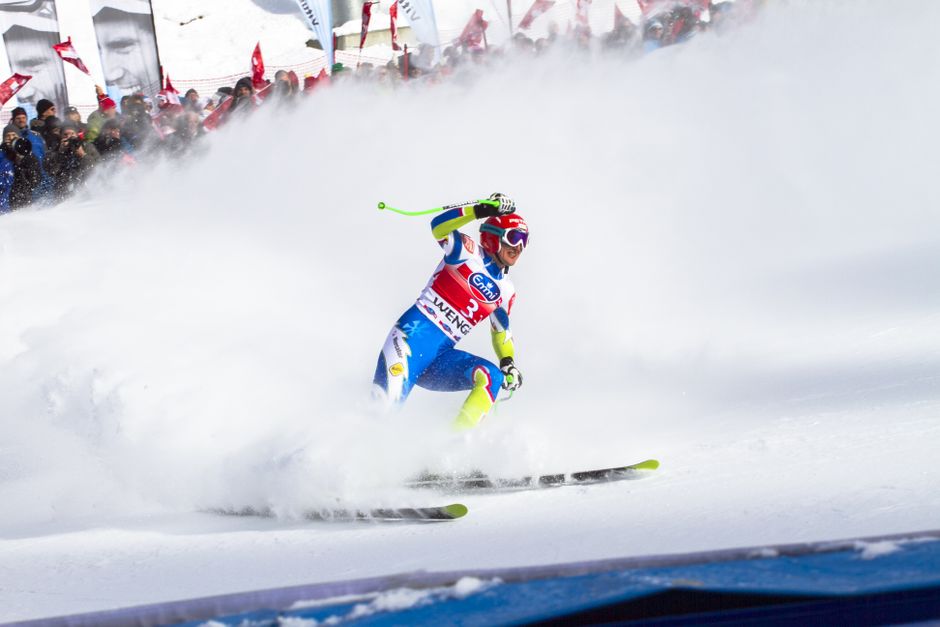
You are in the start house, boots clicked in, listening to the beep countdown and the muffled cheering from the finish. Or you are standing at the top of a blue run you have never skied, looking at the roll-over where the slope disappears and trying to decide whether to go. Fear on a steep slope is not a flaw; it is information. Ski mental training means practicing the skills between your ears (reading terrain, managing fear, rehearsing a course, settling a race-day routine, rebuilding after a fall) the way you practice turns. This page is about mental performance for recreational skiers, ski racers and coaches. Mental performance is not the same as mental health; see the section below.
Quick answer: Fear on steeper terrain is useful information; good skiers manage it with preparation, terrain choices and a plan, not by ignoring it. Imagery of a course, a fixed pre-start routine and patient steps back onto the snow after a fall are common tools, but research on them in skiing is small and none of them guarantees a faster run or a safer day. If worry, low mood or trouble eating or sleeping lasts more than a couple of weeks, or a fall has left you with headaches, confusion or other injury symptoms, see a doctor or other qualified professional; in a crisis call or text 988 (US).
Fear and risk on steeper terrain
We did not find a published program that trains skiers to handle fear on steep terrain, so this section mixes what researchers have measured about risk with ordinary coaching practice, and says which is which.
On the research side, a 2022 questionnaire study in Germany (Frühauf and colleagues, International Journal of Environmental Research and Public Health) compared junior freeriders, adolescent alpine ski racers and adult freeriders. Accident and close-call involvement did not differ between the groups, but deliberate risk-taking was lower in adult freeriders than in junior freeriders and alpine skiers, and the authors called for risk education for teenagers that goes beyond listing mountain dangers. A 2026 survey of 4,792 North American backcountry skiers and snowboarders (Shonnard and colleagues, Wilderness & Environmental Medicine) found that confidence in assessing avalanche terrain rose along with willingness to take risks, avalanche training and experience, and that over 30% of respondents without level 1 avalanche training still felt confident appraising complex terrain. Both are questionnaires; feeling confident and being right differ.
For competitive alpine racing, an international panel co-developed a risk management framework (Bonell Monsonís and colleagues, BMJ Open Sport & Exercise Medicine, 2025) built around three steps: identify the risk, assess it, then reduce it. It is not a mental drill, but the three steps suit any mountain. Coaching ideas that fit it:
- Choose the slope before the slope chooses you. Step up in pitch one run at a time, on terrain and snow you can read, with the same partner who can see you. Our skiing training page covers building the legs for it.
- Separate fear from danger. Ask which it is: a real hazard (ice, a cliff band, a crowded cat track, weather) or only unfamiliarity. Hazards change the plan; unfamiliarity may only need a slower first look. A coaching habit, not a tested method.
- Have a bail-out. Know before you drop in where you will stop, traverse or side-slip.
- Learn with a good teacher. A 2026 cluster-randomized trial of 216 novice skiers in China (Gao and colleagues, Frontiers in Psychology) found that autonomy-supportive instruction, which gives learners choices, produced bigger gains in skill, self-efficacy and mental toughness over three weeks than conventional teaching.
Shared rules are on our skiing rules and etiquette page; in the backcountry, avalanche training and a qualified guide matter more than any mindset tip here.
Confidence after a fall or injury
A hard fall can leave sore knees and a shaken nerve. First comes the body: the CDC HEADS UP guidance says an athlete with a suspected concussion should stop and see a health care provider. Our skiing injuries page and skiing recovery page cover the body.
After that, the mind often needs time as well. A 2026 systematic review of 14 studies of competitive athletes (Rajpoot and colleagues, Sports) found that in seven groups of athletes with ACL injuries, higher psychological readiness to return, measured with the ACL-RSI questionnaire, predicted a successful return to sport at 6 to 24 months. Two studies found contrasting links with a second ACL injury. In skiing specifically, a 2026 scoping review of return to performance after ACL injury in competitive alpine skiing (Spörri and colleagues, Scandinavian Journal of Medicine & Science in Sports) noted that there is little evidence on the psychological and social factors that shape the return, and proposed a stepwise return on snow. The International Ski and Snowboard Federation (FIS) also published a 2026 return-to-performance consensus statement with 196 expert statements (Spörri and colleagues, BMJ Open Sport & Exercise Medicine); we read only its abstract, so we do not summarize it. In a small 2026 study of 34 skiers and snowboarders after ACL reconstruction (Altay and colleagues, The Knee), 47.1% returned to their pre-injury sport; time away from work and older age were the strongest predictors, and fear of movement was not significant.
Let your clinician or physical therapist decide when your body is ready, and treat confidence as its own gradual job. Common coaching ideas:
- Step back, then up. Return to terrain you already know on an easy day before the steeper runs. This echoes the stepwise return in the Spörri review, but is no individual prescription.
- Use small goals. Three clean turns on a green run, then a full blue run.
- Say so. If fear is strong and does not ease, tell your coach and clinician; a qualified professional can help.
Visualization of courses and runs
Imagery means rehearsing a run in your mind with as many senses as possible. In a 2025 study (Volgemute and colleagues, Frontiers in Psychology), nine alpine skiers did a six-month guided imagery program alongside their regular on-snow training, and their imagery ability scores and performance indicators rose. With nine skiers and a before-and-after design, it cannot show the imagery caused the change; the same paper found stronger imagery ability among higher-achieving athletes across 500 athletes of various sports.
Race courses give imagery a natural script: after inspection, many coaches have racers close their eyes and ski it in their mind, including the hard turns. That is common practice, not a studied formula. Freeride competitors take it further: according to a 2025 perspective article (Mulder and colleagues, Frontiers in Physiology), they descend complex slopes based only on visual inspection, without practice runs, so the line they picture from the top is the one they have to ski.
- Try 3 to 5 minutes the night before and again in the start area. That length is a coaching suggestion, not a researched dose.
- Picture the run at real speed, including a bobble and the calm return to your line.
- Imagery adds to real runs; it never replaces them.
Race-day routines and focus
A routine is a short, fixed sequence that gets you ready and cuts noise: the same warm-up, the same boot buckle order, a few breaths at the gate. A 2026 position statement from Exercise and Sports Science Australia on performance under pressure (Schweickle and colleagues, Sports Medicine) lists pre-performance routines among its evidence-based strategies, along with psychological skills training and mindfulness-based approaches. It covers sport in general, not skiing. The FIS consensus statement on warm-up and cool-down (BMJ Open Sport & Exercise Medicine, 2025) covers physical and psychological warm-up for competitive skiers; we read only its abstract, so we do not repeat its recommendations. For meals, fluids, inspection timing and gear, see our ski day and race day page.
What can be shaped between runs? A few common coaching habits: pick one focus for the next run (for example, “quiet upper body in the steep”), have a reset cue after a mistake, and leave a wasted run behind you. A 2026 narrative review (Boraxbekk and colleagues, Scandinavian Journal of Medicine & Science in Sports) argues that updating working memory in changing terrain is central to elite alpine skiing, but it offers a research framework, not a training method.
Motivation, goals and handling pressure
A 2025 study of 332 college skiers across four ski events (Wu and colleagues, Behavioral Sciences) found that a team climate focused on learning and improvement (a task-involving climate) was linked with better psychological need satisfaction and greater mental toughness, while a climate focused on beating teammates was linked with lower mental toughness. It shows associations only; clubs and parents can praise effort and learning, not only podium finishes.
Coaches often split goals into outcome (make the team), performance (cut two seconds from the flat section) and process (hold the line through the third gate). Process goals are within your control on a day when the snow, the course or the result is not. That split is coaching practice, not one study’s finding. The ESSA statement above also lists practicing under pressure among its strategies.
Youth skiers
In the German study above, teenage alpine skiers and junior freeriders reported more deliberate risk-taking than adult freeriders, which is why its authors favor risk education over scare talk. A 2025 cross-sectional study of 50 professional alpine skiers (Mogedano-Cruz and colleagues, Frontiers in Psychology) found that higher neuroticism and psychological inflexibility were associated with more injuries, and depressive symptoms with higher perceived injury severity. It is small and cannot show cause and effect. For age-level guidance and pathways, see our youth skiing page and our skiing leagues and associations page.
Mental performance is not mental health
Everything above is about performance skills. Anxiety, depression, disordered eating, burnout, substance use and sleep problems are health matters, and the tips on this page are not treatment. The 2026 IOC consensus statement on mental health in elite athletes (Reardon and colleagues, British Journal of Sports Medicine) says mental health symptoms are common in athletes, can affect performance and are treatable. The IOC’s updated Sport Mental Health Assessment Tool (SMHAT2, Gouttebarge and colleagues, British Journal of Sports Medicine, 2026) is designed for licensed health professionals, not for self-diagnosis.
If low mood, constant worry, changes in eating or sleep, or loss of interest in skiing last more than a couple of weeks, talk to a doctor, licensed psychologist or other qualified professional. If you or someone you know is in crisis, call or text 988 (the US 988 Suicide & Crisis Lifeline, free and open all day and night); outside the US, contact your local emergency or crisis line.
Skiing mental training: FAQs
Is it normal to be scared on steep slopes?
Yes. Fear is a normal response to speed and a real fall risk. Treat it as information: step up the pitch gradually, know your exit and take lessons. If fear is intense or growing, talk to a coach or a qualified professional.
How do I get my confidence back after a fall?
Get any injury checked first; a head knock needs a health care provider (CDC HEADS UP). Then return gradually with your clinician’s guidance: known terrain, small goals. Skier-specific research is limited, so these are coaching ideas, not guarantees.
Does visualization help ski racers?
Many racers use it. Use it alongside real runs; the one small skier study is described above.
What should I do between runs on race day?
Stay warm, eat and drink as planned, pick one focus for the next run and let the last one go. Logistics are on our ski day page; the mental routine is coaching practice, not a researched formula.
Is fear of skiing a mental health problem?
Usually it is a skills and experience matter. If worry spreads into daily life, sleep or eating, lasts more than a couple of weeks, or follows a head injury, see a doctor or other qualified professional.
Sources
- Schweickle MJ et al. Performance under pressure in sport: ESSA position statement. Sports Medicine, 2026. PMID 42271117
- Frühauf A, Kopp M, Niedermeier M. Risk factors for accidents and close calls in junior freeriders, adolescent alpine skiers and adult freeriders. Int J Environ Res Public Health, 2022. PMID 36429791
- Shonnard CC et al. Acceptance of risk and confidence assessing avalanche terrain and conditions. Wilderness & Environmental Medicine, 2026. PMID 40888460
- Bonell Monsonís O et al. Risk management framework for competitive alpine skiing. BMJ Open Sport & Exercise Medicine, 2025. PMID 41001254
- Gao H et al. Autonomy-supportive ski instruction in novice skiers: cluster-randomized controlled trial. Frontiers in Psychology, 2026. PMID 42293892
- Rajpoot YS et al. From slump to comeback: psychological determinants of performance decline, burnout and recovery in competitive athletes. Sports, 2026. PMID 42188542
- Spörri J et al. Returning to performance after ACL injury in competitive alpine skiing: scoping review. Scand J Med Sci Sports, 2026. PMID 41797294
- Spörri J et al. FIS consensus statement on return-to-performance in competitive alpine and freestyle skiers and snowboarders. BMJ Open Sport Exerc Med, 2026. PMID 41756195
- Spörri J et al. FIS consensus statement on warm-up and cool-down in competitive alpine and freestyle skiers and snowboarders. BMJ Open Sport Exerc Med, 2025. PMID 40226333
- Altay N et al. Key determinants of return to sport after ACL reconstruction in snowboarders and skiers. The Knee, 2026. PMID 42190336
- Volgemute K et al. The benefits of guided imagery on athletic performance: a mixed-methods approach. Frontiers in Psychology, 2025. PMID 40290535
- Mulder E, Holmberg HC, Supej M. A perspective on competitive freeride skiing and snowboarding. Frontiers in Physiology, 2025. PMID 41036321
- Boraxbekk CJ, Supej M, Holmberg HC. Cognitive neuroscience in alpine skiing. Scand J Med Sci Sports, 2026. PMID 41521369
- Wu X et al. Motivational processes associated with mental toughness among college skiers. Behavioral Sciences, 2025. PMID 40426388
- Mogedano-Cruz S et al. Psychological predictors of sports injuries in elite ski athletes. Frontiers in Psychology, 2025. PMID 41256090
- Reardon CL et al. IOC consensus statement on mental health in elite athletes. Br J Sports Med, 2026. PMID 42580854
- Gouttebarge V et al. IOC Sport Mental Health Assessment Tool 2 (SMHAT2). Br J Sports Med, 2026. PMID 42463297
- CDC HEADS UP: concussion response
- 988 Suicide & Crisis Lifeline
General information for education only, not medical advice. It does not replace a doctor, psychologist or other qualified professional. See how we work in our editorial policy. Back to the skiing hub.