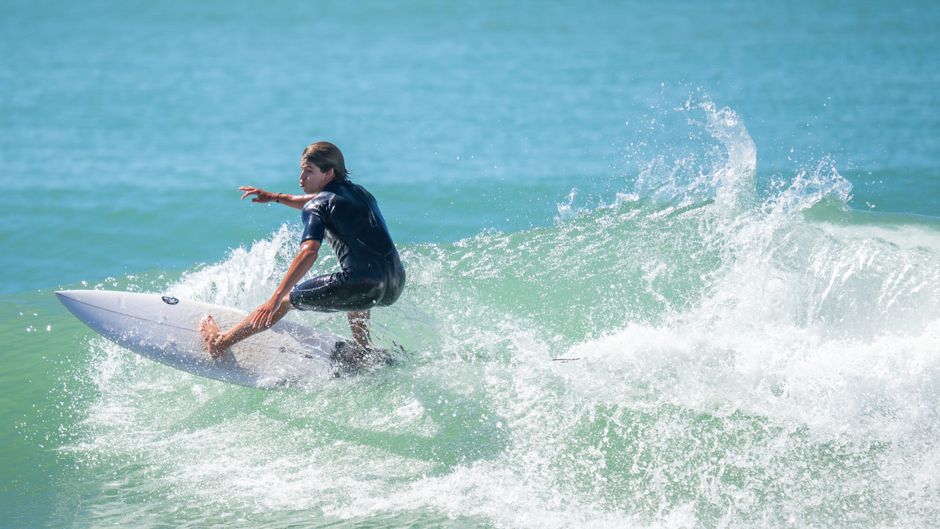
The set is bigger than the forecast said. You are sitting on the shoulder, your heart is going, and the heat clock (or just the light fading) is telling you to go. Or you are at a crowded peak, a better surfer is paddling for the same wave, and you have to decide in two seconds. Every surfer knows moments like these. Surfing mental training means practicing the skills between your ears (routines, focus, how you handle fear and wipeouts, how you choose waves) the way you practice your pop-up. This page is for surfers, parents of groms and coaches. It is about mental performance, which is different from mental health; there is a clear section on that difference below.
Quick answer: Mental skills are habits you can practice: a short routine before you paddle out, one or two focus cues, a plan for what you do after a hold-down or a bad wave, and a plan for how you will choose waves. Research on mental skills in surfers is thin, and nothing here guarantees better scores or bigger waves. Fear in the water can be a useful warning, so build up in steps with experienced people. If worry, low mood, panic or trouble eating or sleeping lasts more than a couple of weeks or gets in the way of daily life, see a doctor, licensed psychologist or other qualified professional, and in a crisis call or text 988 (US).
What the research does and does not cover
Honest starting point: when we searched PubMed we found no controlled study of fear of bigger waves, of wipeout recovery, of wave selection under pressure or of heat strategy in surf contests. What exists is mostly small studies on warm-ups, enjoyment, motivation and injuries, plus broad reviews of mental skills across many sports. Where a topic below has no surfing study, we say so and describe it as common coaching practice, not a proven method.
Fear of bigger waves
We found no study that tested a method for reducing fear of bigger surf, so there is no proven recipe. What coaches commonly suggest is gradual: move up in small steps in size, with a friend or an experienced surfer in the water, on days you have prepared for. Fear is also information. It can tell you the break is beyond your skill, your fitness or your breath-holding ability today, and “not today” is a legitimate decision. Practical preparation (conditioning, breath-hold safety, knowing the spot) is covered in our surfing training guide and in the ocean-safety parts of the session day guide.
One small piece of related research: a 2026 interview study of 14 Italian workers who surf regularly (International Journal of Environmental Research and Public Health) found that they described learning to manage uncertainty, risk and decision making in the water, and carrying that into work. That is how recreational surfers describe their own experience; it does not show that surfing trains courage in anyone else.
After a wipeout
We found no study on bouncing back from a wipeout or a long hold-down. Many coaches teach three steps: first get safe (breathe, surface, check your board and the people around you); then give yourself a minute; then take one lesson (“I stood up too late on that section”) and go back to the next wave. A long breath out and a fixed cue word you rehearse in practice can help you reset. If a wipeout caused a head knock, dizziness or confusion, that is a medical question, not a mindset one; see our surfing injuries guide. A 2026 scoping review of head trauma in surfing (Acta Neurochirurgica) notes that no validated return-to-play guidelines were found in the literature it reviewed, so ask a clinician before going back in.
Routines and warm-ups
A routine gives your mind something to do besides worry: the same order of stretching, the same breaths, one cue for the first wave. A 2026 position statement from Exercise and Sports Science Australia on performance under pressure (Schweickle and colleagues, Sports Medicine) lists pre-performance routines among evidence-based strategies, alongside psychological skills training and mindfulness-based approaches. It also says pressure can help as well as harm, and that practicing with some pressure can prepare athletes.
There is surfing-specific research on warming up. In a 2025 study of surfers in an artificial wave pool (Serpell and Cook, Journal of Strength and Conditioning Research), surfers reported feeling better prepared after a land warm-up than without one, and the hormone changes measured (testosterone and cortisol) lined up with those feelings. An earlier 2024 pool study of 19 advanced surfers (Cook and colleagues, Frontiers in Sports and Active Living) found higher core temperature after a warm-up with passive heat retention and a typical 20% higher wave-performance score than with no warm-up. These are small pool studies, not ocean heats, but they suggest a warm-up is both a physical and a mental readiness ritual.
Wave selection and crowds
Choosing a wave in two seconds is a decision under pressure. We found no study on wave-selection strategy, so the common coaching advice is simply that: decide your plan before you paddle out (for example, “I will wait for the second wave of the set” or “I will take anything that is rideable”), watch two or three sets before committing, and keep checking who has priority. In a crowd the stakes are real. In a 2026 analysis of the Global Surfer Survey (Tran and Peden, Injury Prevention), 93 of 815 Australian respondents (11.4%) reported having injured another person while surfing, mostly in accidental collisions in crowded or low-visibility surf. The authors call for education on spatial awareness and etiquette. Calm decisions protect other people as well as your score.
Contest heats and pressure
A heat compresses a session into a short window, with scored waves and a clock. We did not research the formats of particular contest series, and we found no study of mental strategies in surf heats. A 2024 study of 19 professional Brazilian surfers in simulated competitions (Souza and Guerra, International Journal of Sports Physiology and Performance) found that heat scores were associated with jump and strength measures, which is a reminder that scores come from many things at once, not only from mindset. What you can control is your preparation: rehearse a heat in practice sessions (set a timer, count your waves, practice choosing early), write a simple plan with one or two process goals (for example, “paddle hard into the first good wave”) and have a reset cue for after a poor wave.
For food, water, sun and cold-water logistics around contest days, see our session day guide; for contest rules and organisers see the rules guide and leagues and associations guide.
Enjoyment, motivation and goals
Enjoyment is not a side issue in surfing. A 2026 survey of 404 recreational surfers on the Korean coast (Lin and colleagues, Frontiers in Sports and Active Living) found that more sessions or longer sessions did not keep adding to flow and enjoyment; the gains levelled off, and the authors caution that this is cross-sectional data from one culture. A 2026 survey of 146 Spanish surfers and para surfers (Acta Psychologica) found that competitive surfers more often named performance and recognition as motivators, while recreational surfers valued social connection, and that quality of life did not differ overall between the two groups. Take from this that your reasons for surfing matter, and that chasing results can crowd out the reason you started.
Split goals into three kinds: outcome (make the next round), performance (catch a set number of waves in a session) and process (a deep, low bottom turn; eyes up early). Process goals are fully in your control, which makes them steady on a day when the waves are poor. Visualization (picturing a wave from take-off to kick-out with as many senses as you can) is a common add-on. A 2023 systematic review and meta-analysis across sports (Reinebo and colleagues, Sports Medicine) found moderate effects for imagery, multimodal psychological skills training and mindfulness-based approaches, but the effects were not stable when weaker studies were removed, and we found no surfing-only trial. Treat imagery as an extra to real water time.
Young surfers
We found no study of mental training in young surfers, so we only say this: most groms need fun, supportive coaching and time in the water more than a specialist. If a young surfer shows lasting distress, start with their pediatrician or a licensed mental health professional. Safety and training for juniors are in our youth surfing guide.
Mental performance is not the same as mental health
Everything above is about performance skills. Anxiety disorders, depression, disordered eating and burnout are health matters, not mindset problems, and they are not fixed by a better heat plan or a surf trip. The 2026 International Olympic Committee consensus statement on mental health in elite athletes (Reardon and colleagues, British Journal of Sports Medicine) treats them as medical and psychological care issues. Signs to take seriously include worry or low mood lasting weeks, panic before paddling out, avoiding the water you used to love, big changes in eating or sleep, or dread of every session.
You may have read that surfing helps mental health. A 2025 systematic review of seven studies in military members and veterans (BMJ Military Health) reported generally beneficial effects on depression, anxiety and positive mood, but the authors say it cannot be concluded that surfing is better than other exercise. It is not a substitute for care. Start with your doctor, a licensed psychologist or other qualified mental health professional. In the US, you can call or text 988 (Suicide & Crisis Lifeline) at any time.
Frequently asked questions
How do I get over fear of bigger waves?
We found no study that tested a method. Common coaching advice is to move up in small steps, with experienced company and good conditioning, and to treat fear as information. Skipping a day that is beyond you is a sound decision.
How do I reset after a bad wipeout?
Get safe first, take a slow breath, learn one thing and go to the next wave. We found no wipeout-specific research, so this is coaching practice. A head knock or dizziness needs medical advice.
Does warming up before a surf help my head as well as my body?
In a 2025 pool study, surfers felt better prepared after a land warm-up, and hormone changes matched. It is a small study, but it supports using a warm-up as a routine.
How should I pick waves in a heat?
We found no research on it. Decide a plan before paddling out, watch a few sets, and rehearse the plan in practice sessions.
Does visualization help surfers?
A 2023 review across sports found moderate benefits for imagery, but the effects were not stable once weaker studies were removed, and we found no surfing-only trial. It works best alongside real surfing.
Is nervousness before a contest normal?
Some nerves are common, and the ESSA statement says pressure can have helpful as well as harmful effects. If worry is constant, causes panic or disrupts sleep or eating, talk to a doctor or licensed mental health professional.
Sources
- Serpell BG, Cook CJ. Perceptions of Warm-Up Effectiveness Maps to Stress Physiology in Surfers. Journal of Strength and Conditioning Research, 2025. PMID 42709704
- Cook CJ et al. Effects of a land-based warm-up and passive heat retention on core body temperature, hormones, and subsequent performance in elite surfers. Frontiers in Sports and Active Living, 2024. PMID 39450117
- Lin M et al. Nonlinear dynamics of surfing participation, flow, and enjoyment. Frontiers in Sports and Active Living, 2026. PMID 42389150
- González-Noriega M et al. The quality of life of competitive and recreational Spanish surfers and para surfers. Acta Psychologica, 2026. PMID 41724031
- Tran M, Peden AE. Injuries caused to others by recreational surfers in Australia. Injury Prevention, 2026. PMID 41856554
- Souza PC, Guerra RLF. The Influence of Lower-Limb Strength and Power on the Speed and Heat Results of Professional Brazilian Surfers. International Journal of Sports Physiology and Performance, 2024. PMID 39637849
- Ratz C et al. Evaluating head and neck trauma in surfing: injuries and prevention in an olympic sport. Acta Neurochirurgica, 2026. PMID 41880015
- Gemmano CG et al. Surfing Across Life Domains: A Qualitative Study on the Role of Leisure Activities in Occupational Well-Being. International Journal of Environmental Research and Public Health, 2026. PMID 42652295
- González-Devesa D et al. Effectiveness of surfing on psychological health in military members: a systematic review. BMJ Military Health, 2025. PMID 39384219
- Reinebo G et al. Effects of Psychological Interventions to Enhance Athletic Performance: A Systematic Review and Meta-Analysis. Sports Medicine, 2023. PMID 37812334
- Schweickle MJ et al. Performance Under Pressure in Sport: A Position Statement from Exercise and Sports Science Australia. Sports Medicine, 2026. PMID 42271117
- Reardon CL et al. Mental health in elite athletes: International Olympic Committee consensus statement (2026). British Journal of Sports Medicine. PMID 42580854
- 988 Suicide & Crisis Lifeline
General information for education only, not medical advice. It does not replace a doctor, psychologist or other qualified professional. See how we work in our editorial policy. Back to the surfing hub.