This article contains affiliate links: if you buy through them we may earn a commission, at no extra cost to you. Read our affiliate disclosure.
It is ten minutes before a Saturday rehearsal and the studio floor is quiet except for one dancer rolling her feet over a tennis ball and another slowly sweeping her leg through a small circle, hand on the barre. Nobody has jumped yet. That unhurried routine is dance injury prevention: the habits around a dancer, warm-up, technique, steady training load, strength work, good floors and shoes, and enough food, that aim to lower the chance of getting hurt. They can lower the odds. They cannot promise anything.
Quick answer: The International Association for Dance Medicine & Science (IADMS) advises a 15 to 20 minute dynamic warm-up, strength work outside class, turnout that comes from the hip, a gradual build in hours, and enough food and rest. Dance on a floor with some give and in shoes that fit. See a sports medicine doctor, physical therapist or athletic trainer if pain sits in one spot, gets worse each day, hurts at night or stops you rising onto demi-pointe, or if periods stop.
General information, not medical advice. This page is about lowering risk. For what each dance injury looks like and its warning signs, see our dance injuries guide.
Know where the risk sits
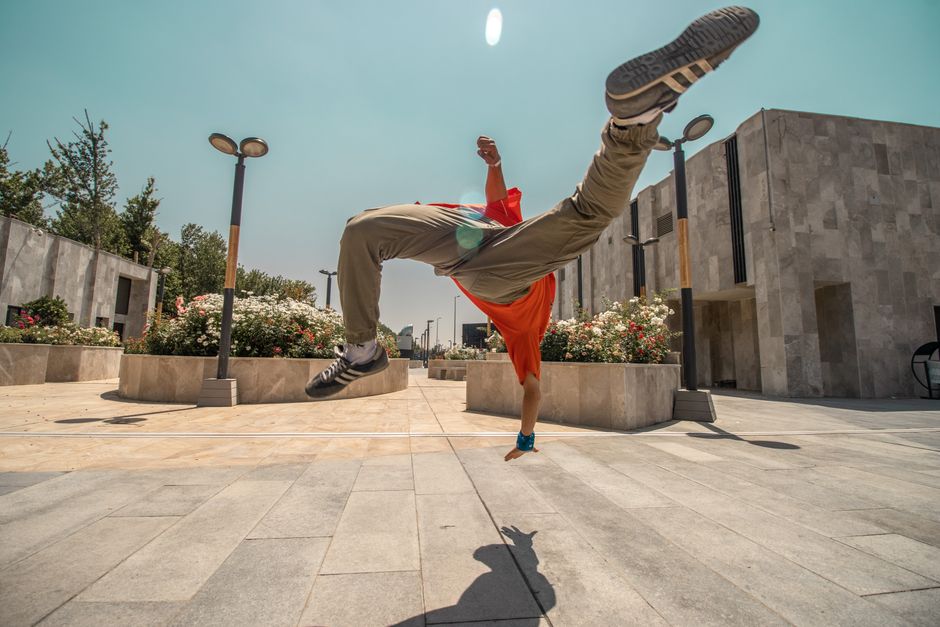
Prevention works best when it aims at the real problem. A 2015 systematic review of ballet injury studies (Smith et al., Orthopaedic Journal of Sports Medicine) found about 1 injury per 1,000 dance hours, three quarters of them overuse injuries in amateur dancers, with the lower body involved in 66 to 91% of injuries and the foot and ankle in 14 to 57%. So most advice starts at the feet, then the hip, the lower back and the knee. Hip-hop and breaking carry a different pattern, with more hand, wrist, shoulder and knee trouble, so the same list does not fit every style.
Warm up before class or rehearsal
Unlike soccer, dance has no widely tested named warm-up program, so be careful with anyone who says there is one. What exists is guidance. The IADMS resource paper on warm-up (Kozai and Surgenor, 2017) recommends 15 to 20 minutes, built in three or four sections and mostly dynamic movement. It notes that static stretching held longer than 15 seconds can reduce strength and power, and that the effect may last up to an hour. It also warns against over-stretching stabilizers such as the hip adductors, especially in hypermobile dancers.
The same paper says the benefits fade once the body goes back to rest, so a dancer waiting in the wings should keep warm with clothing and movement. Pre-show timing is on our performance and competition day page.
Technique: turnout, landings and jumps
- Turnout from the hip. The IADMS turnout paper (Wilmerding and Krasnow, 2011) reports that on average about 60% of turnout comes from hip rotation. Forcing the feet beyond what the hips allow tends to roll the foot in and stress the inside of the leg and knee.
- Landings. In a study of professional dancers in three Dutch companies (Meuffels and Verhaar, Acta Orthopaedica, 2008), all 6 anterior cruciate ligament ruptures happened while landing a jump on the left leg in a turned-out position with the knee collapsing inward. A study cannot tell one dancer how to land, but a teacher can watch your knees over your toes on every landing.
- Add jumps gradually. IADMS describes plyometric training as helpful in dancers if approached slowly, starting in parallel with a focus on height, then adding technique and turnout.
Progressive load, rest and time off
The IADMS Dance Fitness paper (Irvine, Redding and Rafferty, 2011) points out that rehearsals and performances can be more demanding than the classes that lead up to them, so a sudden jump in hours is a risk. The busy weeks are the ones to watch: summer intensives, tech week, competition season and a long run of shows. IADMS says rest cannot be stressed enough, and lists severe and prolonged fatigue, changes in behaviour and loss of motivation as signs of overtraining.
For tendons, the IADMS paper on managing tendinopathy (Rudavsky and Cook, 2015) calls modifying load, not stopping completely, best practice. It describes allegro and jumping as high load and barre and adagio as low load, and says total unloading is not advised. For dancers who play more than one sport or dance year-round, the American Academy of Pediatrics (Brenner, 2016) advises 1 to 2 days off each week and about 3 months off a year, taken in blocks of at least a month. There is no published weekly-hours limit for dancers that we can quote, so we do not invent one.
Strength and conditioning
IADMS says supplemental strength training can lead to better dancing and fewer injuries without getting in the way of the art. A 2025 meta-analysis of 15 studies and 351 dancers (Frontiers in Physiology) found strength training clearly improved strength and power and did not significantly change flexibility. The IADMS paper suggests strength work two or three times a week, with full recovery between sets. Single-leg strength, calf and foot work, hip rotators, the trunk and, for partnering and breaking, the shoulders are the usual targets. Plans, sets and examples are on our dance training page. A physical therapist or qualified strength coach should set them up for young dancers or anyone coming back from injury.
Floors and surfaces
Ausdance, the Australian dance body, says a safe dance floor is sprung, semi-sprung or cushioned and absorbs at least 53% of shock, while concrete absorbs none and can cause injury, pain and irreversible damage. A 2014 study of one touring ballet company (Journal of Science and Medicine in Sport) measured three theatre floors; none met European sports-surface standards for force reduction, and the highest injury rate came on the floor whose force reduction varied most. It was one company, so it points to a pattern but does not prove one.
At home, a thin marley roll over concrete or tile adds grip but, judging from its thickness of 1 to 1.5 mm, no real shock absorption. That is our reading of maker specs together with Ausdance, not a tested result. Floor options are on our dance gear page.
Shoes, pointe readiness and protective gear
Pointe is where the research is clearest. The IADMS guidelines for starting pointe (Weiss, Rist and Grossman, 2019) say not before age 12, and only with enough ankle plantar flexion, alignment and strength. They discourage it for dancers who are not pre-professional or who take class only once a week, suggest delaying it for a weak core or legs or hypermobile feet, and advise that with twice-weekly classes pointe begin in the fourth year of training. A teacher, and sometimes a physical therapist assessment, decides readiness. Fitting is a conversation, not a shopping trip: see youth dance and dance gear.
No independent standard certifies that a dance shoe or toe pad prevents injury. Many dancers use gel toe tubes and pads against blisters and pressure, such as the Bloch Gel Toe Tube, and resistance bands such as the THERABAND Beginner Kit for foot and ankle strength. Those are comfort and training tools, and their makers’ wording is theirs, not a clinical result.

Bloch Gel Toe Tube
- Elastic fabric tube
- Gel lining inside
- 2 tubes per pack

THERABAND Beginner Resistance Band Kit
- Yellow, red, green flat bands
- Clinic-standard color system
$11.99 at Amazon, as of Nov 17, 2026 02:07 UTC
Check price on AmazonEat enough: energy availability
Energy availability is what is left from the food you eat after the energy dance uses. The International Olympic Committee (IOC) consensus statement of 2023 on Relative Energy Deficiency in Sport (REDs) says too little for too long can harm bones, hormones and performance, and can happen by accident during heavy schedules. An IADMS bone health paper (Robson and Chertoff, 2018) notes dancers with low calorie and low calcium intake have a relatively high rate of stress fractures. In 50 competitive female dancers, lower energy availability scores went along with more injuries (Medicina, 2022). The IOC’s prevention advice is education and taking the focus off weight and leanness. Details are on our dance nutrition page.
Youth and growth spurts
The IADMS paper on the adolescent dancer (Daniels, 2000) says the growth spurt typically comes at ages 11 to 14 and lasts 18 to 24 months, with strength, flexibility and balance often dipping and growth plates near the knees more vulnerable. It suggests limiting jumps, challenging lifts, kneeling sequences and grand pliés during that time. Parents and teachers can use that as a reason to pull back and not to push through.
What prevention cannot do
Every point above is about lowering risk. None guarantees an injury-free career. Dancers get hurt even with good habits: in an international study of 260 professional dancers (Vassallo et al., Clinical Journal of Sport Medicine, 2017), point prevalence of injury was 54.8% in ballet and 46.3% in modern, and more than 15% of injured dancers had not reported their injury. Telling a teacher early is itself a prevention habit.
When to see a professional
- Right away: any suspected concussion, a possible broken bone, a joint that looks out of place, or numbness and tingling.
- Soon: pain in one spot that is getting worse, pain that wakes you or does not ease with rest, pain that changes how you move, back pain when arching, hip catching, a limp in a child, or missed periods.
Recovery basics are on dance recovery, and trackers some dancers use for sleep and load are on dance wearables.
Dance injury prevention: FAQs
How long should a dancer warm up?
IADMS recommends 15 to 20 minutes of mostly dynamic movement, with long static stretches saved for after class.
Does strength training make dancers less flexible?
A 2025 meta-analysis of 351 dancers found no significant change in flexibility, and IADMS says strength work does not interfere with the aesthetic of dance.
When is a dancer ready for pointe?
IADMS says not before 12 and not without enough ankle range, alignment and strength; with two classes a week, usually in the fourth year of training. Your teacher decides.
Does the floor really matter?
Ausdance says concrete absorbs no shock and can cause injury; sprung or cushioned floors are the safer choice. A thin marley sheet laid on concrete does not change that.
Can eating too little cause injuries?
The IOC’s REDs consensus says low energy availability can harm bone health, and IADMS reports a relatively high stress-fracture rate in dancers with low calorie and calcium intake. A missed period is a reason to see a doctor.
Sources
- Smith et al., injury incidence in ballet, systematic review, 2015
- Vassallo et al., musculoskeletal injury in professional dancers, 2017
- Meuffels and Verhaar, ACL injury in professional dancers, 2008
- Strength training and fitness in dancers, meta-analysis, Frontiers in Physiology, 2025
- Dance floor mechanical properties and injuries in a touring ballet company, 2014
- Ausdance, safe dance floors
- IADMS, The Importance of a Good Warm-Up
- IADMS, Dance Fitness
- IADMS, Managing Tendinopathy in Dancers and Dance Teachers
- IADMS, Turnout for Dancers
- IADMS, Guidelines for Initiating Pointe Training
- IADMS, The Challenge of the Adolescent Dancer
- IADMS, Bone Health and Female Dancers
- IOC consensus statement on REDs, 2023
- Torstveit et al., REDs prevention, 2023
- Energy availability and injury in competitive female dancers, Medicina, 2022
- AAP clinical report, sport specialization, Brenner 2016
General information for education only, not medical advice. It does not replace a visit with a doctor, physical therapist or athletic trainer. See how we write and check our pages in our editorial policy.