This article contains affiliate links: if you buy through them we may earn a commission, at no extra cost to you. Learn more.
Tuesday night at the local pool room: the click of a clean break, a team of five crowded around a scoresheet, someone chalking up and pacing around the table to read the shot. Down the street, a family plays its first game on a new table in the basement. And in Orlando at the end of November, Team USA and Team Europe walk out to a loud crowd for the Mosconi Cup. Billiards is one of the few sports you can start at eight and still play at eighty, and the World Confederation of Billiards Sports (WCBS) estimates about 200 million amateur players worldwide.
Billiards, page by page
- Rules: how the game works at every level
- Leagues & associations: pro, college, high school and youth
- Youth & high school: ages, safety and recruiting, for players and parents
- Injuries & sports health: prevention, concussion, when to see a pro
- Training & conditioning: before: off-season to in-season
- Game day: during: fueling, hydration, heat
- Recovery: after: games, tournaments, sleep
- Nutrition & supplements: what to eat, tested supplements
- Best wearables: trackers and watches for the sport
- Gear: the complete equipment list
Buying guide · Our Billiards buying guide compares the gear we'd pick, with prices and sizing:
This page is for everyone at the table: pool for beginners, league players, parents and the people who want to keep their backs and eyes happy through a long tournament day. It covers the main games, every level from juniors to the pro tour, the basics of good form, and an honest look at sports health: pool is a low-injury sport, but hours bent over a table add up.
Billiards at a glance
| The family | Pool (pocket billiards), snooker (a bigger table and smaller balls) and carom (no pockets, three balls). Each has its own world body under WCBS: the WPA for pool, the IBSF for snooker and English billiards, the UMB for carom. |
|---|---|
| Main pool games | 8-ball, 9-ball and 10-ball, plus straight pool (14.1), one-pocket and bank pool. |
| Tables | Pro and tournament pool: 9-foot, with a 100 x 50 inch playing surface. 8-foot (92 x 46) and 7-foot tables are common at home and in bars and leagues. |
| Balls and cue | WPA spec balls are 2¼ inches across and weigh 5½ to 6 ounces. Cues must be at least 40 inches long, weigh no more than 25 ounces and have a tip no wider than 14 mm. |
| Where people play | Home game rooms, bars and pool halls, amateur leagues (APA, CSI’s BCA Pool League and USA Pool League), junior events and the pro tours. |
| Health in one line | Few injuries. The main risks are being hit by a ball or cue and the strain of long hours bent over the table. |
How pool works
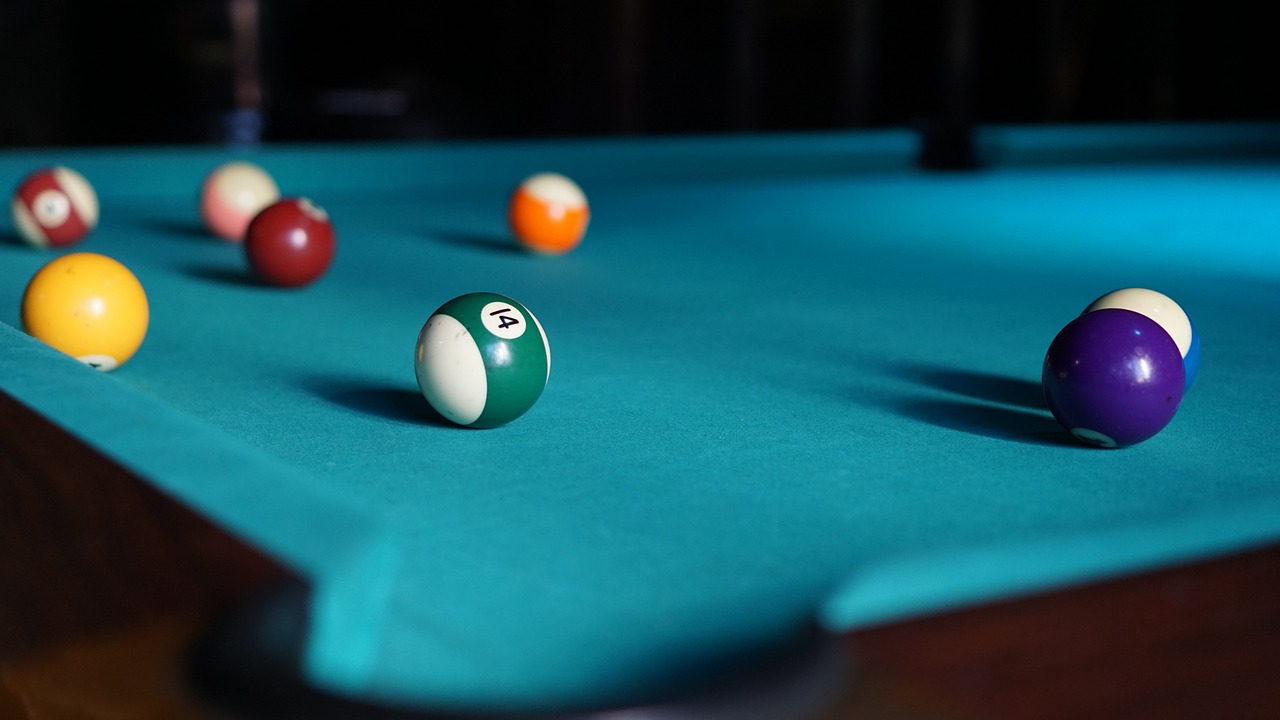
You use a cue to strike the white cue ball, which hits the object balls toward six pockets. The World Pool-Billiard Association (WPA) writes the world standardized rules. In 8-ball you claim solids (1–7) or stripes (9–15), clear your group, then call and sink the 8-ball. In 9-ball you must hit the lowest-numbered ball first, and whoever legally pockets the 9 wins the rack. 10-ball is played the same way, but every shot is called and the 10 only wins when it’s the last ball on the table.
The common fouls are scratching the cue ball into a pocket, hitting the wrong ball first and no ball reaching a rail after contact. A foul gives your opponent ball in hand: they place the cue ball anywhere on the table. Our billiards rules page explains it all in plain words, along with etiquette and how league rules differ.
Pool for beginners: your first hour at the table
- Find a straight cue. Roll house cues on the table and skip any that wobble.
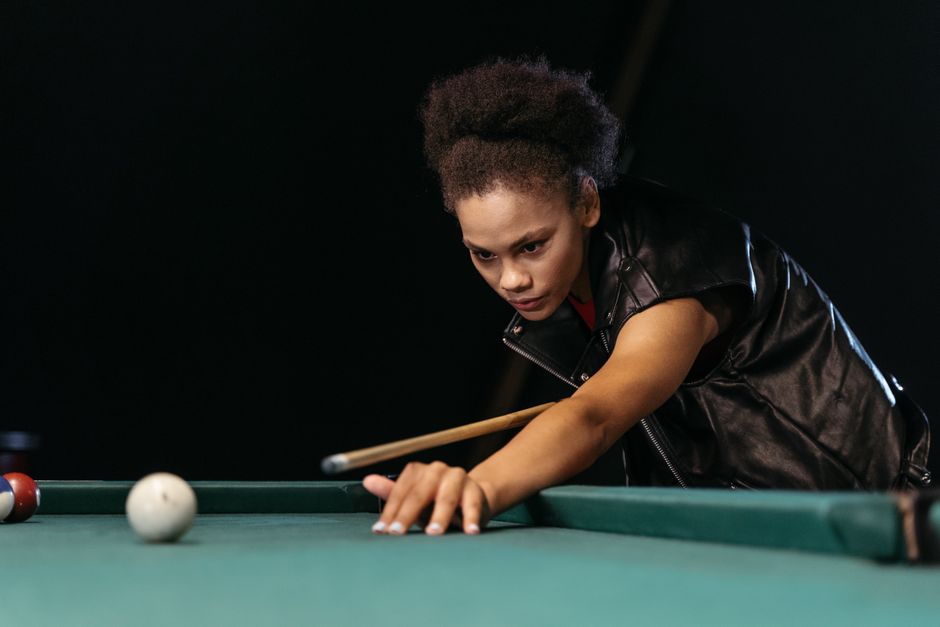
- Stance: feet about shoulder-width apart, your back foot in line with the shot, knees soft, and bend from the hips so your chin comes down toward the cue. You don’t have to bend all the way down; find what’s steady for your back.
- Grip: hold the back of the cue loosely, like a bird you don’t want to squeeze, with your forearm hanging about straight down at contact.
- Bridge: start with an open bridge (cue resting in the V between thumb and first finger), then learn the closed loop bridge for more control.
- Stroke: a few slow practice strokes, a short pause, then a smooth follow-through. Only the arm below the elbow should move, and your body stays still until the ball is gone.
- Chalk every shot or two. Chalk is what keeps the tip from sliding off the ball (a miscue).
A few lessons from a certified instructor (the BCA’s Professional Billiard Instructors Association has more than 300) speed things up a lot. Our billiards training page has drills.
Billiards at every level
Kids and juniors
The Billiard Education Foundation (BEF), formed in 1994 out of the BCA’s junior programs, runs junior state championships and the Junior National Championships, where young players compete for academic scholarships and a chance to represent the United States abroad. The 2026 Junior Nationals were held July 6–11 in Dubuque, Iowa. Internationally, the WPA holds junior world championships; in 2026 they were in Oslo, Norway. See our kids and pool guide.
Amateur leagues
Leagues are the heart of American pool. The American Poolplayers Association (APA) says it has more than 275,000 members in the US, Canada, Japan and Singapore, and its handicap system, the Equalizer, lets a beginner play a strong player on fair terms. CueSports International (CSI) runs the BCA Pool League and the USA Pool League and uses FargoRate ratings. See our leagues and associations page.
College
Pool isn’t an NCAA sport. For decades the main college event was the ACUI Collegiate Pocket Billiards National Championship, founded in 1937, but ACUI discontinued the program in June 2020.
Pro tours and international play
Matchroom’s World Nineball Tour is the main pro circuit. Its US Open Pool Championship, in its 49th edition, was played August 25–30, 2026 in Frisco, Texas, with a $500,000 prize fund. The Mosconi Cup, Europe against the USA since 1994, is set for November 27–30, 2026 in Orlando. In snooker, the 2026 World Championship was played at the Crucible Theatre in Sheffield for the 50th straight year, and China’s Wu Yize beat Shaun Murphy 18–17 in the final. Billiards isn’t an Olympic sport, but WCBS is recognized by the IOC, and billiards is on The World Games program through Karlsruhe 2029.
Sports health for pool players
Let’s be honest: pool is a safe sport. A study of US emergency room data from 2000 to 2020 (Bhardwaj and colleagues, Medicine, 2024) estimated 78,524 billiards-related ER visits over those 21 years, a small number compared with other sports. Being struck by a ball or a cue caused 51% of them, and most were bruises, scrapes and cuts; 3.2% of patients were admitted to the hospital. This section is general information, not medical advice.
- Watch the cue and the break. Give a player room behind their stroke and keep balls on the table.
- Your back. Pool means many bent-over shots, often for hours. The American Academy of Orthopaedic Surgeons (AAOS) recommends combining aerobic exercise with exercises that keep the back and abdominal muscles strong and flexible, and good posture. Stand up straight between shots.
- Long nights. Tournament days can run into the small hours: eat real meals, drink water, and get your sleep (the CDC recommends 7 or more hours for adults). Our league night and tournament day page covers it.
- Head knocks. If someone is hit in the head by a ball or cue and seems dazed or has a headache, dizziness or nausea, the CDC’s HEADS UP advice is to stop play and have a healthcare provider check them.
AAOS says to see a doctor if back pain lasts more than a few weeks or comes with fever, chills or unexplained weight loss, and to get care right away for leg weakness or loss of bladder or bowel control. More on our billiards injuries page and recovery page.
Gear for pool
You can play your whole life on house cues, but your own cue gives you the same feel every time. Three good first buys: the Viking Valhalla 100, a 58-inch, two-piece maple cue with a weight system set at 18 ounces and a lifetime warranty against warping (about $120 on Amazon in October 2026); a box of Master chalk (12 cubes, about $10); and a Casemaster Q-Vault Supreme hard case so the cue survives the trip (about $22). For the back after a long session, many players like a TriggerPoint GRID foam roller from our foam roller guide. Our billiards gear page covers tips, gloves, balls, home tables and room sizes.
Viking Valhalla 100 Pool Cue
- 58-inch, 2-piece maple
- Weight system set at 18 oz
- Lifetime warp warranty
Master Billiard Chalk, 12 Cubes
- 12 cubes
- Colors to match cloth
- Made in the USA
Casemaster Q-Vault Supreme 1×1
- Hard resin shell
- Holds 1 butt + 1 shaft
- Accessory pocket
TriggerPoint GRID 1.0 Foam Roller
- 13-inch roller
- Multi-density surface
- Hollow core
Billiards FAQs
What’s the difference between pool, billiards and snooker?
“Billiards” is the family name. Pool is pocket billiards on a 7- to 9-foot table with six pockets. Snooker is played on a bigger, 12-foot table with 15 reds and six colours. Carom billiards, like three-cushion, uses three balls on a table with no pockets.
What’s the easiest pool game for beginners?
Most people start with 8-ball: you only need to pocket your own group, and you’ll find it in every bar and league. 9-ball is a great second game because every shot teaches you to plan where the cue ball goes next.
What size pool table is regulation?
WPA tournaments use 9-foot tables with a 100 x 50 inch playing surface. The WPA also sets specs for 8-foot tables (92 x 46 inches). Home and bar tables are often 7- or 8-foot.
How do I join a pool league?
Find your local APA or CSI (BCA Pool League or USA Pool League) area through their websites, or ask at a pool hall. Handicaps mean you don’t have to be good. APA regular league play is for members 18 and older, and local venues may set higher ages.
Pool rewards the player who keeps showing up: chalk, stand tall between shots, and make the next ball easy. Keep exploring with our massage gun guide, the best wearables for pool players, nutrition for long tournament days, and every other sport on our sports hub.