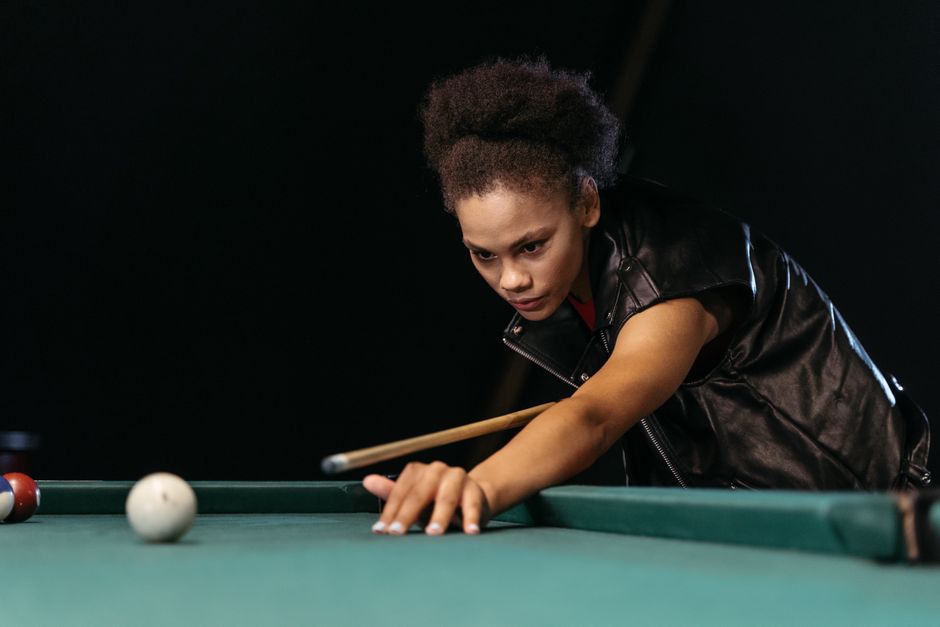
You are down 5 racks to 6 in a race to 7. Your opponent just ran out from a safety you thought was good, and you have been sitting in the chair for ten minutes. When you finally rise, the layout is hard: a long cut with the cue ball tight to the rail. Nothing about your stroke changed in those ten minutes. What changed is what is going on in your head. Mental training for pool players means practicing routines, attention, self-talk, goals and imagery so you can shoot your own shot, rack after rack, under pressure. It supports good play; it cannot promise a win or a run-out.
Quick answer: Research on pressure in sport supports a repeatable pre-shot routine, a short reset for the chair, practice that includes pressure, and honest feedback. Pool is a closed-skill sport, where you start the action yourself, and that is where these tools have worked best in studies. Nothing here guarantees a result. See a doctor or licensed mental health professional, not only a coach, if worry, low mood, disordered eating or exhaustion are affecting daily life, or if your stroke freezes or jerks only in matches.
General information for players of pool, snooker and carom. Back to the billiards hub. Stance, drills and a basic routine are on our billiards training page, and time rules, food and the chair for league night or tournament day are on the game day page. This page goes deeper on the thinking side and avoids repeating those.
Why the mind matters when you shoot alone, then sit
Pool is unusual: you take your turn alone with the table, and then you may watch for a long time. A 2021 study of recreational, university-team and national-team 9-ball players found that the better groups were not just more accurate on angle and spin tests, they were also more consistent from shot to shot (Pan, Komar and Kong, BMC Sports Science, Medicine and Rehabilitation). Consistency under pressure is partly a mental skill: doing the same thing on the shot that matters as you did on the easy one. A 2020 study of people learning pool with full-body motion sensors found that players became less variable as they improved (Haar and colleagues, Scientific Reports). That is a reason to practice the routine until it is automatic.
A pre-shot routine for every shot
A 2026 meta-analysis of 21 studies on choking under pressure (Zeng and colleagues, Psychology of Sport and Exercise) looked at quiet eye, pre-performance routines, mindfulness, self-talk and other tools, and found effects were larger and more consistent in closed-skill sports like pool. A 2026 position statement from Exercise and Sports Science Australia (Schweickle and colleagues, Sports Medicine) also lists pre-performance routines among the approaches with evidence behind them. Neither study was done on pool players specifically, so read them as support for the idea, not a recipe. A workable structure many coaches teach:
- Behind the shot: look at the whole layout, decide on the shot and the cue ball position, and commit. Decide, then shoot; do not decide while bent over the cue.
- Step in: the same footwork, the same number of practice strokes, every time.
- Final look: a still, steady look at the object ball before you stroke. Quiet eye, a steady last fixation on the target, is one tool in the 2026 meta-analysis.
- After the shot: stay down, note the result in one word, then stand. The timing guidelines of the American Poolplayers Association (APA) allow about 20 seconds for an average shot and 45 seconds for a special situation, so a routine has to fit the clock; practice with the time in mind.
Use the full routine on easy shots too. If you only use it when you are nervous, it becomes a signal that the shot is scary.
Concentration across a long match
Under APA guidelines an 8-ball team match should take no more than 4 hours and a 9-ball team match no more than 3.5 hours, and under World Pool-Billiards Association (WPA) regulations matches over 9 racks (8-ball) or 13 racks (9-ball) allow one 5-minute time out between racks. Those numbers are on our game day page with the food and hydration side. Here is the thinking side:
- Break the match into racks. The score is a story you tell between racks; during a rack there is only the next shot. This is common coaching practice, not a pool study.
- Have a chair reset. A slow breath and a cue word as you sit and again as you stand. A review of slow breathing (Zaccaro and colleagues, Frontiers in Human Neuroscience 2018) linked breathing under about ten breaths a minute with higher heart rate variability and feeling calmer and more alert. That supports a breath as a reset; it does not prove it improves scores.
- Follow the table. Reading the layout while you wait keeps your mind in the game.
- Rest your eyes. The American Academy of Ophthalmology lists long periods of focusing and poor lighting among causes of eye strain. Look far away between racks.
Pressure shots and safeties
The pressure study above recommended practicing under pressure so the real thing feels familiar (Schweickle and colleagues). In pool that can be simple: play a drill with a penalty, shoot a last rack against a friend with only bragging rights at stake, or keep a score of how often you complete a run-out from a set layout. For decisions, set rules in practice rather than at the table:
- Decide the shot type before you stand. Many players write their own rule, such as “if the run-out has more than one risky shot, I play safe.” This is a coaching idea, not a tested rule.
- Treat a safety as a full shot. It gets the same routine and the same commitment as a pot.
- Name the plan in one phrase (“stay on the rail,” “hide the ball”) so your mind has something specific to do.
Self-talk that is short and instructional tends to help with fine skills. A 2011 meta-analysis of 32 studies (Hatzigeorgiadis and colleagues, Perspectives on Psychological Science) found self-talk helped most on fine or novel tasks, which fits the precision of a stroke.
Handling a bad run
Every player has a night when balls will not drop, the cue ball keeps finishing in the wrong place, and the opponent gets every roll. We could not find a pool-specific study that tells players how to handle it, so this is common coaching practice rather than research. A few ideas: go back to the first step of your routine instead of trying to fix the stroke mid-match; use the chair reset after every miss; and take your time out if your rules allow it, since time-outs are part of the match format (APA coaching and WPA time-out rules are covered on the game day page). After the match, write down one thing that went well and one thing to practice, and leave it there.
Be careful with feedback. In a study of snooker players from club to professional level (Welsh, Dewhurst and Perry, Psychology of Sport and Exercise 2023), critical feedback from a coach improved break-off performance and praise impaired it, and mentally tougher players handled it better. It is one study of one task, but it suggests asking a coach or teammate for honest notes rather than only reassurance.
Goals, motivation and imagery
- Goals you control. “Run my full routine on every shot” is yours; “win the tournament” depends on a bracket. An expert statement on goal setting for Exercise and Sports Science Australia (Swann and colleagues, Sports Medicine 2026) is a good place to read more.
- Imagery. A 2026 scoping review mapped how athletes use mental imagery to manage stress (Zhao, Wang and Anuar, Frontiers in Psychology). We found no pool-specific study giving a size of benefit. A simple use is picturing the cue ball paths for a rack while you sit.
- Motivation. Scored practice and a notebook give you proof of progress, which many players find more motivating than results alone. This is general practice, not a study result.
Tournament nerves
Feeling revved up before a big match is normal and is not a sign you will play badly. Ways to prepare, all common practice rather than pool-specific research: know your table assignment and check-in time (WPA regulations say arriving more than 15 minutes late loses the match); get time on a practice table if one is available; rehearse your routine so it does not change when the crowd is watching; and decide beforehand how you will reset after an early miss or a bad break. Food, drink, caffeine and the rest of the day’s logistics are on our game day page, and format and sanctioning details are on the rules and leagues and associations pages. We do not recommend alcohol or any medicine as a nerves strategy; the CDC says drinking less is better for health, and prescribed medicine questions belong with your doctor.
Players in youth programs can read more about the sport itself on our youth billiards page. We found no pool-specific research on mental skills for young players, so we offer no youth advice here.
Mental performance is not mental health
Everything above is about performance skills: focus, routines and handling pressure. Anxiety, depression, disordered eating, burnout or trouble sleeping are health matters, not a lack of mental toughness. The IOC consensus statement on mental health in elite athletes (Reardon and colleagues, British Journal of Sports Medicine 2019) treats them as health concerns that need assessment and care. If you are struggling, talk to a doctor or a licensed mental health professional. In the United States, you can call or text 988, the Suicide and Crisis Lifeline, at any time. If your stroke freezes or jerks only in matches, sometimes called the yips, a sport psychologist is the right kind of professional to ask about (a 2024 systematic review covers this kind of movement problem in sport; Nijenhuis and colleagues). The Association for Applied Sport Psychology lists resources for finding sport psychology help. For tools and books, see our guide to the best mental training tools for athletes.
Billiards mental training: FAQs
Does a pre-shot routine really help in pool?
The research supports it. A 2026 meta-analysis of 21 studies found routines and related strategies reduced the drop in performance under pressure, with larger effects in closed-skill sports like pool. It was not a pool-only study, and no routine guarantees a result.
How do I stay focused during a long pool match?
Break the match into racks, use a short reset (a breath and a cue word) each time you sit and stand, rest your eyes on something distant, and follow the table while you wait. These are common coaching practices rather than pool-specific research.
What should I do after a bad rack or a bad run?
Go back to the first step of your routine, take a breath, and shoot the next shot only. Afterward, note one thing that went well and one thing to practice. We found no pool-specific study on bad runs, so this is general coaching practice.
Should I play safe or go for the shot under pressure?
Set a rule in practice, such as how many risky shots you will accept in a run-out, and use the same routine for both options. A written rule is easier to follow than a decision made while nervous. This is coaching practice, not a tested rule.
Are nerves before a tournament normal?
Yes. Feeling revved up is common and does not mean you will play badly. If worry or low mood is affecting your daily life, talk to a doctor or licensed mental health professional.
Sources
- Pan C, Komar J, Kong PW. Development of new 9-ball test protocols for assessing expertise in cue sports. BMC Sports Sci Med Rehabil 2021 (PMID 33531054)
- Haar S, van Assel CM, Faisal AA. Motor learning in real-world pool billiards. Sci Rep 2020 (PMID 33208785)
- Zeng et al. Counteracting choking under pressure in sport: a meta-analysis of interventions. Psychol Sport Exerc 2026 (PMID 41951087)
- Schweickle et al. Performance under pressure in sport: ESSA position statement. Sports Med 2026 (PMID 42271117)
- Welsh, Dewhurst, Perry. Mental toughness and feedback in snooker. Psychol Sport Exerc 2023 (PMID 37665907)
- Nijenhuis et al. Task-specific dystonia (yips) in sports: systematic review. 2024 (PMID 38456155)
- Hatzigeorgiadis A et al. Self-talk and sports performance: a meta-analysis. Perspect Psychol Sci 2011 (PMID 26167788)
- Zaccaro A et al. How breath-control can change your life. Front Hum Neurosci 2018 (PMID 30245619)
- Swann C et al. Goal setting in exercise and physical activity: an expert statement for ESSA. Sports Med 2026 (doi)
- Zhao L, Wang Y, Anuar N. Mapping the use of mental imagery for stress management in athletes. Front Psychol 2026 (doi)
- Reardon CL et al. Mental health in elite athletes: IOC consensus statement. Br J Sports Med 2019 (doi, PMID 31097450)
- APA time guidelines (APA)
- WPA playing regulations, 2025 (WPA)
- American Academy of Ophthalmology: What is eye strain (AAO)
- CDC: Moderate alcohol use (CDC)
- 988 Suicide and Crisis Lifeline (988lifeline.org)
- Association for Applied Sport Psychology resources (appliedsportpsych.org)
General information for education only, not medical advice. It does not replace a doctor, licensed mental health professional or qualified coach. See our editorial policy for how we research and write.