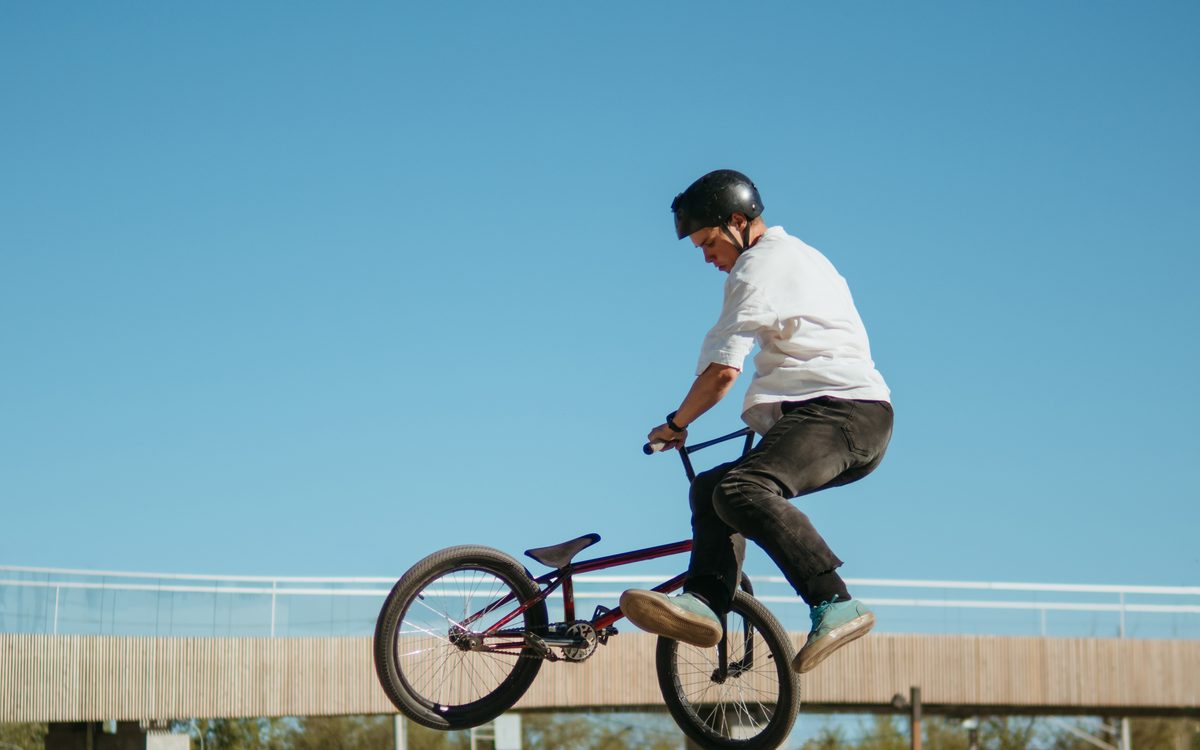
Most of what makes a rider look effortless at the top of a quarterpipe happens away from the ramp: strong legs that can push into a jump, hands and shoulders that can take a hard landing, a core that keeps a spin tight. BMX freestyle training is the mix of riding practice, strength and conditioning, and rest that prepares a rider for short, powerful efforts and lots of repetition. This page is general information from published research and general coaching practice; it is not a personal plan. See also the BMX freestyle hub.
Quick answer: A 2025 preliminary review in Frontiers in Physiology says elite BMX freestyle riders show strong anaerobic power, explosive leg power, upper-body strength for landings, a strong core and good neuromuscular control, with moderate aerobic fitness. Research is limited, so the weekly shape below is general coaching practice, not a prescription. Build up slowly and ask a coach or athletic trainer to tailor it.
What the sport asks of the body
The 2025 review in Frontiers in Physiology, which the authors call preliminary because research on the sport is scarce, reports that elite male riders tend to have lower body fat and an advantageous power-to-weight ratio. It describes substantial anaerobic power for aerial and rotational skills, and typically moderate maximal oxygen uptake, which it suggests helps with recovery between competition efforts and with coping with a heavy training load. It also names high lower-limb explosive power for jump amplitude, significant upper-body strength for bike control and absorbing landings, a robust core for rotations, and well-developed neuromuscular control including dynamic balance and coordination. The review points to explosive power and eccentric strength as training focuses and says female riders are understudied, so be careful about assuming these findings apply equally to every rider.
A competition run is about 60 seconds, according to the UCI, and many riders ride longer sessions of repeated attempts. In plain terms: short bursts, then rest, then more bursts, plus the fine skill of keeping your balance.
A sensible weekly shape (general coaching practice)
No federation publishes a standard week for park riders, so the outline below is general practice that coaches and athletic trainers commonly use for power sports. Adjust it with a coach; the numbers are examples, not rules.
- 2 to 4 riding sessions. Plan what you are working on before you arrive: one or two tricks at the right level, not ten. Warm up on easy features first.
- 2 strength sessions off the bike. Squats and lunges for the legs, push and pull movements for the upper body, and core work. A coach can set the load.
- 1 short power or jump session. Low-volume jumps and landings with full rest between sets, stopped when form fades.
- 1 or 2 easier days. Mobility, a walk or an easy spin on a bike. These are part of training, not time off.
- At least one full rest day. Hands, wrists and shoulders take a lot of repeated impact. Rest is when you adapt.
Skills first, then strength
Park progress comes from time on the bike with a plan. General coaching practice is to break a trick into steps, practise the steps on a smaller feature or into soft landing (a foam pit or airbag where a facility has one), and add height or rotation only when the previous step feels routine. Filming sessions helps many riders see what they are actually doing, and a coach can give faster feedback than a video alone.
Off the bike, three themes follow the review above. Explosive leg work (jumps, light jump squats, sled pushes) for height. Upper-body and core strength to control the bike and absorb landings. Balance and coordination drills such as single-leg work, balance boards and flatland-style balance practice. Start with body weight and light loads, learn the movement pattern, and add load slowly. Young riders should be coached by a qualified adult.
Periodisation basics
Periodisation just means planning the year in blocks. A common general approach is: a base phase for strength and skill volume, a build phase when riding intensity and trick difficulty go up, a pre-competition phase with run practice, then an easier phase after the season ends. For riders without a contest calendar, the same idea still helps: rotate focus blocks of a few weeks (for example, one block on a new trick family, one on strength) and take a lighter week every few weeks. These timings are examples from general practice; no source we reviewed sets exact block lengths for BMX freestyle.
Practising whole runs
Because contest runs are about a minute (UCI), many coaches have riders practise full-length runs, flowing from one feature to the next, once the individual tricks are consistent. Try two or three run attempts per session with full rest, then drop the intensity. If landings are getting heavier or lines are getting messy, stop; many riders get hurt when tired. Our injury prevention page covers warm-up and load, and the recovery page covers what to do afterwards.
Tracking progress without overdoing it
Simple notes are enough: what you rode, what you landed, how hard it felt from 1 to 10, how you slept and any sore spots. If sessions keep feeling harder or sore spots linger, cut the load. A wearable can add data, but it is not needed; no source we reviewed shows that a device improves BMX freestyle results.
Youth and beginners
Young riders are still growing, and a qualified coach should supervise strength work. The goal at first is to learn to ride well and enjoy it; heavy lifting and large jumps can wait. The same applies to adults who are new: your fitness is rarely the problem, your skill ladder is, so move up in small steps.
BMX freestyle training FAQs
How many days a week should I ride?
No source sets a number. Many riders ride two to four days, include strength work and keep a full rest day. Hands and wrists need rest. This is general practice, not a rule.
Do I need to lift weights for BMX freestyle?
You do not need to, but the 2025 Frontiers in Physiology review says leg power, upper-body strength and core strength matter for elite riders. Start with a coach and light loads.
Is cardio important?
The same review says riders’ aerobic capacity is typically moderate, and the sport is mostly short, powerful efforts. A little general fitness helps recovery between runs, but most training time goes to skills and strength.
How do I learn a new trick safely?
General coaching practice: break it into steps, practise on a smaller feature or soft landing, add height or rotation slowly, and stop when tired. Do not copy a professional clip on a feature that is too big for you.
Do female riders train differently?
The review says female riders are understudied. A coach should tailor training to the individual rider rather than assume one profile fits everyone.
Sources
- Frontiers in Physiology 2025: physiological and physical characteristics of BMX freestyle athletes (PubMed)
- UCI: What is BMX Freestyle – Park?
- UCI: What is BMX Freestyle – Flatland?
- BMC Sports Science, Medicine and Rehabilitation 2026: severe injuries in competitive cycling over an Olympic cycle (PubMed)
General information for education only, not medical advice. It does not replace a sports medicine doctor, physical therapist, athletic trainer or registered dietitian who knows you. See our editorial policy for how we write and source our pages.