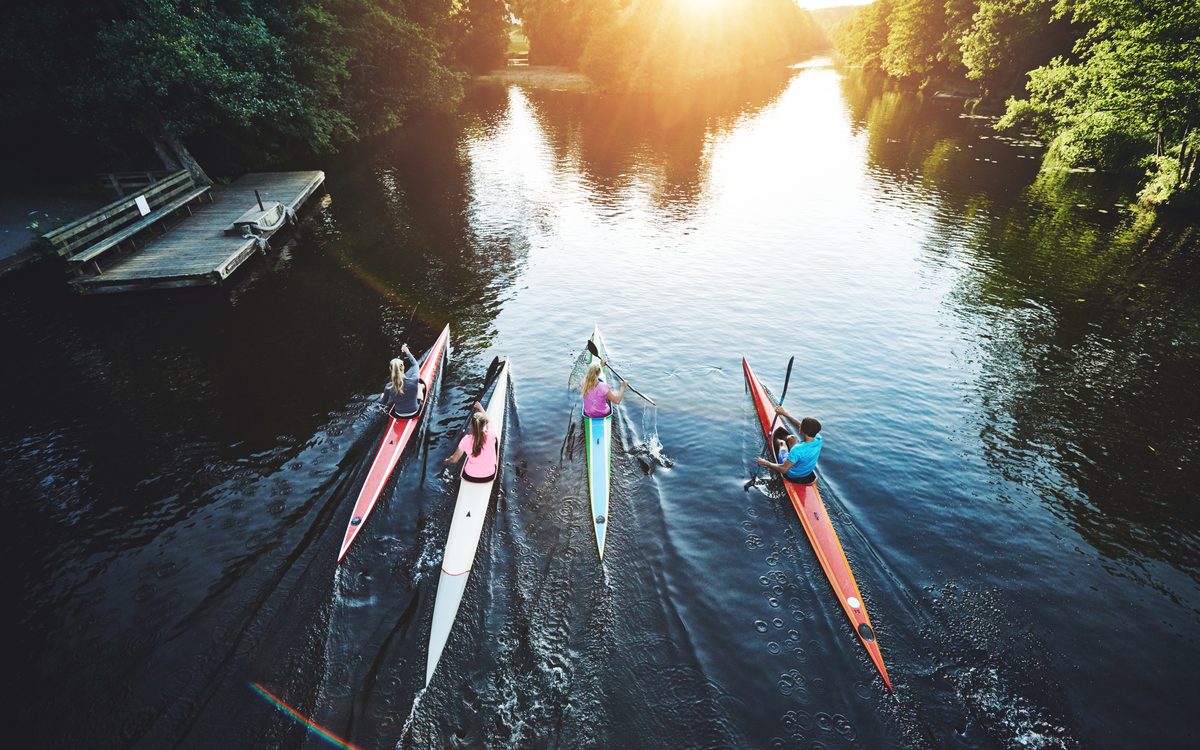
After a hard Saturday session the boats are racked, the paddlers sit on the dock with a drink, and the argument starts: ice bath, foam roller, compression sleeves, early night. Canoe sprint recovery is everything an athlete does between sessions so that the next one goes well: sleep, food, easy movement, managing the training load and noticing when something is more than soreness. The honest picture is that sleep and sensible load matter most, and that many popular gadgets have weak evidence.
Quick answer: Sleep and load management are the foundation of recovery for paddlers. A 2026 network meta-analysis of 16 trials in endurance athletes found no recovery method clearly better than passive rest, and compression garments did not improve performance. Foam rolling can briefly improve range of motion, but evidence for injury prevention is limited. Ordinary soreness fades in a day or two; pain that lingers, sharpens or is joined by numbness is a reason to see a sports medicine doctor, physical therapist or athletic trainer.
Sleep: the best-supported tool
A 2025 study followed 17 French national-team canoe-kayak athletes (9 women) over about 12 months, 5,855 nights, using chest straps and validated smart rings plus training logs. Sleep quantity and fragmentation measures, such as time in bed, total sleep time, efficiency and the number of sleep phases, explained up to 79 percent of the differences between the four night types the researchers found. Heart rate and heart-rate variability each explained 4 percent or less. About 41 percent of nights were classed as optimized recovery: long, uninterrupted sleep with a low breathing rate. The highest-performing athlete group had slightly lower sleep efficiency but strong heart-rate and heart-rate-variability markers, so the authors say robust autonomic markers may compensate. This was a descriptive study with no test of whether changing sleep improves results. It does suggest that sleep deserves attention, but wearable scores are estimates, and a bad score is not a diagnosis. In general coaching practice, regular bed and wake times, a dark cool room and limited late caffeine are the first steps.
Load management
Recovery starts with the plan. A 2026 study of 25 Czech elite sprint kayakers found different power profiles in winter preparation and summer competition, which fits the idea that training emphasis changes across the year. In practice, coaches schedule easier days after hard ones and easier weeks every so often. We found no sourced rule for how many hard sessions per week suit a paddler, so ask your coach. A training log with how you felt, sleep and any pain helps spot trends. More on shaping the year is on the training page.
Mobility and flexibility
Paddling asks for rotation through the trunk and upper back, steady shoulders, and strong hips. In general coaching practice, mobility work for the upper back, shoulders, hips and hamstrings is a common part of paddlers’ routines. We found no sprint-specific trial showing that stretching prevents injury, so treat it as a comfort and movement habit, not a guarantee. Gentle movement should not cause sharp pain.
Foam rolling and massage tools
A 2026 review of foam rolling research in BMC Sports Science, Medicine and Rehabilitation says the evidence consistently supports acute increases in range of motion, short-term pain reduction, and brief changes in stiffness and blood flow. It also says evidence for better performance, injury prevention or “fascial adhesion release” is limited or inconclusive, and safety data are scarce. A roller is a comfort tool. If you use one, avoid rolling directly on a painful joint or a suspected injury. Our guides on foam rollers and recovery tools compare products.
Cold water, compression and other methods: what the evidence says
- Overall. A 2026 systematic review and network meta-analysis of 16 randomized trials (273 participants) of competitive endurance athletes found that no modality outperformed passive recovery for muscle soreness, creatine kinase or sport performance, with very low to low certainty for most comparisons. The one moderate-certainty result was that compression garments do not improve performance.
- Cold-water immersion. A 2026 umbrella review of 15 meta-analyses found methodological quality low to critically low and certainty of evidence low to very low. It reported that 10 to 15 minutes at 10 to 15 degrees C, or at 5 to 10 degrees C, appeared most effective in those studies. The evidence is weak, and cold immersion carries its own risks, so check with a doctor if you have a heart or circulation condition.
- Honest summary. Many athletes like these methods because they feel good. Feeling better is a fair reason to use them, as long as they do not take the place of sleep, food and rest.
Soreness versus injury
General rules of thumb used by coaches and clinicians: muscle soreness is dull and spread across a muscle, appears a day or so after unfamiliar work, and eases with gentle movement. Injury pain is more often sharp, localized, present at rest, or getting worse each session, or is joined by swelling, numbness, tingling or weakness. If you are unsure, ask a professional, and see the injuries page for patterns reported in paddlers.
Recovery between races
At a regatta the gaps between heats, semifinals and finals can be short: the ICF world championship rules ask for at least 30 minutes between rounds in 500 and 1000 metre events. Common practice is easy paddling or walking, fluids and food that the athlete has used in training, shade, and dry clothes. Plan it in practice, not on race day.
Canoe sprint recovery FAQs
How much sleep do paddlers need?
We found no sprint-specific target. The French national-team study linked longer, uninterrupted sleep with better recovery nights, but did not set a number. Aim for regular, sufficient sleep and talk to a professional if you sleep poorly.
Do ice baths help canoe sprint recovery?
Evidence from reviews is low-certainty. A 2026 umbrella review reported possible benefits for some protocols but also very low-quality evidence, and a 2026 network meta-analysis found no method beat passive rest.
Should I use a foam roller?
It can briefly improve range of motion and ease tightness, per a 2026 review. Evidence for injury prevention is limited. Do not roll an area that is sharply painful.
Is soreness a sign of injury?
Usually not if it is dull, widespread and fading. Sharp, localized, lingering or worsening pain, or numbness, should be checked by a professional.
Do wearables and sleep trackers help?
They can show trends, and a 2025 study used them with national-team paddlers, but the scores are estimates and are not diagnoses. Use them as a prompt, not a rule.
Sources
- Recovery patterns in elite canoe-kayak athletes across the Olympic training year (Front Sports Act Living, 2025).
- Seasonal changes in power profile of elite sprint kayakers (2026).
- Effects of foam rolling and the knowledge-to-action gap (BMC SSMR, 2026).
- Physical recovery modalities in competitive and elite endurance athletes: systematic review and network meta-analysis (2026).
- Post-exercise cold-water immersion: umbrella review of 15 systematic reviews (Sports Med Open, 2026).
- ICF, Canoe Sprint Competition Rules 2025 (world championships chapter).
General information for education only, not medical advice. It does not replace a sports medicine doctor, physical therapist, athletic trainer, dietitian or coach who knows you. How we write: see our editorial policy.
Keep exploring: the canoe sprint hub, nutrition and athlete health and the sports hub.