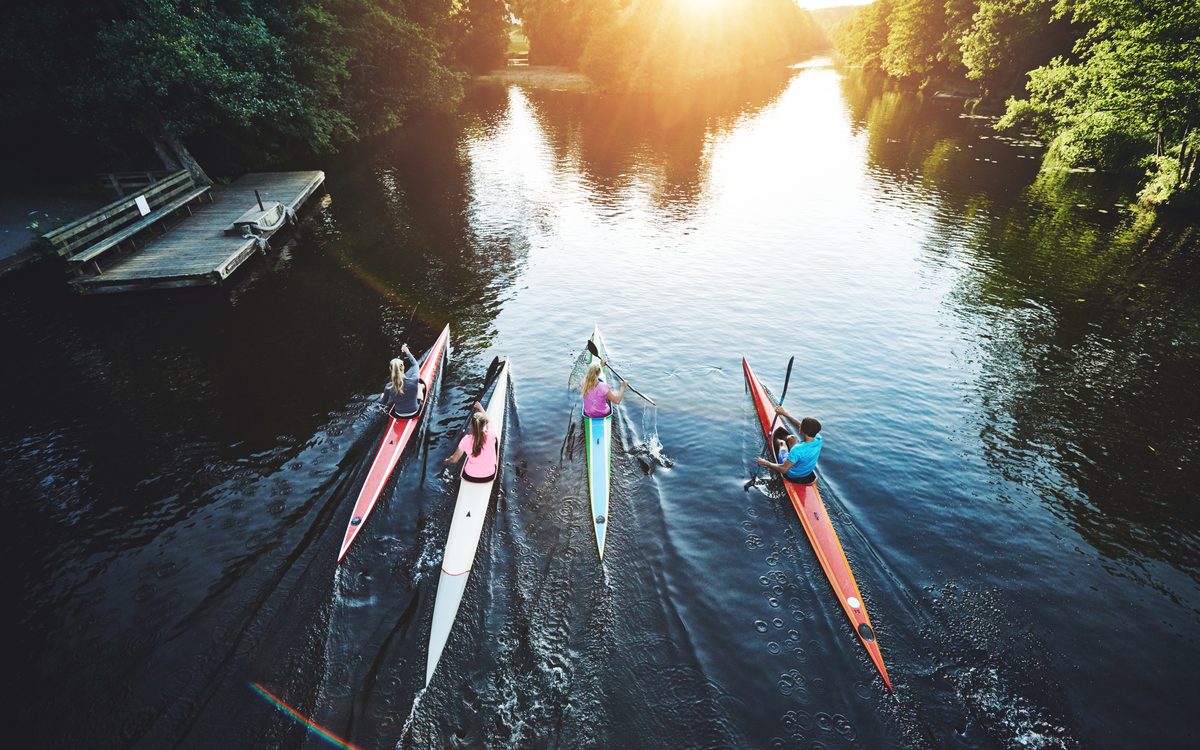
In January the lake is frozen or the water is too cold to be safe, and a sprint kayaker is on an indoor paddling ergometer, watching the power number on the screen and counting strokes to the next interval. By July the same athlete is on open water, and the work looks different again. Canoe sprint training is the planned mix of paddling, strength, aerobic and anaerobic work, and rest that prepares a paddler for races that last from under a minute to a few minutes. This page covers what the sport asks of the body, what the research says, and how the weeks and the year are usually shaped. It is general information; a qualified coach should design your program.
Quick answer: Sprint paddlers need a large aerobic engine, strong upper-body and trunk muscles, and tolerance for hard effort. Research on kayakers links performance to oxygen uptake, power at maximal oxygen uptake and upper-body strength, but the studies are small and mostly of men. A sensible week mixes several water sessions, one or two strength sessions and a full rest day; see a coach for details and a doctor if pain does not settle.
What the sport demands
A 2025 systematic review of 17 studies of flat-water kayaking found that performance was strongly linked to maximal oxygen uptake, aerobic and anaerobic thresholds, peak aerobic and anaerobic capacity, and upper- and lower-body strength and power. It was less clear whether total lean mass mattered. In a 2026 study of 24 national-level male kayakers, the power produced at maximal oxygen uptake had the strongest association with a 500 metre ergometer time (r = -0.71); maximal oxygen uptake itself added little on top of it. Reference values from 2025 for international medallists, measured on an off-water test, included a mean maximal oxygen uptake of 57.6 mL/min/kg for eight men and 52.2 for two women, with peak blood lactate near 11.9 and 9.3 mmol/L. Those groups are tiny, so treat them as examples, not targets.
Strength shows up too. A 2026 analysis of 133 Chinese national-championship paddlers found that a higher relative prone bench pull was linked to faster 200 metre times, with a smaller association at 500 and 1000 metres, and the pattern was stronger for kayak than canoe. That is an association in one dataset, not proof that lifting more will make you faster.
What the training research actually covers
A 2026 scoping review of canoe sprint training research found only 12 qualifying studies out of 357 identified. High-intensity interval training, warm-up work, and resistance and core training were the main topics. The studies leaned toward male elite kayakers, with few women and few canoe events, and quality was mostly moderate, with small samples. The authors call the field early-stage. That is why this page offers few numbers: a lot of what coaches do comes from experience and is not backed by trials.
- High-intensity intervals. In a 2025 study of six trained male kayakers, an 8-week high-intensity interval program was followed by faster 200 and 1000 metre time trials. Six people with no control group is a hint, not a guarantee.
- Warm-up. In a 2026 crossover trial of 11 elite male sprint kayakers, an interval-style warm-up produced the highest power in a 2-minute ergometer test, but a self-selected warm-up was not significantly different and athletes preferred it. Higher blood lactate just before the test was linked to worse performance.
A sensible weekly shape (general coaching practice)
No source we found prescribes a weekly volume for sprint paddlers, so the following is a common pattern in general coaching practice, not a standard. A club-level paddler might build a week around:
- Two to four water sessions: technique and easy aerobic paddling, plus one session with harder intervals or race-pace starts.
- One or two strength sessions that include pulling (rows, pull-ups), pressing, legs and trunk work.
- An optional easy cross-training session, such as a run, bike or ergometer, for aerobic fitness.
- At least one full rest day, and an easier week every few weeks.
Beginners usually need fewer hard sessions and more technique. Teenagers should follow their coach and keep school, sleep and growth in mind.
Periodisation basics
Periodisation means arranging the year in phases. A 2026 study of 25 Czech elite sprint kayakers tested them in the winter preparatory period and the summer competition period. Peak power on a 30-second upper-body test was lower in summer (down 37.3 W), while mean power was higher (up 14.8 W) and stroke cadence rose 2.8 rpm. The authors say this fits a shift in emphasis from peak toward sustained output across the season, but they did not show training caused it. In common coaching practice the year runs from a general base, through a build with more race-specific work, into a competition phase with sharper but lower-volume training, then a short taper before key races and a break afterwards. Your coach will adapt this to your calendar.
Young paddlers and testing
A 2026 machine-learning study followed 729 young German canoe sprint athletes, aged about 13 to 17, and tried to predict whether they would later reach international or only national level. The 2000 metre on-water test was the most important input, but precision for picking future internationals was low: many predicted stars did not make it. The authors call it a screening tool, not a selector. A 2026 PeerJ study of 82 Chinese youth paddlers found canoeists had stronger posterior core stability, while the male kayakers had more explosive peak power. The sensible takeaway for parents is that test scores at 13 or 14 should not be treated as a verdict. See also canoeing for related pages.
Monitoring and when to back off
Many programs track sessions with a training log, heart rate and ergometer power. Numbers are a prompt for a conversation, not a replacement for how you feel. Pain that lingers, sharp shoulder or back pain, or a run of poor sleep are reasons to talk to your coach and, if needed, a clinician. More detail is in injury prevention and recovery.
Canoe sprint training FAQs
How many days a week should I train?
No standard exists. A common club pattern in general coaching practice is several water sessions, one or two strength sessions and a rest day, but your coach should set it from your age, experience and schedule.
Do canoeists and kayakers train differently?
Mostly the same ingredients, but a 2026 PeerJ study of youth athletes found differences in strength and core profiles, and canoe research is much thinner than kayak research. Follow your coach for boat-specific technique.
Is an indoor paddling ergometer useful?
Many studies of kayakers use ergometer tests, and clubs use them for winter work and testing. It is a tool, not a replacement for time in the boat.
Does lifting weights make you faster?
Research links upper-body strength with sprint performance, but those are associations. Strength work is also commonly used to build resilience; it should be introduced gradually.
Should I warm up the same way before every race?
The 2026 crossover trial found self-selected warm-ups performed as well as an interval warm-up in experienced paddlers, but it was 11 men on an ergometer. A routine you have practiced is a reasonable aim.
Sources
- Physiological and physical determinants of flat-water kayaking, systematic review (2025).
- Aerobic variables and 500 m sprint kayak performance (2026); power, lactate and VO2max in international kayakers and rowers (2025).
- Pre-competition strength and sprint canoe/kayak performance (PLoS One, 2026).
- Research trends and gaps in canoe sprint training: a scoping review (2026).
- HIIT in flatwater kayakers (2025); self-selected versus standardised warm-ups in elite kayakers (2026).
- Seasonal changes in the peak-to-sustained power profile of elite sprint kayakers (2026).
- Young German canoe sprint athletes, machine-learning prediction (2026); youth flatwater paddlers, structural vs functional specialization (2026).
General information for education only, not medical advice. It does not replace a sports medicine doctor, physical therapist, athletic trainer, dietitian or coach who knows you. How we write: see our editorial policy.
Keep exploring: the canoe sprint hub, rules and getting started, nutrition and the sports hub.