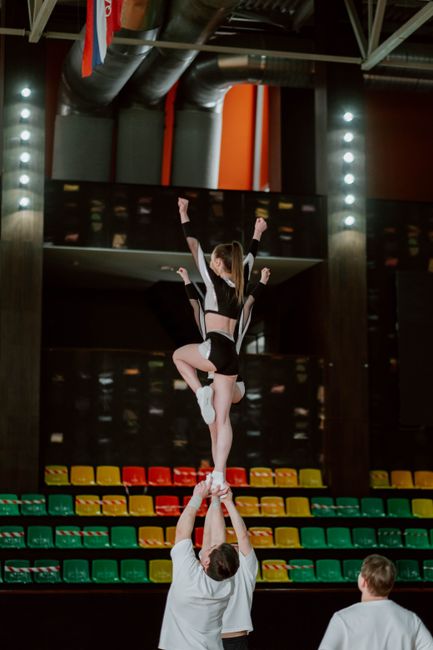
The music cuts out, the squad takes its spot on the mat, and the flyer in the middle of the stunt group feels her stomach drop. Last week she hit this stunt ten times in a row. Today there is a panel of judges, a crowd, and a landing that suddenly looks very far away. Every cheerleader, from a Level 1 all-star to a college flyer, knows some version of that moment. Mental training for cheerleaders means practicing attention, routines, self-talk and honest planning so the squad can meet that moment with more control. It is a different thing from mental health care, and it cannot promise a score.
Quick answer: Skills with research support for performing under pressure include a repeatable pre-routine, self-talk, mindfulness and a steady focus point, and they seem to work best in skills that are done the same way each time, which describes much of a cheer routine. Fear of a stunt or a tumbling skill is a safety signal: step back to a skill you own and tell your coach. See a doctor or licensed mental health professional if worry, low mood, restricting food or exhaustion are affecting daily life, and tell a trusted adult about any coach behavior that frightens or humiliates you.
General information for cheerleaders, parents and coaches. Back to the cheerleading hub. Competition-day food, schedule and bag logistics are on our competition day page; the physical side is on the training page and the injuries page.
Fear of a stunt or a skill
Fear is information, not weakness. A back handspring that used to feel easy, a new elite stunt, or a flyer who has just come off a bad fall can all trigger it. We did not find cheerleading-specific studies on how to treat fear of skills, so what follows is common coaching practice, not tested cheer science. The practice that fits the rules is the one the USASF rulebook itself states: coaches must require proficiency before skill progression. In plain words, fear is a good reason to go back to the step you can do cleanly, with mats, spotters and a coach, and build up again when that step feels solid.
- Name it to your coach. “I am scared of the full-up” gives the coach something to work with. Hiding it and throwing the skill anyway is how people get hurt.
- Make the step smaller. Drill the first half, add spotting or a softer surface, then link the parts.
- Practice the landing and the bail. A 2024 lab study of cheerleaders found that a flyer’s own landing technique, more than the bases’ catch, shaped how hard the landing hit her body. Knowing how to land and how to bail can make the skill feel less like a leap of faith.
- Rest if you are tired. Fatigue makes skills feel scarier. Our recovery page covers sleep and days off.
Trust and teamwork in a stunt group
Cheer is one of the few sports where your safety literally depends on teammates catching you. The research on trust inside cheer squads is thin, so we will not put numbers on it. What we can say from the research we did find is that the coaching environment matters. In a 2024 survey of current and retired Swedish competitive cheerleaders (Lundqvist), a high-quality coach-athlete relationship was a protective factor against harassment and abuse, and a mentally healthy environment went with high wellbeing. Practical habits many squads use, which are coaching custom rather than tested methods:
- Say the count and call “ready” out loud before every stunt, so everyone knows the group is set.
- Give feedback about the stunt, not the person: “the base on the left was late” becomes “we are early on count three.”
- Any athlete, flyer or base, should be able to say “stop, I am not ready” without being mocked.
Performing under judging pressure
A routine is at most two and a half minutes under USASF rules, and it is scored once, in front of people. A 2026 meta-analysis of 21 studies (Zeng and colleagues) looked at methods that reduce “choking,” the drop in performance under pressure. The methods included quiet eye training, pre-performance routines, mindfulness, left-hand contraction, self-talk and rational emotive behavior therapy. Performance held up better with them, and the effects were larger and more consistent in closed-skill sports, where the task is done in a stable, planned way. That description fits a rehearsed routine more than it fits a game of soccer, though the studies in the review were not on cheerleaders. Ways squads use this:
- A short pre-routine. A breath, a cue word for your first skill, a look at your spot on the mat. The same every time, at practice and on stage.
- Practice under pressure. Run full-outs for another squad, in front of parents, with a “judge” scoring. Pressure you have met before is less of a stranger.
- Focus on counts, not scores. Your eight-counts, your catch and your landing are in your control. The panel is not.
- Imagery. Walk through the routine in your head, from your own eyes, including the landing. The research on imagery is mixed: a 2026 review of imagery in gymnasts (Yang) found 16 studies with mixed results and weak quality, so treat it as one tool, not a fix.
For the warm-up rotation, what to eat and how a long competition day runs, see the competition day page.
Confidence after a fall
A dropped stunt in a routine, a hard fall in practice or time off with an injury can all shake confidence. After an injury, a doctor or athletic trainer decides when you can return, not your mood and not the competition calendar. A 2025 systematic review of 62 studies (Liu and Noh) found that questionnaires on psychological readiness have value for predicting outcomes after injury, including return to sport, and said more research is needed on injury-specific measures. A 2025 review of 24 qualitative studies (Liu, Noh and Kim) found that injury often disrupts athletic identity, and that some athletes rebuild it through other roles, such as coaching or helping the squad. In the Swedish cheerleading survey, anxiety and depression scores above the clinical cut-off were linked to injury episodes.
- Stay part of the squad while you heal: count for the group, watch video, help with choreography.
- After a bad routine, give yourself a short debrief with one thing that worked, one thing to fix, then let it go.
- Coaches: drops happen. A squad that is punished for a drop learns to hide fear, which is the opposite of what keeps people safe.
When it is a health matter, not a mental skills matter
Mental performance skills help with focus and nerves. They are not treatment for anxiety, depression, disordered eating, burnout or abuse, and a mental skills coach is not a substitute for a licensed professional. The 2026 International Olympic Committee consensus statement on mental health in elite athletes says mental health symptoms and disorders are common in elite athletes, can have sport-related causes, and can affect performance. It says management should address the training and competition environment too, and that with appropriate support many athletes continue to train and compete.
- Anxiety and low mood. In the 2024 Swedish survey of 284 cheerleaders, 33.1% of participants scored in the range suggesting anxiety and 8.9% in the range suggesting depression. These are screening scores in one country, not diagnoses. If worry or sadness is hard to switch off, talk to a doctor or licensed mental health professional.
- Body image and disordered eating. In a 2022 survey of 268 female competitive cheerleaders (Smith and colleagues), 34.4% showed eating disorder risk, with higher risk among college cheerleaders than all-star ones. The cheerleaders wanted to be smallest in a midriff uniform, and felt their coaches wanted them to be smallest too. Weighing, comments about bodies and uniform pressure are health issues, not motivation. If you notice restricting, fear of weight gain, hiding food, purging or extra workouts, see a doctor; the ANAD helpline is 1-888-375-7767. A 2026 study of 15 elite female cheerleaders in Japan measured high energy use, around 2,600 kcal per day on average, so under-eating costs real fuel; see our nutrition page.
- Abuse and misconduct. The Swedish survey found psychological abuse reported by 21.6% of current and 53.5% of retired cheerleaders. If a coach humiliates, threatens or controls you, tell a parent or trusted adult. In the United States you can also contact the U.S. Center for SafeSport (uscenterforsafesport.org).
- Burnout. Constant exhaustion, dread of practice or loss of enjoyment deserve a conversation with a doctor, not only more mental training.
- Crisis. In the United States, call or text 988 (Suicide and Crisis Lifeline) any time. Outside the US, use your local emergency number or crisis line.
For performance skills such as routines and imagery, the Association for Applied Sport Psychology lists resources at appliedsportpsych.org. Young cheerleaders and their families may also want the youth page.
Cheerleading mental training: FAQs
How do I get over fear of a stunt or back handspring?
Tell your coach, then go back to a step you can do cleanly, with mats and spotting, and build up again. USASF rules say coaches must require proficiency before skill progression, so stepping back is within the rules and not a failure. We did not find cheer-specific studies on treating this fear.
How can I calm nerves before judges?
Use the same short routine every time: a slow breath, a cue word, eyes on your spot. A 2026 meta-analysis found routines, self-talk, mindfulness and quiet eye training helped performance hold up under pressure, with clearer effects in closed-skill tasks. It does not guarantee a score.
Does visualization help cheerleaders?
It may help some athletes, but the evidence is mixed. A 2026 review of imagery in gymnasts, a related sport, found mixed results and weak study quality. Use it in addition to practice, never in place of it.
How do I rebuild confidence after falling out of a stunt?
Check first that you are physically fine and cleared by a doctor or athletic trainer if you were hurt. Then return in small steps with your coach, and keep a role in the squad while you recover. If fear stays strong or you feel low for weeks, see a licensed professional.
Is it normal for a coach to comment on my weight?
It is common enough to be studied, and it is a health risk, not motivation. In a survey of 268 female competitive cheerleaders, 34.4% showed eating disorder risk, and athletes felt their coaches wanted them to be smallest. Talk to a parent or doctor and see the health section above.
Sources
- USASF Cheer Rules, effective June 1, 2026 (PDF)
- Zeng et al. 2026, counteracting choking under pressure, meta-analysis, Psychol Sport Exerc (PubMed)
- Yang 2026, mental imagery and performance in gymnasts, Front Psychol (PubMed)
- Muller et al. 2024, landing in cheerleaders, Front Sports Act Living (PubMed)
- Lundqvist 2024, harassment, abuse and mental health among Swedish cheerleaders, J Sports Sci (PubMed)
- Smith et al. 2022, eating disorder risk and body image dissatisfaction in female competitive cheerleaders, Int J Environ Res Public Health (PubMed)
- Ichikawa et al. 2026, total energy expenditure of elite female cheerleaders, J Int Soc Sports Nutr (PubMed)
- Liu and Noh 2025, psychological readiness scales and return to sport, BMC Psychol (PubMed); Liu, Noh and Kim 2025, athletic identity and sport injury (PubMed)
- IOC consensus statement on mental health in elite athletes 2026 (PubMed)
- 988 Suicide and Crisis Lifeline (988lifeline.org); ANAD helpline (anad.org); U.S. Center for SafeSport (site); AASP (appliedsportpsych.org)
General information for education only, not medical advice. It does not replace a doctor, licensed mental health professional or qualified coach. See our editorial policy for how we research and write.