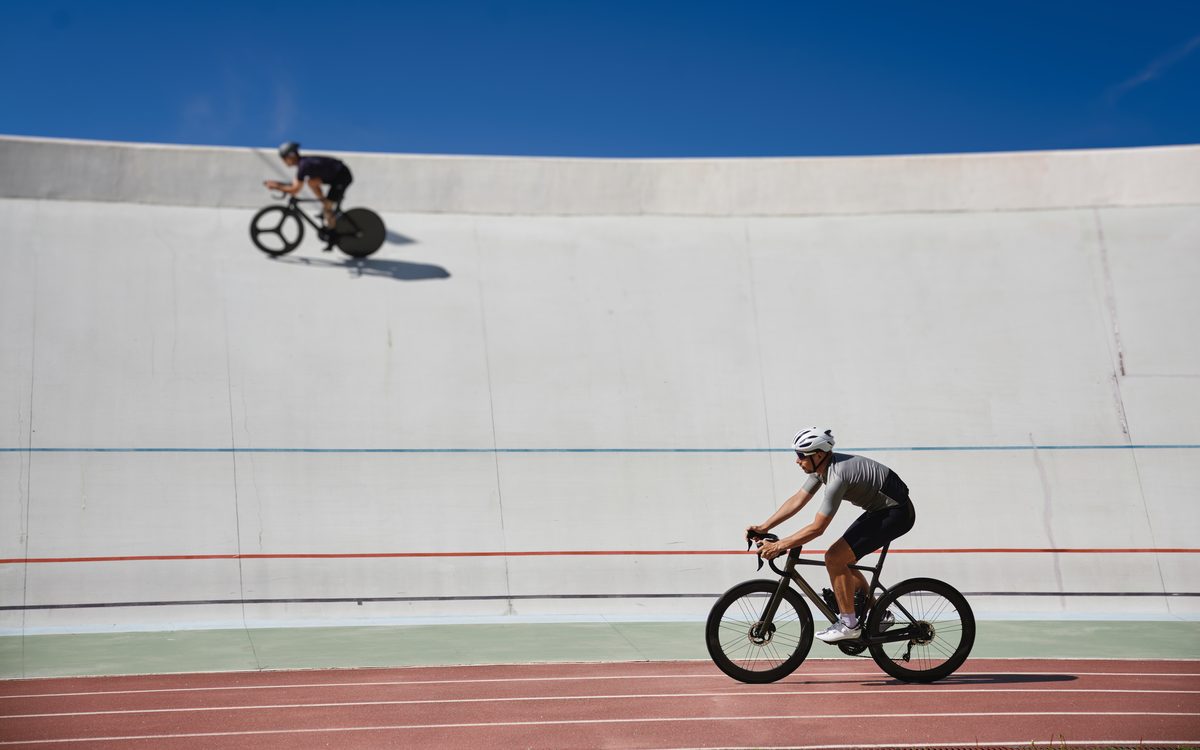
Picture a 4,000 m team pursuit in the last kilometre: four riders in a line, the leader swinging up the banking to give way, the next one taking over a wheel that is already close to the limit. The whole sport is built on how well an engine, a body and a plan hold up in efforts that last from about ten seconds to about four minutes. Track cycling training is the planning of those efforts, the strength work behind them and the rest between them. We cover the sport itself on the track cycling hub and the basics of riding it on our getting-started page.
Quick answer: Track events demand very different things: sprinters need top-end power in seconds, endurance riders need a high sustained power plus the ability to ride just above it. Published training data from elite squads show mostly easy riding with a small share of hard work, plus gym sessions. Use the examples as context, not as a prescription, and work with a certified coach, especially if you are under 18 or returning from injury.
What each kind of track rider asks of the body
A 2005 study by Dorel and colleagues (International Journal of Sports Medicine) measured 12 world-class French track sprinters and found a mean maximal power of about 1,600 W, reached at about 130 rpm, and linked 200 m performance to maximal power relative to frontal area and to the rider’s optimal pedaling rate. A 2023 study of 13 world-class and elite sprinters (Wackwitz and colleagues, Journal of Sports Sciences) reported maximal power of about 2,112 W in the seven men and 1,223 W in the six women, and found standing profiles produced higher maximal power than seated ones. A 2026 machine-learning study of 333 elite male sprinters (Kim and Park, Sports Medicine Open) found a 30-second ergometer test and flying-distance results helped predict track sprint performance. Those are elite numbers. They tell you what the event rewards, not what a beginner should chase.
Endurance events lean on a different measure. Pugh and colleagues (2022, International Journal of Sports Physiology and Performance) tested three four-man team-pursuit squads and found the international team had a higher critical power (407 W versus 381 W and 376 W) while their anaerobic work capacity was similar. The better team also recovered faster at 25 and 50 W below critical power, which is what riders do when they sit in the draft. In short, riding just below your limit and bouncing back counts as much as the size of your burst.
What elite training looks like, according to the data
Stadnyk and colleagues (2024, International Journal of Sports Physiology and Performance) followed five male team-pursuit riders in the 36 weeks before a 2018 Commonwealth Games world record. On-bike sessions made up about 70% of sessions, gym or strength training about 13%, and the riders covered about 11,246 km. More than 65% of training by heart rate and 70% by power was in the low-intensity zone, while only 5.3% (heart rate) and 7.7% (power) was above threshold. A second paper on the same squad found 81% of weekly training below the first lactate threshold in two record-breaking seasons. The authors called it a pyramidal pattern: lots of easy work, a middle layer, a little very hard work. This is a tiny sample of five national-level men, so it is a description of one group, not proof of the best method.
A broader 2022 mapping review (Stadnyk and colleagues, Sports Medicine) searched 4,019 records and found 71 studies on track cyclists, most about testing, and none a true experiment. That matters for you as a reader: much of what coaches do is based on experience, and a 2024 survey of 159 track coaches, practitioners and athletes (Stadnyk and colleagues, Journal of Science and Medicine in Sport) found people relied mainly on prior experience.
A sensible weekly shape (general coaching practice)
The following is how many coaches organize a week for a club-level rider with a full-time job. It is general practice, not a study result, and the numbers are examples. Adjust it with a coach.
- Two track or specific sessions. One for starts, accelerations or flying efforts if you sprint; one for pace and group riding if you race mass-start events.
- One or two easy endurance rides. This is where most of the hours go, matching the pyramid pattern in the elite data.
- One or two strength sessions. Lifting, jumping and trunk work, with the heavy exercises learned under supervision.
- A full rest day, and a lighter week every few weeks.
Strength and conditioning
Strength work is common in track programs, and the published support is modest. A 2026 meta-analysis of heavy strength training in cyclists (Llanos-Lagos and colleagues, European Journal of Applied Physiology; 17 studies, 262 participants) found it improved efficiency, anaerobic power and performance but not VO2max, with low-quality evidence overall. A 2026 narrative review of resistance training for cyclists (de Pablos and colleagues, Scandinavian Journal of Medicine and Science in Sports) discusses one to two sessions a week at 60 to 85% of one-repetition max using three to five compound lower-body lifts. The CDC adult guidelines suggest at least two days a week of muscle-strengthening for all major muscle groups. A 2026 study of 19 elite sprinters (Thompson and colleagues, Sports Biomechanics) found simple isometric tests, such as an on-bike push at a set crank angle, were repeatable and linked to peak power, which is why some teams use them to track progress.
Periodization basics
Periodization means arranging the year: a base period with more easy volume, a build with race-specific intensity, a peak with reduced volume before key events and a break afterward. Coaches adapt it to the calendar, such as the UCI Track World Cup (six meetings from October to January) and national championships. Elite teams also plan special blocks. A 2023 study of nine male team-pursuit riders (Tebeck and colleagues, European Journal of Sport Science) found heat acclimation in the weeks before a world record raised plasma volume by 8.2% while hemoglobin mass stayed the same. That is an elite team tool, not a beginner one.
Training load belongs to your whole life, so keep an eye on sleep, food and stress. See recovery and nutrition. Link to the sport’s data tools on our cycling wearables page.
Track cycling FAQs
Should a track sprinter and a pursuiter train the same way?
No. Sprint events reward peak power and acceleration, while pursuit and team-pursuit events reward high sustained power and recovery while riding in a draft. Studies of each group show different limiting factors. A coach can tailor the mix.
How much of my training should be hard?
The elite team-pursuit data in Stadnyk 2024 showed only about 5 to 8% of training above threshold in a 36-week period. That is one small group of national-level men, so use it as context, not a target.
Do track cyclists lift weights?
Many do. In the same elite squad, about 13% of sessions were gym or strength work. Meta-analyses suggest heavy strength training can help efficiency and anaerobic power, but evidence quality is low.
Can I use a power meter or heart rate strap?
Many riders do. Our cycling wearables page covers options. Data helps most when a coach or a plan gives it context.
Is it safe for teenagers to start heavy lifting?
Youth strength work should be supervised by a qualified coach. The American Academy of Pediatrics recommends 1 to 2 days off a week from a main sport; talk to a pediatrician or sports medicine doctor.
Sources
- Dorel et al. 2005, torque and power-velocity in world-class track sprinters (PubMed)
- Wackwitz et al. 2023, power-cadence profiles in track sprint cyclists (PubMed)
- Kim and Park 2026, track sprint performance in elite male cyclists (PubMed)
- Pugh et al. 2022, critical power and recovery in team-pursuit cyclists (PubMed)
- Stadnyk et al. 2024, training for elite team-pursuit cyclists, part I (PubMed)
- Stadnyk et al. 2024, training for elite team-pursuit cyclists, part II (PubMed)
- Stadnyk et al. 2022, systematic mapping review of track cycling research (PubMed)
- Stadnyk et al. 2024, survey of track cycling coaches, practitioners and athletes (PubMed)
- Thompson et al. 2026, isometric benchmark tests in elite track sprinters (PubMed)
- Tebeck et al. 2023, heat acclimation before a team-pursuit world record (PubMed)
- Llanos-Lagos et al. 2026, heavy strength training in cyclists (PubMed)
- de Pablos et al. 2026, resistance training for cyclists (PubMed)
- CDC: physical activity guidelines for adults
- Wikipedia: Track cycling (World Cup calendar, general format facts)
General information for education only, not medical advice. It does not replace a sports medicine doctor, physical therapist, athletic trainer or registered dietitian who knows you. See our editorial policy for how we research and write. More on this sport: track cycling hub, cycling hub and all sports.