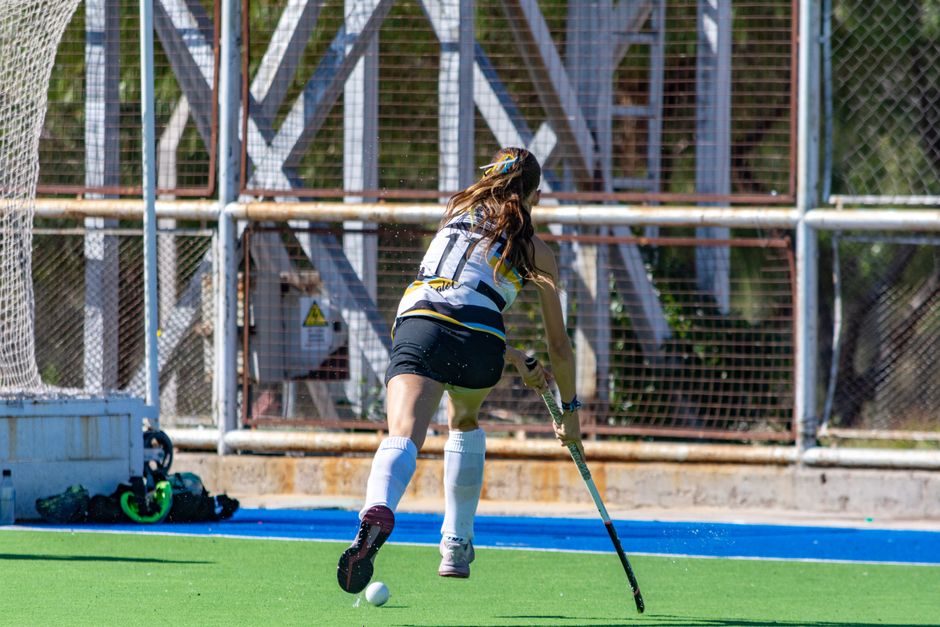
The whistle goes for a penalty corner in the last minutes of a tight game. The injector sets the ball, the defenders crouch behind the goal line, the goalkeeper is already breathing hard inside the pads, and for a few seconds every player on the pitch is doing the same thing: trying to stay calm enough to do the simple job well. Field hockey mental training means practicing the skills between your ears (focus, routines, quick decisions, trust in teammates, a plan for the next play) the way you practice your push pass. This page is for players, parents and coaches. It is about mental performance, which is different from mental health; there is a clear section on that difference below.
Quick answer: Mental skills are trainable habits: a short routine before set plays, one or two simple cues, practice under a little pressure, and a plan for the next play after a mistake. Research on field hockey players is small and mostly describes what players do, so none of it promises a better result. If worry, low mood, or trouble eating or sleeping lasts more than a couple of weeks or gets in the way of daily life, see a doctor, licensed psychologist or other qualified professional, and in a crisis call or text 988 (US).
Penalty corners and shootouts: pressure moments
Penalty corners are among the most likely ways to score, which is why they feel so heavy. In an analysis of 319 penalty corners in elite women’s indoor hockey in England (Vinson and colleagues, Journal of Sports Sciences, 2013), 22.6% ended in a goal, and tactical choices mattered: corners taken from the goalkeeper’s right were more likely to score, and goals were less likely when the goalkeeper rushed out to the edge of the circle. That tells players that decisions, not just nerve, shape the outcome, and that the numbers come from one indoor competition.
Shootouts add a different kind of pressure: one attacker, one goalkeeper, everyone watching. A 2023 study from New Zealand (Hoskens and colleagues, Psychology of Sport and Exercise) tested the idea of “reinvestment,” where thinking too hard about how to move can disrupt a skill. Players who scored higher on conscious motor processing did worse in shootout scenarios, but not in one-on-one play in open play. It suggests that, when the moment is still and personal, filling your head with technique instructions may not help. It does not tell us what to say instead; one simple cue and a settled routine are common coaching choices, not a tested fix.
A 2026 position statement from Exercise and Sports Science Australia on performance under pressure (Schweickle and colleagues, Sports Medicine) lists pre-performance routines among the evidence-based strategies, along with psychological skills training and mindfulness-based approaches. It also says pressure can help as well as harm, and that practice with some pressure can prepare athletes. In hockey terms, that could mean finishing a training session with penalty corners or shootouts where the result counts for something small, such as who carries the cones.
Nerves are normal and measurable. In a 2026 study of 52 elite Spanish women’s players during a national cup (Stress and Health), players who went on to lose their matches had higher morning cortisol rises than players who went on to win, and the rise was moderately linked with self-reported anxiety. The authors caution that it is not a reliable marker of stress or performance for any individual. It shows that match day feels different to the body; it does not show that nerves cause losses.
Decision-making on the pitch
Field hockey asks for quick choices with a stick in your hands: pass, dribble, shoot, or go wide. Two eye-tracking studies give a first look. In a 2025 study of 15 skilled youth players in 3 versus 3 situations (European Journal of Sport Science), the first place a player looked was most linked with a correct decision, and players who first looked at open space tended to decide best; every player looked at the ball last before acting. It is a small study with set scenarios, so treat it as a clue and not a rule.
On penalty corners, a 2021 study of experienced players (Frontiers in Psychology) found that attackers considered reacting to the defenders’ behavior a promising approach, but rarely used it, and that looking at the ball, the stopper and the goal area helped players adapt to the defense. The authors conclude that adapting at the moment of the injection looks promising and needs more training.
How you practice matters too. A 2019 study of 13 under-14 players (Research Quarterly for Exercise and Sport) found that small-sided games with fewer players brought more technical actions per player, and that a possession game produced more passes and fewer dribbles than a normal game. Coaches can use game rules to nudge players toward the decisions they want to practice. For the running side of those games, see our field hockey training guide.
Confidence, coping and goals
Confidence grows from proof: tackles won in training, a drag flick you can repeat, a fitness test you passed. Split goals into three kinds: outcome (make the team, win the league), performance (win your one-on-ones, complete passes under pressure) and process (scan before receiving, reset your stick position). Process goals stay in your control when the scoreboard does not go your way.
A 2023 study of 60 South African national and university women’s players (Journal of Human Kinetics) found that players with higher emotional intelligence scores reported better ability to cope with adversity, to concentrate and to keep confidence and motivation, and that national players scored higher than university players on several coping measures. The study is a one-time survey, so it cannot say which causes which.
Imagery and preparation also show up in talent research. A 2023 study of 267 women in a North American national talent program (Journal of Sports Sciences) found that players selected for age-group teams differed from those not selected in imagery and active preparation, and in perfectionist tendencies. It describes group differences before the season, and does not show that imagery improves selection chances. A 2023 review across sports (Reinebo and colleagues, Sports Medicine) found moderate effects for imagery and mindfulness-based approaches, but the authors report that the effects were not stable once weaker studies were removed. We found no field hockey-only trial; treat imagery as an add-on to real practice.
Pressure training and mental toughness
One small study used a Division I women’s field hockey team. In 2025 (International Journal of Exercise Science), 15 players had five one-hour sessions on psychological skills, then two strength and conditioning sessions with team-relevant demands and consequences. Mental toughness scores rose after the pressure sessions, and higher scores beforehand were linked with better performance in them. There was no comparison group and the sample was one team, so it shows that the approach is workable, not that it works.
Teamwork and the goalkeeper
We found no field hockey study that tests a way to build team chemistry, communication on the pitch, or a penalty-corner defense mindset, so we do not offer a method here. Common coaching practice is to give each player a clear job on set plays, agree short calls, and talk openly about line-ups. Treat that as practice, not proof.
For goalkeepers specifically, the research we found is about what they read, not how they feel. A 2012 case study of one skilled drag-flicker (Journal of Human Kinetics) suggested that useful information for goalkeepers may appear at the ball-and-stick position before the dragging action. One player is not a rule. We found no goalkeeper mindset study; full kit also makes goalkeepers hot, so see our game-day guide for heat and breaks.
After a mistake
Every player gives away a ball, misses a trap or concedes a corner. How fast you return to the next play matters more than the error. Many coaches teach three steps: acknowledge it (a slow breath), learn one thing (“I looked at the ball, not the space”), and move to the next job. Talk to yourself the way you would to a teammate. We found no field hockey study that tests a reset routine, so this is common coaching practice, not a proven method. Heavy playing schedules can wear on players; see our recovery guide and injuries guide.
Preparing for a match
Put the mental pieces into the days before: one or two imagery sessions of your role on penalty corners and shootouts, a few set-play routines you can repeat, one or two process goals, and enough sleep. Meals, fluids, quarter breaks and tournament logistics are in the game-day guide; rules for penalty corners and shootouts are in the rules guide. Young players have their own page: youth field hockey.
Mental performance is not the same as mental health
Everything above is about performance skills. Anxiety disorders, depression, disordered eating and burnout are health matters, not mindset problems, and a better routine does not fix them. The 2026 International Olympic Committee consensus statement on mental health in elite athletes (Reardon and colleagues, British Journal of Sports Medicine) treats them as medical and psychological care issues.
Field hockey players are not exempt. A 2023 survey of 187 German players (Scandinavian Journal of Medicine and Science in Sports) found depression symptoms in 18.3% of women and 4.8% of men, higher scores in players with 60 or more matches in the past year, and that only 4 of the 20 players with depression symptoms had received counseling or therapy. Signs to take seriously include worry or low mood lasting weeks, panic before games, withdrawing from the team, or big changes in eating or sleep. Start with your doctor, a licensed psychologist or other qualified mental health professional. In the US, you can call or text 988 (Suicide & Crisis Lifeline) at any time. For eating worries, see our nutrition and supplements guide and talk to a clinician.
Frequently asked questions
How do I stay calm before a penalty corner or shootout?
Use the same short routine every time, such as a slow breath and one cue word, and practice it under a little pressure in training. A 2023 study found that more conscious thinking about movement went with weaker shootout performance, so keep instructions simple. Nerves are normal.
Where should I look when I receive the ball?
One 2025 study of 15 youth players found that first looking at open space went with better decisions in 3 versus 3 scenarios. It is one small study; ask your coach what fits your position.
How do I bounce back after giving away a goal?
Pick a reset cue, such as a breath or a stick tap, rehearse it in practice, take one lesson and move to the next play. We found no study that tests this in field hockey, so it is coaching practice.
Do goalkeepers need different mental training?
We found no study of goalkeeper mindset in field hockey. Goalkeepers face set plays and shootouts, so the routines above apply, and a coach who works with goalkeepers can tailor them.
Should my daughter or son see a sport psychologist?
Most young players need fun, supportive coaching, not a specialist. If a child shows lasting distress, start with their pediatrician or a licensed mental health professional.
Sources
- Vinson D et al. Penalty corner routines in elite women’s indoor field hockey: prediction of outcomes based on tactical decisions. Journal of Sports Sciences, 2013. PMID 23305340
- Hoskens MCJ et al. Reinvestment in one versus one in-field and shoot-out field hockey performance. Psychology of Sport and Exercise, 2023. PMID 37665924
- Anticipatory Cortisol Regulation During Competition in Elite Female Field Hockey Players. Stress and Health, 2026. PMID 42402792
- Examining the Gaze Behaviour and Decision-Making of Field Hockey Players In Situ. European Journal of Sport Science, 2025. PMID 41045151
- Adaptive Gaze Behavior and Decision Making of Penalty Corner Strikers in Field Hockey. Frontiers in Psychology, 2021. PMID 34408695
- Creating Appropriate Training Environments to Improve Technical, Decision-Making, and Physical Skills in Field Hockey. Research Quarterly for Exercise and Sport, 2019. PMID 30794115
- The Influence of Emotional Intelligence on Coping Ability in Senior Female Field-Hockey Players in South Africa. Journal of Human Kinetics, 2023. PMID 37229407
- Psychological characteristics of developing excellence in talented female field hockey players. Journal of Sports Sciences, 2023. PMID 37132613
- Enhancing Mental Toughness and Strength and Conditioning Performance in Collegiate Athletes Through Pressure Training. International Journal of Exercise Science, 2025. PMID 40487838
- Gómez M et al. Kinematic pattern of the drag-flick: a case study. Journal of Human Kinetics, 2012. PMID 23487429
- Prevalence of symptoms of depression and generalized anxiety disorder in field hockey players of German first and lower leagues. Scandinavian Journal of Medicine and Science in Sports, 2023. PMID 37309991
- Reinebo G et al. Effects of Psychological Interventions to Enhance Athletic Performance: A Systematic Review and Meta-Analysis. Sports Medicine, 2023. PMID 37812334
- Schweickle MJ et al. Performance Under Pressure in Sport: A Position Statement from Exercise and Sports Science Australia. Sports Medicine, 2026. PMID 42271117
- Reardon CL et al. Mental health in elite athletes: International Olympic Committee consensus statement (2026). British Journal of Sports Medicine. PMID 42580854
- 988 Suicide & Crisis Lifeline
General information for education only, not medical advice. It does not replace a doctor, psychologist or other qualified professional. See how we work in our editorial policy. Back to the field hockey hub.