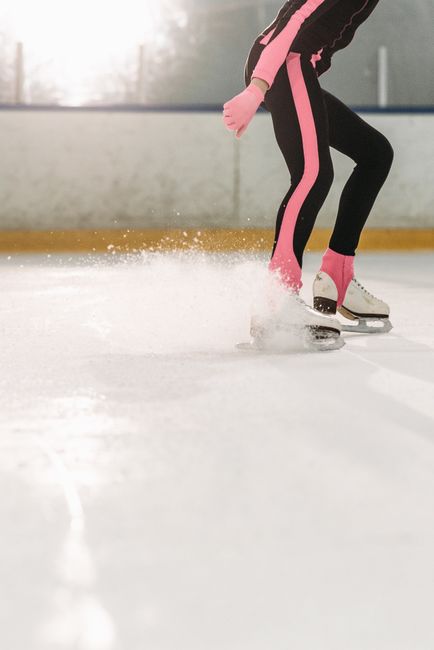
The skater glides to center ice, holds the starting pose, and the arena goes quiet. In a few seconds the music will start, and the first jump is a double axel she has landed hundreds of times in practice. Her heart is pounding anyway. Mental training for figure skaters means practising attention, routines, self-talk and honest planning so you can meet that moment with more control. It is separate from mental health care, and it cannot promise a score or a landing.
Quick answer: The mental skills with the best support for skaters are a fixed pre-program routine, calm breathing, short cue words and a plan for what to do after a fall. A 2026 meta-analysis found these kinds of techniques reduced the drop in performance under pressure, especially in sports where the athlete starts the movement, though no technique guarantees a result. See a doctor or licensed mental health professional if anxiety, low mood, restricting food or exhaustion are affecting daily life, or if a fear of jumps keeps you from skating at all.
General information for skaters, parents and coaches. Back to the figure skating hub. Warm-up groups, rink-cold, food and the competition bag are on our competition day page; the physical side is on the training page and the injuries page.
Why skating is mentally different
Skating is a closed-skill sport: you start the movement yourself, alone on the ice, with no teammate to pass to and no opponent to react to. Jumps must be landed on one blade, in front of judges, in a program that lasts 2 minutes 40 seconds (short program) or up to 4 minutes (senior free skate) under International Skating Union (ISU) rules as of 2026.
It is also why researchers have started asking skaters directly. In a 1993 interview study of 17 of the 20 senior U.S. national champions from 1985 to 1990, the skaters described using several ways of coping, including rational thinking and self-talk, a positive focus, support from coach and family, mental preparation before competing (relaxation and visualization), and training hard and smart. They also used different strategies for different stresses. It is old and self-reported, so treat it as ideas to try.
Fear of jumps and mental blocks
Many skaters hit a stage where a jump they used to do suddenly feels impossible: they stall on the take-off, pull out of the rotation, or stop attempting it at all. Skaters often call this a mental block. We found no skating-specific study of jump fear and no tested treatment, so what follows is general coaching practice, not a proven method:
- Tell your coach early. A skater who forces a jump she is afraid of can fall badly. Fear is useful information, and a coach can change the plan.
- Go back a step. Return to the easier version of the jump (a single before the double, or off-ice drills from our training page) and rebuild one piece at a time.
- Check for a physical cause. Pain, a growth spurt, a boot that no longer fits or a past injury can all make a jump feel wrong. If a head hit was involved, follow the guidance on our injuries page.
- Ask for help if it persists. A sport psychologist or licensed mental health professional can teach breathing, imagery and routines, and can check whether something bigger is behind the fear. The Association for Applied Sport Psychology publishes resources for finding one.
Performance anxiety before you skate
Nerves before skating are common. In a 2023 survey of 137 female competitive skaters in Sweden (mean age about 13), 47% screened positive for anxiety on a questionnaire. A screening result is not a diagnosis, and this was one regional snapshot, but it shows worry is widespread and worth taking seriously.
The 2026 meta-analysis of 21 studies mentioned above looked at ways to counter “choking,” the drop in performance under pressure. The interventions included pre-performance routines, quiet-eye training, mindfulness and self-talk. Effects were larger and more consistent in closed-skill sports, where skating belongs, but the authors call for more research in real competition settings.
A routine before you skate
A pre-program routine means doing the same short sequence every time you step on the ice, so your mind has something to hold on to besides the scoreboard. Skaters and coaches commonly build one like this (general practice, not a tested protocol):
- Off-ice: the same warm-up, the same music or quiet, a few slow breaths with a long exhale.
- At the boards: a last word with your coach, then one thing to focus on, such as “tall” or “push through the ice.”
- Center ice: a breath, a look at the starting spot, the starting pose, then a quick mental picture of the first element.
- During the program: short cue words for each element rather than thoughts about scores.
Imagery. Picturing a program before skating is popular, but the evidence is modest. A 1985 experiment on 59 Canadian skaters found that four sessions of imagery training did not improve their school figures more than a control group, although senior skaters were better at kinesthetic imagery (imagining how the movement feels) than novices. It tested one narrow task, so it does not settle whether imagery helps free skating today.
When you fall in the middle of a program
Falls happen at every level. ISU rules deduct 1.0 point for a fall by a senior singles skater, as of the 2026–27 season, which is small next to the points the rest of the program can still earn. The mental task is to avoid letting one fall turn into three. Skaters and coaches usually teach a quick reset (general practice):
- Get up and find the music. Rejoin the program where it is now, not where you planned to be.
- One breath, one cue word. Use the same cue you practice for the next element.
- Skate the next element, not the last one. Save the review for the boards, where your coach can help.
- Check for injury. If you hit your head, stop; U.S. Figure Skating’s concussion guidance is immediate removal from the ice with no return until a concussion-trained professional gives written clearance (see our competition day page).
Judging pressure and perfectionism
Every element is graded, and that pressure can turn into perfectionism. A 2026 study of 47 Spanish competitive figure skaters (mean age 16.8) found that perfectionism, anxiety and pressure about the competition uniform were linked with higher risk of an eating disorder, and that perfectionism appeared to be the pathway connecting them. It was a small, cross-sectional study, so it shows links, not causes.
What helps in practice (again general coaching ideas): set goals you control (the quality of your edge, the clarity of your cue, completing the program) rather than only the score, which belongs to the judges; judge a program by what you learned, not only by the placement; and ask a coach or sport psychologist for help if your self-worth rises and falls with every result.
Body image and disordered eating: a health matter
This section is about health, not mental performance. Skating’s look, costumes and the idea that lighter jumps better can put heavy pressure on body image. In a 2026 survey in the Clinical Journal of Sport Medicine of 57 skaters aged 13 to 25, 35.1% screened positive for an eating disorder or disordered eating, 51.8% had received comments about their weight or shape, and those comments were associated with a positive screen. Fewer than 16% had heard of Relative Energy Deficiency in Sport (REDs). In a separate study of 199 elite female skaters, eating disorder symptoms were linked with a poorer relationship with parents.
Skating a hard program on too little food is not a mental skill. The International Olympic Committee’s 2023 consensus on REDs explains that low energy availability can affect health and performance. Weight comments from coaches, judges or peers, and any push to skip meals, are things to take to a trusted adult, a doctor or a sports dietitian. See our figure skating nutrition page for the fueling side.
Mental performance is not mental health care
Routines, cue words and imagery are performance tools. Anxiety that will not settle, low mood, loss of joy in skating, restricting food, panic before practice or exhaustion are health matters. The 2026 International Olympic Committee consensus statement on mental health in elite athletes says mental health symptoms and disorders are common among elite athletes, can affect performance, and with appropriate support and treatment many athletes can keep training and competing. Take these concerns to a doctor or licensed mental health professional, not only to a coach. In the United States, you can call or text the 988 Suicide and Crisis Lifeline at 988 any time; for eating concerns the ANAD helpline offers free support. In an emergency, call your local emergency number.
Preparing for competition
Logistics (warm-up groups, staying warm, fueling, the bag) are on our competition day page. Parents can help most with a simple message such as “I love watching you skate,” and by leaving technical advice to the coach. Recovery between events, especially at multi-day competitions, is covered on the recovery page.
Mental training: FAQs
How do I stop being so nervous before I skate?
You may not stop it, but you can make it manageable. Use the same routine every time, breathe out slowly, and give yourself one short cue word for the first element. A 2026 meta-analysis found routines and similar techniques reduced the performance drop under pressure, especially in sports like skating. If nerves are constant or overwhelming, talk to a doctor or licensed mental health professional.
What should I do if I’m suddenly afraid of a jump I used to land?
Tell your coach, step back to an easier version, and rebuild in small steps. Check for pain, boot fit or a past injury as well. We found no skating-specific research on jump fear, so this is general coaching advice. If the fear lasts or spreads, a sport psychologist can help.
What do I do after I fall in my program?
Get up, find the music and skate the next element. Under ISU rules a senior singles fall costs 1.0 point, and the rest of the program still counts. If you hit your head, stop and get checked.
Does visualization work for figure skaters?
The evidence is thin. A 1985 study of 59 skaters found imagery training did not beat a control group on school figures, though advanced skaters imagined movement more vividly. Many skaters still find it calming, so it is fine as an extra tool, not a guarantee.
Is perfectionism good for skaters?
Caring about quality helps, but perfectionism that makes every mistake feel like failure is linked in a 2026 study of 47 skaters with eating disorder risk. Aim for process goals, and talk to a professional if self-criticism is taking over.
Where can a skater get help for anxiety or an eating disorder?
Start with a doctor, a licensed mental health professional, or a trusted adult. In the U.S., the 988 Lifeline is available by call or text, and ANAD runs a free eating disorders helpline.
Sources
- International Skating Union, Special Regulations and Technical Rules, Single and Pair Skating and Ice Dance (2026–27 season) (PDF)
- Gould D, Finch LM, Jackson SA 1993, coping strategies used by national champion figure skaters (PubMed)
- Zeng Z et al. 2026, counteracting choking under pressure in sport, meta-analysis (PubMed)
- Jederström M et al. 2023, anxiety and depression caseness in female competitive figure skaters in Sweden (PubMed)
- Mumford B, Hall C 1985, internal and external imagery in figure skating (PubMed)
- Cordero LF et al. 2026, perfectionism and eating disorder risk in competitive figure skaters, Eating Behaviors (PubMed)
- Tietzen MA et al. 2026, eating disorders and disordered eating in figure skaters, Clin J Sport Med (PubMed)
- Scoffier S et al. 2011, disordered eating attitudes in elite female figure skaters (PubMed)
- IOC consensus statement on REDs 2023 (PubMed); IOC consensus statement on mental health in elite athletes 2026 (PubMed)
- U.S. Figure Skating Concussion Education Information (PDF)
- 988 Suicide and Crisis Lifeline (988lifeline.org); ANAD helpline (anad.org); Association for Applied Sport Psychology (appliedsportpsych.org)
General information for education only, not medical advice. It does not replace a doctor, licensed mental health professional or qualified coach. See our editorial policy for how we research and write.