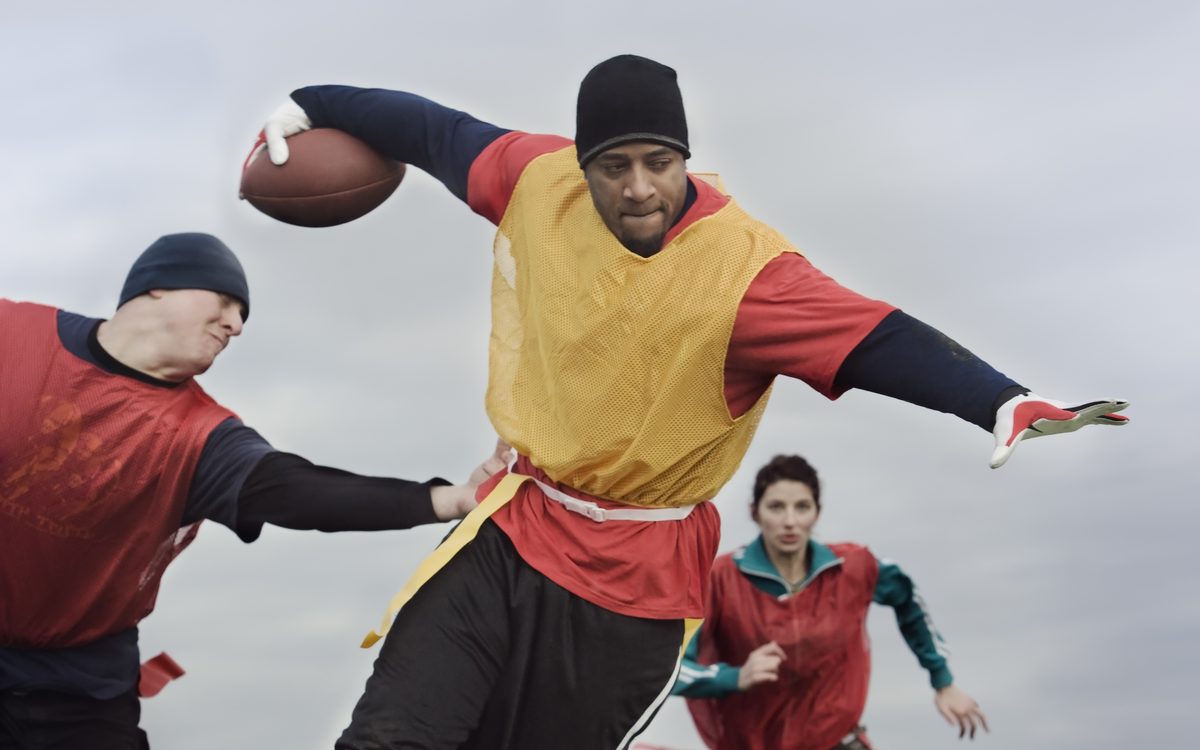
A defender reaches for a flag, the ball carrier cuts away, and their feet tangle. Both players get up slowly, one holding a finger, one rubbing a knee. Flag football injuries are usually milder than in tackle football, but they are real: bruises from collisions, sprains, jammed fingers, falls and, less often, concussions or knee ligament tears. This page walks through what the surveillance studies show, how to think about rehab in general terms, and when to see a professional. It does not diagnose anything and cannot tell you when you may play again.
Quick answer: Studies of flag football find mostly bruises, sprains and strains, finger injuries and falls, with the head, face and neck, ankle and foot, and fingers among the most common sites. Concussions and ACL tears are less common but serious. Rehab is a job for a clinician: see a sports medicine doctor, physical therapist or athletic trainer for pain that lasts, swelling, a knee that gives way, or any head injury with symptoms.
This page is about what happens after an injury. To lower your risk first, read injury prevention. Hub: flag football.
What the numbers show
Youth tournaments. A study of regional and national youth flag tournaments (1,939 players ages 6 to 12, J Athl Train, 2023) recorded 47 injuries by athletic trainers, 2.4% of players and 5.1 per 1,000 athlete-exposures. The head, face and neck accounted for 31.9% and the ankle and foot for 19.1%. Contusions (bruises) were 55.3% of injuries, and 74.5% came from direct impact. Girls had a higher risk (risk ratio 2.73), but only 195 players were girls, so the authors’ numbers are a caution, not a firm result.
Emergency departments. An analysis of US emergency department data from 2013 to 2022 (Sports Health, 2025) found 2,508 flag football injuries, an estimated 86,443 nationally. Collisions were the most common cause (35.7%). Younger players more often had head injuries and fractures, and older players more often had strains, sprains and finger injuries. A companion study of female players (Orthopaedic Journal of Sports Medicine, 2025) found 605 patients, an estimated 22,666 nationally from 2014 to 2023. Strains and sprains were the most common diagnosis (30.2%), the finger the most common body part (22.6%), falls the leading cause (19.1%) and 98.2% were treated and released. These numbers count injuries that reached an emergency department, so they miss minor ones and cannot be turned into a rate per player.
Common injury patterns
- Bruises and contusions. The most common injury in the youth tournament study, mostly from direct impact.
- Sprains and strains. The most common diagnosis in the female emergency department study. Ankles are exposed when players cut and plant.
- Finger and hand injuries. Catching and falling put fingers at risk. A finger that looks out of shape needs to be checked.
- Knee ligament injuries. AAOS says most ACL tears happen without contact, when an athlete pivots, cuts or lands with a straight leg, with a pop, a knee that gives way or swelling within 24 hours. Female athletes are at higher risk, AAOS says by 2 to 8 times.
- Hamstring strains. AAOS describes sudden sharp pain at the back of the thigh during sprinting, sometimes with swelling and bruising.
- Head injuries and concussion. The CDC found youth flag players had a median of 8 head impacts a season, against 378 in tackle, but concussions still happen from collisions and falls.
Concussion: what to do
The CDC’s HEADS UP program lists signs such as headache, dizziness, confusion and balance problems. If a concussion is suspected, remove the player from play the same day. A health care provider decides when the player can return, not the coach or the player. Call 911 for danger signs such as repeated vomiting, a seizure or a headache that gets worse. Our mental training page also covers how to cope with time off.
General rehabilitation principles
Rehab is individual, and we do not give recovery times, because they vary by injury and person. What the sources do say is general:
- Get it checked. AAOS says a sprained ankle should be checked if you cannot put weight on it or if swelling is marked. A pop, a giving-way knee or swelling within hours needs a professional.
- Rehab is more than rest. The National Athletic Trainers’ Association (NATA) position statement on ankle sprains (Kaminski and colleagues, 2013) recommends a balance training program of at least 3 months after a sprain, plus tape or a brace for return to sport, because a previous sprain is the most consistent risk factor for another.
- Gradual return. A physical therapist or athletic trainer builds a graded return, from walking to jogging to cutting to game play, and a clinician makes the clearance decision.
- Keep the rest of your body moving when your clinician says it is safe, so you do not lose fitness while an injury heals.
Return-to-play is a medical decision. This page does not clear anyone to play, and we do not offer universal healing timelines.
When to see a professional
- Pain that lingers, returns or wakes you at night.
- Swelling, bruising that spreads, or a joint that looks out of shape.
- A knee that gave way, locked or popped.
- Inability to put weight on a leg, or to grip or catch with a hand.
- Any head injury with symptoms, and always for danger signs.
Athletic trainers are licensed or regulated in all 50 states, according to the NATA, and many leagues and schools have one on site. See also recovery and mobility for sleep, load and soreness.
Flag football injuries FAQs
What are the most common flag football injuries?
In a youth tournament study, bruises were 55.3% of injuries, mostly from direct impact. In emergency department data on female players, strains and sprains were the most common diagnosis (30.2%) and the finger the most common body part (22.6%).
Are ACL tears common in flag football?
We did not find a flag-specific ACL rate. AAOS says most ACL tears are non-contact, from pivoting, cutting or landing, which flag involves. Female athletes face a higher risk.
Can you get a concussion playing flag football?
Yes. The CDC found far fewer head impacts per season than in tackle, but collisions and falls still cause concussions. Remove the player and see a health care provider.
How long does a sprained ankle take to heal?
It depends on the injury. We do not give times. AAOS says to have it checked if you cannot put weight on it or the swelling is marked.
When can I play again after an injury?
Only a clinician can clear you. A typical return is gradual, with strength, balance and movement checks along the way.
Sources
- Youth flag football tournament injuries, J Athl Train 2023
- NEISS flag football injuries 2013-2022, Sports Health 2025
- Female flag football injuries, Orthop J Sports Med 2025
- CDC, comparing head impacts, flag vs tackle
- CDC HEADS UP, signs and symptoms
- CDC HEADS UP, response
- AAOS OrthoInfo, ACL injuries
- AAOS OrthoInfo, sprained ankle
- AAOS OrthoInfo, hamstring muscle injuries
- NATA ankle sprain position statement (Kaminski 2013)
- NATA, about athletic training
General information for education only, not medical advice. See a sports medicine doctor, physical therapist or athletic trainer about your own situation. How we write and check our pages is in our editorial policy.