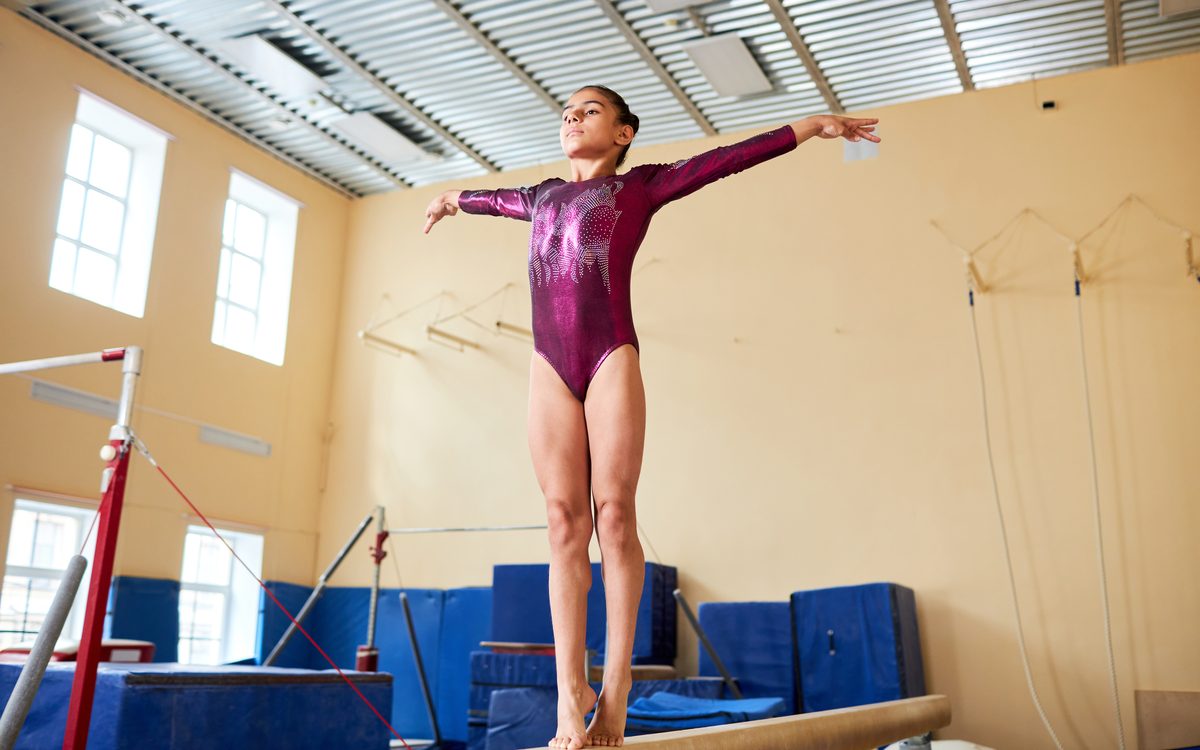
The landing looked fine. The gymnast stuck it, saluted, and walked off the floor, and only in the van home did the back of her ankle start to throb. Artistic gymnastics injuries range from ankle sprains and sore wrists to bone stress injuries and, less often, tendon ruptures and head injuries. This page names the usual patterns with the numbers behind them and explains how rehabilitation is generally approached. It cannot diagnose anything or say when a gymnast may return to training; that is a clinician’s decision.
Quick answer: In studies of college and elite artistic gymnasts the ankle, wrist, lower back, knee, Achilles tendon and elbow come up most often, and men tend to have more upper-body injuries than women. Competition carries a higher injury rate than practice. See a sports medicine doctor, physical therapist or athletic trainer for pain that keeps coming back, and call emergency services for a head injury with danger signs.
How often gymnasts get hurt
Numbers differ by study, level and how injuries are defined; a 2024 consensus statement for artistic gymnastics says reported incidence varies widely partly because injuries are defined and reported inconsistently (Casey 2024). Keep that in mind with the figures below.
| Study | Who | Main finding |
|---|---|---|
| Kerr 2015 (J Athl Train) | NCAA women, 2009-10 to 2013-14 | 9.22 injuries per 1000 athlete-exposures; competition 14.49 vs practice 8.69; ankle 17.9%, lower leg or Achilles 13.6%, trunk 13.4%, foot 12.4%; floor 41.9% and uneven bars 28.2% of apparatus injuries |
| Marshall 2007 (J Athl Train) | NCAA women, 1988-2004 | Competition 15.19 vs practice 6.07 per 1000; about 70% of competition injuries from floor landings or dismounts |
| Westermann 2015 (Sports Health) | One Division I program, 2001-2011 | Men 8.78 and women 9.37 per 1000; men most often hand or wrist (24%), women foot or ankle (39%) |
| Kruse 2021 | Elite US men, 2008-2018 | 180 injuries among 2,102 gymnasts; ankle the top site, vault the top event; 58.5 per 1000 gymnasts in competition vs 27.1 in training; concussion 5.7 per 1000 |
| Charpy 2023 | French elite women, six seasons | 91.4% of gymnasts injured at least once a season; 1.8 injuries per 1000 hours; knee 16%, elbow 12%, ankle 12%; 88% of injuries needed a change in training |
For children, a 2022 study of US emergency department data (Tisano) estimated about 72,542 youth gymnastics injuries a year; wrist and lower arm fractures were more common in childhood, and ankle injuries and concussions more common in adolescence.
Ankle and foot
Sprains are the leading diagnosis in NCAA women (ligament sprain 20.3%, Kerr 2015), and the ankle is the top injury site in elite men (Kruse 2021). Rehabilitation after a sprain generally focuses on controlling swelling early, restoring motion, then strength, balance and landing control before full skills. Marshall and colleagues recommended a brace or tape for gymnasts with a prior sprain.
Achilles and lower leg
A 2023 survey of NCAA programs counted 71 Achilles ruptures from 2013 to 2018 (42 of 80 programs responded); 95% happened on floor, 98% on the take-off of a tumbling skill, and 46% had pain at the tendon beforehand (Kobayashi 2023). A separate survey found 18 of 21 ruptures occurred after more than 10 years of competitive gymnastics (Muhlenhaupt and Stauss 2024). Lingering heel or tendon pain deserves evaluation. A sudden pop or feeling of being kicked at the back of the ankle needs urgent medical care. Young gymnasts also get shin-bone stress injuries; see below.
Wrist and hand
Wrist pain is the most common overuse complaint. A 2026 meta-analysis of 25 studies found a pooled prevalence of about 53% (DiLeo 2026), linked to age 10 to 14, training intensity, years of training and weekly hours. “Gymnast’s wrist,” or distal radial epiphysitis, is irritation of the growth plate at the thumb side of the wrist; Children’s Mercy describes pain that is worse with impact and weight bearing, mild swelling and reduced motion, diagnosed by exam and X-ray. It needs a clinician because growth plates are involved.
Back
A 2026 systematic review found low back pain in 25 to 50% of competitive gymnasts, rising with age and training volume (Qin 2026). AAOS describes spondylolysis as a stress fracture in the vertebra’s pars interarticularis that is common in gymnastics and often feels like a muscle strain, with pain that may spread to the buttocks and thighs and worsens with activity; most cases are treated without surgery. A 1976 study of 100 young female gymnasts found defects in 11%, about four times the rate of non-athletic peers (Jackson 1976). Back pain that lasts should be assessed.
Elbow and shoulder
A 2022 review (Bonazza) of elbow overuse in youth gymnasts describes lateral elbow injuries such as osteochondritis dissecans of the capitellum and radial head stress fractures. A 2026 review of injuries in male and female artistic gymnasts lists medial elbow injuries, spondylolysis, gymnast’s wrist, knee ligament injuries and Achilles ruptures as common, and notes that scoring changes since 2004 encouraged harder skills (Hadley 2026). In men, a literature review reports the upper body, especially the shoulder, as the most common site, in contrast with women’s lower-limb pattern (PMID 30407945); we saw only a summary of it.
Bone stress injuries
A 2026 study of 129 young female gymnasts found tibial bone stress injuries in 64.7% of pre-pubertal, 30.9% of early-pubertal and 4.4% of late-pubertal gymnasts, with weaker tibial and calf strength in those with repeated episodes (Steinberg 2026). Bone stress injuries can also signal that a gymnast is not eating enough for the training; see nutrition and athlete health.
Concussion
Head injuries happen in gymnastics from falls, short landings and missed catches. The CDC’s HEADS UP guidance says to recognize the signs, remove the athlete from play right away, and let a health care provider decide when it is safe to return. Call 911 for loss of consciousness, a worsening headache, repeated vomiting, seizure, confusion, or neck pain or weakness.
Rehabilitation principles
This is general information, not a plan.
- Get a diagnosis first. Treatment for a sprain, growth plate irritation, stress fracture and tendon injury differ.
- Rehab is staged. Clinicians generally progress from protecting the area, to motion, to strength and control, to sport-specific skills such as landings. The speed depends on the injury and the person, so no universal timeline is given here.
- Train around it. Under a clinician’s guidance, some gymnasts keep up conditioning on unaffected areas. Core stability work for 8 to 12 weeks reduced low back pain in studies in the Qin review.
- Do not return early. USA Gymnastics’ policy lists returning to training prematurely after a serious injury without medical clearance as misconduct.
- Look at the whole athlete. Sleep, fuel and training load affect healing; see recovery.
Prevention is on a separate page: injury prevention. The sport-wide page is gymnastics injuries.
Artistic gymnastics injuries FAQs
What is the most common injury in artistic gymnastics?
In NCAA women’s data the ankle is the most common site and sprains the most common diagnosis (Kerr 2015). In elite men the ankle was also the top site (Kruse 2021), while a literature review reports the shoulder as the main upper-body site in men.
Are gymnasts more likely to get hurt in competition?
Yes, in the studies above: NCAA women’s competition rates were roughly 1.7 to 2.5 times practice rates, and elite men were injured about twice as often in competition as in training.
What is gymnast’s wrist?
It is irritation of the growth plate at the end of the forearm’s radius bone from repeated impact and weight bearing. See a doctor; it is not something to push through.
Does back pain in a young gymnast mean a stress fracture?
Not necessarily, but spondylolysis is a recognized cause, and back pain that lasts should be evaluated by a sports medicine professional.
How long does it take to recover from a gymnastics injury?
It depends on the injury and the person. No universal timeline exists. A clinician sets the plan and the return to training.
Sources
- Kerr 2015, NCAA women’s gymnastics injuries (PMID 26196702)
- Marshall 2007 (PMID 17710171)
- Westermann 2015 (PMID 25984262)
- Kruse 2021, elite male gymnasts (PMID 33055133)
- Charpy 2023, French elite women (PMID 37901753)
- Casey 2024, IOC extension for artistic gymnastics (PMID 39371409)
- Tisano 2022, youth gymnastics emergency visits (PMID 35722179)
- Kobayashi 2023 (PMID 36853933) and Muhlenhaupt 2024 (PMID 38193754)
- DiLeo 2026, wrist pain (PMID 41552624) and Children’s Mercy, Gymnast Wrist
- Qin 2026, low back pain (PMID 42298596), AAOS spondylolysis and Jackson 1976 (PMID 132328)
- Bonazza 2022, elbow (PMID 33780632) and Hadley 2026 (PMID 41707121)
- The Young Injured Gymnast literature review (PMID 30407945)
- Steinberg 2026, tibial bone stress injuries (PMID 41570375)
- CDC HEADS UP
- USA Gymnastics Safe Sport Policy
General information for education only, not medical advice. See our editorial policy for how we research and write.