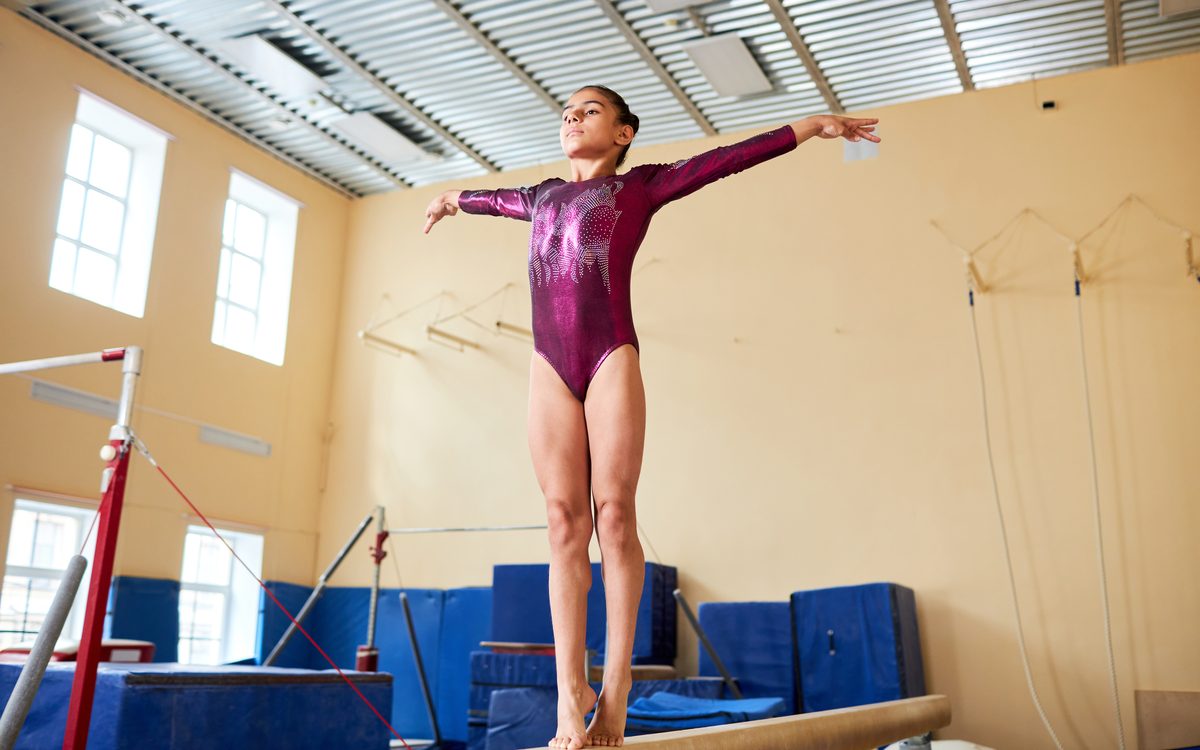
The balance beam is 10 centimeters wide, the arena is quiet, and the gymnast has about 90 seconds to do a routine she has done a thousand times. Her hands are cold and her mind is suddenly loud. Mental training for artistic gymnastics is the set of skills, such as goal setting, imagery, routines, self-talk and focus, that help a gymnast prepare, perform under pressure and recover from mistakes. It is a performance skill, and it does not replace mental health care. Nothing here guarantees a better score.
Quick answer: Common mental skills for gymnasts are specific goals, a short routine before each skill, imagery of the routine, a plan for refocusing after a mistake, and kind self-talk. Research on these in gymnasts is promising but mixed and often low quality, so treat them as tools to try, not guarantees. If a gymnast has persistent anxiety, low mood, disordered eating, burnout or fear that will not ease, see a qualified professional. In a crisis in the US, call or text 988.
What the research says (and does not)
Artistic gymnastics is a closed-skill sport: the routine is planned and the gymnast performs it alone. A 2026 meta-analysis of 21 studies of interventions against choking under pressure (Zeng 2026) found improvements in motor accuracy and execution across sports, especially in closed-skill tasks, using methods such as quiet eye training, pre-performance routines, mindfulness and self-talk. It was not specific to gymnastics.
Gymnastics-specific reviews are less certain. A 2026 systematic review of 9 studies on self-efficacy and performance in artistic gymnastics found a possible positive but inconsistent link with low certainty (Marzoli 2026). A 2026 review of 16 studies on imagery in gymnasts found improved performance in several controlled studies and none in others, with 0 of 8 randomized trials rated low risk of bias (Yang 2026). So these skills are worth trying but not promises.
Confidence
Confidence in gymnastics is usually about a specific skill: “I can do this release on this bar.” General coaching practice is to build it through preparation (many clean repetitions), stepping stones (an easier version first), and noticing what went well. Marzoli’s review linked task- and apparatus-specific confidence with performance, so confidence on beam can differ from confidence on floor.
Focus and routines
Beam and bars reward calm, narrow attention. Gymnasts commonly use a short, repeatable routine before each skill or event, which is general practice: salute, a breath, one cue word, then go. A 2026 study of 17 young gymnasts on floor found a correlation between concentration and performance; the sample is small and correlational. Between events, a reset routine helps: a drink of water, a breath, forget the last rotation and think only about the next apparatus. Written plans work too: the gymnast writes the cue word for each skill on a card in her bag.
Goal setting
Pair outcome goals (“make the team”) with process goals (“two clean landings in practice today”). Write them down, keep them within the athlete’s control, and review them weekly with the coach. Coaches should not tie goals to body size or weight.
Imagery
Imagery means mentally rehearsing a skill or a whole routine in detail, as seen from inside the body and with the feel and sound of the apparatus. Reviews suggest benefits may depend on the gymnast’s level and how imagery is used (Yang 2026). General practice is a few minutes a day, with eyes closed in a calm place, and ending on a good landing. If imagery of a skill brings on panic, stop and talk to the coach.
Handling pressure and mistakes
- Name the feeling. A racing heart and butterflies are normal arousal. Slow breathing and a cue word are common tools (general practice).
- One skill at a time. After a mistake, finish the routine and focus on the next element.
- After a fall. Finish the routine, and save the talk with the coach for after the meet.
- Post-meet notes. A short log of what worked and what to practice builds learning and keeps results in perspective.
Fear and the “twisties”
Gymnasts sometimes lose their sense of where they are in the air, and a skill they know well suddenly feels unsafe; gymnasts call this “the twisties”. TIME’s explainer (citing a Cleveland Clinic definition and sport psychology consultant Jamie Shapiro) describes it as a mind-body disconnect that can last from one turn to weeks or months, and notes that Simone Biles withdrew from events in Tokyo in 2021 because of it. Typical responses, per that article, are to take a break, rebuild with small steps and use safe training settings such as foam pits. We found no peer-reviewed study of the twisties, so treat the press explanation as informational. Never force a gymnast to throw a skill she cannot safely perform. Talk to the coach and a sport psychologist and see a doctor after any head injury; the CDC says to recognize the signs, remove the athlete from play and let a health care provider decide when to return.
Perfectionism and coaching climate
A 2024 study (St-Cyr) of 229 gymnasts and artistic swimmers and a smaller follow-up found that perfectionism driven by other people’s expectations was linked through obsessive passion to disordered eating, while a more harmonious passion was linked to better well-being. A 2023 survey of artistic gymnasts (Greither and Ohlert) found that a more disempowering coaching climate predicted experiences of psychological violence, which in turn were linked with depressive symptoms and lower well-being. A 2025 qualitative study (Barker-Ruchti) of 19 former elite women gymnasts, 18 of them artistic, who had spoken out about abuse described wide-ranging long-term outcomes; those athletes were a self-selected group, so it does not show how common abuse is. Signs of a healthy culture include coaches who explain, listen, welcome questions and do not shame. See the youth gymnastics page for what to look for in a gym.
Competition preparation
For meet logistics, packing and food, see our meet day page and rules and getting started for how a meet runs. Mentally, general practice is to rehearse the meet in practice (full routines in order, with an audience, music and a salute), to plan for a bad warm-up, and to have the same reset routine in the gym and at the meet.
Mental performance is not mental health
Mental skills help a gymnast perform. They are not treatment. The IOC’s 2026 consensus statement says mental health symptoms and disorders are common in elite athletes, may have sport-related causes and can affect performance, and recommends screening and treatment, including attention to the training environment. Anxiety that does not settle, depression, disordered eating, burnout and thoughts of self-harm are health matters for a doctor, psychologist or other qualified professional. In the US, call or text 988 (Suicide and Crisis Lifeline) in a crisis. The ANAD helpline for eating disorders is 1-888-375-7767. See nutrition and athlete health. Athletes can find sport psychology resources at the Association for Applied Sport Psychology (appliedsportpsych.org).
Artistic gymnastics mental training FAQs
How do gymnasts deal with nerves?
Common tools are slow breathing, a short routine, a cue word and focus on the next skill. Research on these is promising but mixed, and nerves are normal.
What are the twisties?
A loss of air awareness that makes known skills feel unsafe, according to TIME’s explainer. It can last from a single turn to weeks or months. Rest, small steps and professional support are the usual responses.
Does visualization work for gymnasts?
Some studies found better performance, and others did not. A 2026 review rated the evidence as weak in quality. It can still be a useful routine.
How can parents help?
Praise effort and learning, ask what the gymnast wants, avoid comments on weight or body, and watch for changes in mood, eating and sleep. Take concerns to a doctor.
When should a gymnast see a sport psychologist?
When fear, anxiety or low mood is lasting, affecting school, sleep or eating, or the athlete asks for help.
Sources
- Marzoli 2026, self-efficacy in artistic gymnastics (PMID 42646881)
- Yang 2026, mental imagery in gymnasts (PMID 41890922)
- Zeng 2026, choking under pressure meta-analysis (PMID 41951087)
- Concentration and young gymnast performance, 2026 (PMID 42555411)
- TIME, What are the twisties
- St-Cyr 2024, perfectionism and disordered eating (PMID 38614219)
- Greither and Ohlert 2023, coaching climate in artistic gymnastics (PMID 40479099)
- Barker-Ruchti 2025, interpersonal violence outcomes (PMID 40819884)
- IOC mental health consensus statement, 2026 (PMID 42580854)
- CDC HEADS UP, signs and symptoms
- 988 Suicide and Crisis Lifeline, ANAD helpline and AASP resources
General information for education only, not medical advice. See our editorial policy for how we research and write.