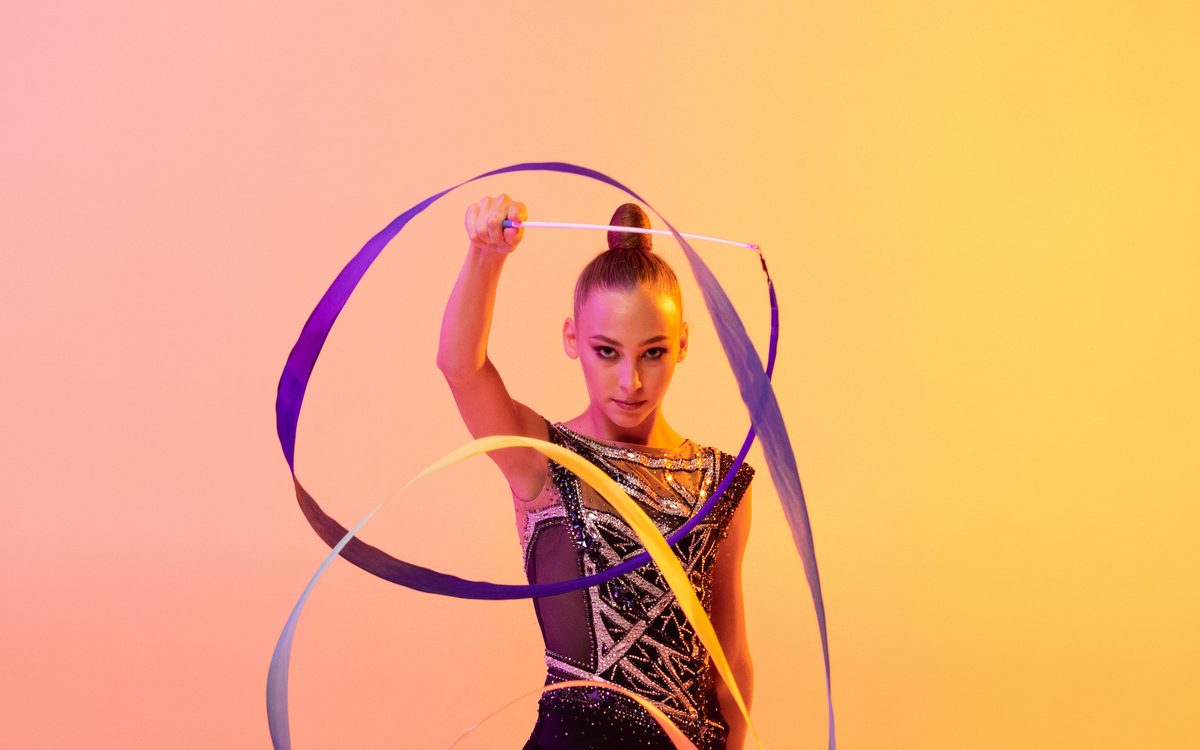
Third apparatus of the day. The hoop leaves her hand, spins high under the lights and, for one long second, she does not know where it will land. Then it is back in her hand and the music keeps going. Mental training in rhythmic gymnastics is the set of skills, such as focus, confidence, imagery, routines and ways of coping with mistakes, that help a gymnast perform under pressure and enjoy the sport. It supports performance. It is different from mental health care, which this page also explains, because anxiety, disordered eating and burnout are health matters, not weaknesses to be coached away.
Quick answer: Mental skills for rhythmic gymnasts include a steady pre-routine, simple goals, imagery, a plan for dropped apparatus and kind self-talk. The evidence is encouraging but mixed: a 2026 review of 16 studies in gymnasts found inconsistent effects and many studies at high risk of bias, so none of these techniques guarantees a better score. If a gymnast has constant worry, low mood, disordered eating or loses interest in the sport, talk to a doctor or mental health professional, not only a coach. In the US, the 988 Suicide & Crisis Lifeline is open by call, text or chat.
Confidence that holds up
Confidence in a judged sport can swing with every score, so many coaches build it from things the gymnast controls: quality of preparation, completed run-throughs, and noticing specific improvements. Perfectionism is a risk. In a study of 89 adolescent rhythmic gymnasts aged 13 to 15 (Donti and colleagues, 2021), international-level gymnasts scored higher than recreational ones on striving for perfectionism and personal standards, and negative reactions to imperfection, together with BMI and training experience, were associated with eating-attitude scores. The researchers did not show that perfectionism causes eating problems, but they suggest it matters. Coaches can praise effort and process, not only scores and appearance.
Focus and routines
Rhythmic routines punish a wandering mind: a throw needs eyes on the apparatus while the body keeps a shape and the music keeps time. A common approach, from general sport psychology practice and not a rhythmic-specific trial, is a short pre-routine used every time: breathing, a cue word, a quick check of posture, then start. On a day with several apparatus, a reset routine between them (shake out, sip water, one cue for the next routine) can stop the previous routine from following her onto the floor. In a small 2026 correlational study of 17 young gymnasts (not specific to rhythmic), concentration was linked with performance, but it is too small to prove cause.
Motivation and goals
Goals work best when they are specific, within the gymnast’s control and flexible. Examples are “catch the ribbon throw cleanly in six of ten run-throughs” or “hold the balance for the full count,” rather than “win.” Mixing outcome goals (a placement) with performance goals (a score) and process goals (my cue words) keeps motivation from depending on results. Keep joy in the picture. A gymnast who is exhausted, injured and afraid of mistakes may be heading toward burnout, which the AAP 2024 report on overuse and burnout in young athletes describes as a health concern.
Imagery and video
Imagery means rehearsing a routine in the mind with as many senses as possible. A 2014 trial in 72 national-level rhythmic gymnasts (Battaglia and colleagues) found that adding video observation and PETTLEP imagery to physical practice improved jumping tests over six weeks compared with physical practice alone. The broader 2026 systematic review of 16 studies in gymnasts found that some controlled studies showed improved judged performance and others found no benefit, with effects depending on expertise, dose and outcomes. Imagery is a low-cost extra, not a substitute for practice, and gymnasts who find it stressful can skip it.
Handling pressure and competition nerves
Nerves are normal. Among 67 elite rhythmic gymnasts tested before a World Cup, the mean pre-competitive anxiety score on the Sport Competition Anxiety Test was moderate (22.7), and 19.4% had high levels in a related analysis (Silva and Paiva). Gymnasts who were very sleepy by day reported higher pre-competition stress, and 78% had poor sleep quality, so sleep is part of the mental plan. Simple tools include slow breathing, a familiar warm-up, a few rehearsed thoughts (“long arms, soft knees”) and focusing on the next movement. For logistics such as bags, music and apparatus checks, see the rules and getting started page.
Setbacks: drops, errors and injuries
Drops are part of the sport. Under the FIG Code of Points 2025-2028, if the apparatus leaves the floor, the gymnast may use a replacement from the sets placed beside the floor, with the line penalty and no extra penalty for the replacement; if the apparatus stays on the floor, she must pick up her own. A rehearsed plan (“drop it, breathe, replace or retrieve, go on with the music”) can help. After a bad routine, a short debrief that starts with what went well and one thing to fix works better than long criticism. After injury, pain can feed worry: in a Spanish survey of 160 gymnasts, injured gymnasts had higher pain catastrophizing, which correlated with pain level. Psychological support is part of rehabilitation.
Groups and decisions
In a group of five, trust and communication matter as much as skill. Body difficulties count only if all five gymnasts perform them, so a late or early gymnast affects everyone. Teams that rehearse recovery moves (“who covers the missing catch?”) and agree on non-verbal cues often cope better, but we did not find rhythmic-specific research on team cohesion.
Mental health is not mental performance
Mental training helps skills. It does not treat anxiety disorders, depression, disordered eating or burnout. The IOC consensus statement on mental health in elite athletes (Reardon and colleagues, 2019) encourages recognizing and treating mental health symptoms with qualified professionals. Signs that call for a doctor or licensed mental health professional include persistent sadness or worry, panic before practice, restricted eating, hiding injuries, sleep trouble that lasts, or withdrawal from friends and the sport. Parents can start with a pediatrician. See our nutrition and athlete health page for eating-related warning signs and help lines.
Safe training environments also protect mental health. The 2016 IOC consensus statement on harassment and abuse in sport says psychological abuse is at the core of other forms and that elite and child athletes are at highest risk. Athletes and parents can report concerns to the U.S. Center for SafeSport. Related: injuries and recovery.
Rhythmic gymnastics mental training FAQs
How do I help my daughter with competition nerves?
Normalize nerves, practice a short pre-routine and breathing, keep the focus on the next movement and make sure she sleeps. If worry is constant or she avoids the sport, see a pediatrician or mental health professional.
Does visualization really work for gymnasts?
Some controlled studies found benefits, including one trial in 72 rhythmic gymnasts, but a 2026 review of 16 studies found mixed results and weak study quality. It is a helpful extra for some athletes, not a guarantee.
What should a gymnast do after dropping the apparatus?
Follow the plan her coach has taught: if it left the floor, a replacement may be used under the FIG code; if not, retrieve her own. Then keep going with the music. Practice this in training.
Is perfectionism bad for gymnasts?
High standards can help, but in one study of adolescent rhythmic gymnasts, negative reactions to imperfection were linked with disordered-eating attitudes. Praising effort and process is safer than praising only perfection.
When is it more than nerves?
Constant anxiety, low mood, panic, restricted eating, hiding pain, long-lasting sleep trouble or losing interest in the sport are reasons to see a health professional. In the US, 988 is available by call, text or chat.
Sources
- Yang, mental imagery in gymnasts, systematic review, Front Psychol 2026
- Concentration and performance in young gymnasts, Front Sports Act Living 2026
- Battaglia et al., video observation and motor imagery in rhythmic gymnasts, 2014
- Donti et al., eating disorder symptoms and perfectionism in adolescent rhythmic gymnasts, 2021
- Silva and Paiva, sleep, anxiety and diet in elite rhythmic gymnasts, Eur J Sport Sci 2016 and 2018 analysis
- Silva and Paiva, sleep and pre-competitive stress in traveller athletes, 2019
- Sastre-Munar et al., injuries, pain and catastrophizing in gymnasts, Healthcare 2022
- AAP, overuse injuries, overtraining and burnout in young athletes, 2024
- Reardon et al., Mental health in elite athletes, an IOC consensus statement (infographic), Br J Sports Med 2019
- Mountjoy et al., IOC consensus statement on harassment and abuse in sport, 2016
- U.S. Center for SafeSport
- FIG RG Code of Points 2025-2028 (replacement apparatus, group difficulty)
- 988 Suicide & Crisis Lifeline
General information for education only, not medical advice. It does not replace a visit with a sports medicine doctor, physical therapist, athletic trainer or registered dietitian. See how we write and check our pages in our editorial policy.