This article contains affiliate links: if you buy through them we may earn a commission, at no extra cost to you. Read our affiliate disclosure.
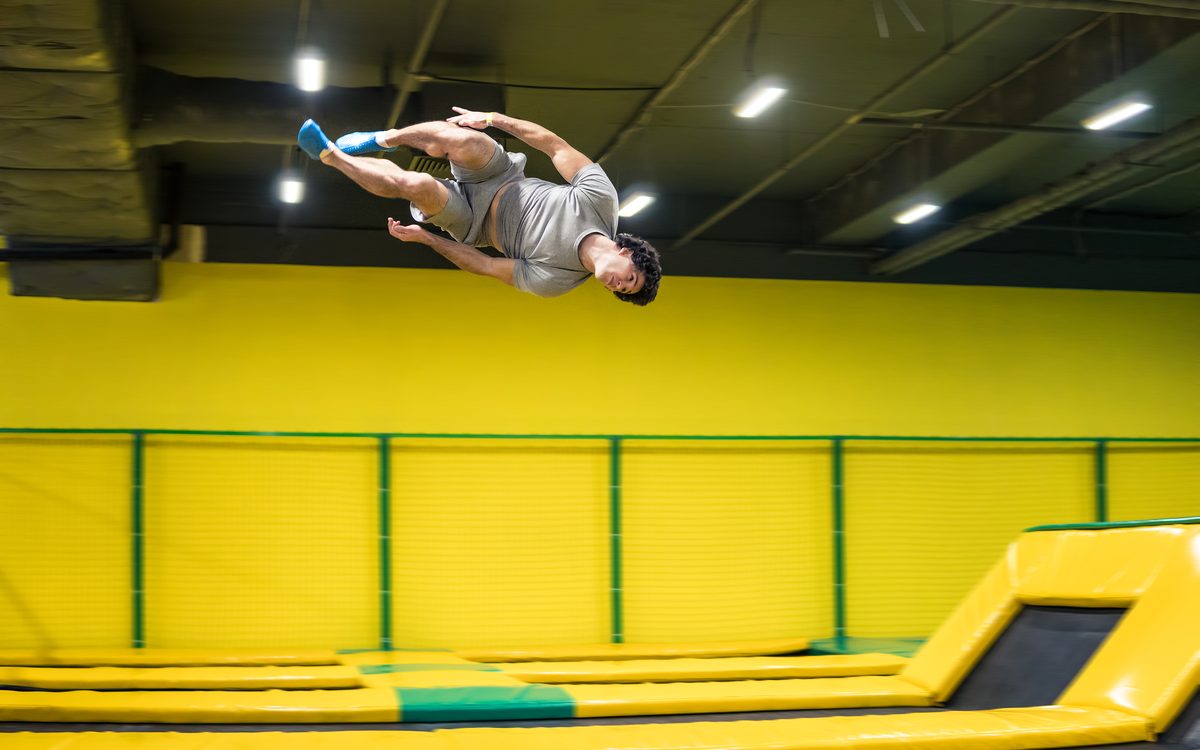
A hall full of beds, one athlete at a time on each, and everywhere the same sound: a flat thump of landing, a pause, another thump. Between turns, athletes do squats and holds on the floor. Trampoline gymnastics training is the mix of time on the bed, strength and power work, balance and mobility, and planned rest that builds toward a ten-skill routine. This page is about the training itself; the rules are in skills, rules and getting started, and the sport overview is on the trampoline gymnastics page.
Quick answer: A trampoline competition is a lot of repeated explosive jumping. In one study of elite men, a simulated competition took about 250 jumps and left jump height lower the next day. Research on elite athletes points to leg strength and jump power as the main physical drivers of time of flight, and balance matters because the bed is an unstable surface. A sensible week mixes bed time, strength and mobility with rest days, and load rises gradually. Training plans for children and teenagers should be set with the coach, and pain that lingers is a reason to see a sports medicine doctor, physical therapist or athletic trainer.
What the sport asks of the body
Jensen and colleagues (Journal of Sports Sciences, 2013) studied 15 elite male trampoline gymnasts in a simulated competition. The gymnasts performed about 252 jumps in total across the routines, and peak heart rate reached 95 to 97 percent of maximum during each routine. Countermovement jump height (a standard floor test of leg power) fell by 3.8 to 5.2 percent after each routine and was still 4.8 percent lower 24 hours later, and blood levels of creatine kinase, a marker of muscle stress, were about 50 to 65 percent higher right after the competition and the next day. The authors concluded that a competition involves many repeated explosive jumps that impair jump performance during and 24 hours after it. It was a small study of elite men, so treat it as a picture of the demand, not a rule for every athlete.
Draper and colleagues (Research Quarterly for Exercise and Sport, 2019) compared trampolining and treadmill running in 23 healthy adults at different intensities. The numbers differed between the two, but the pattern of change with intensity was similar, so the authors suggested that the percentage-of-maximum-heart-rate method commonly used in running can also be used to gauge trampoline sessions. That was recreational bouncing in adults, not coached skills.
Strength, power and time of flight
Time of flight is scored, so strength training has a direct link to points. Dyas and colleagues (European Journal of Sport Science, 2023) tested 32 elite gymnasts (13 senior and 19 junior) and found that the force a gymnast could produce in a loaded jump predicted 72 percent of the difference in 20-jump time of flight among seniors; for juniors, jump height, reactive strength and force together predicted 82 percent. A follow-up trial (Dyas and colleagues, 2025) had 14 nationally elite youth gymnasts (average age 15) do a six-week program. The group that replaced heavy lifts with three isometric squat exercises improved time of flight by 0.83 seconds (2.8 percent) compared with 0.06 seconds (0.2 percent) in the standard-strength group. It is a very small trial, but it fits the picture that strong, powerful legs matter.
A 2022 trial (Yang and colleagues, Frontiers in Physiology) of 15 pre-adolescent national-level trampoline gymnasts found that a ten-week program using low-load blood flow restriction improved lower-body strength and power about as much as moderate-to-high loads. That uses cuffs and belongs with a qualified coach or clinician.
- Common-sense strength work (general strength and conditioning practice, not a prescription): squats and lunge patterns, calf and ankle work, hip and trunk strength, jumping and landing drills on the floor, and upper-body and shoulder work for the arm movements and the hands-and-knees falls the sport includes.
- Jump and landing quality first. Coaches usually teach how to land softly on the floor before adding height or load.
- Children and teens should be coached on technique and supervised before heavy loads are added.
Balance and control
Trampolining takes place on a moving surface. Sun and colleagues (Entropy, 2025) compared 12 elite and 12 sub-elite male trampolinists standing with eyes closed. The elite group showed more automatic, structured balance control and adapted better to a foam surface. The authors suggest that unstable or trampoline-like surfaces may help training, but this was a one-day comparison, so it cannot show cause. A 2026 study of 11 Chinese national-team athletes (Liu and colleagues, Frontiers in Physiology) found differences between left and right sides and between men and women in muscle activity and balance, and recommended targeted single-leg balance and ankle power work.
Skill training also involves the eyes. Natrup and colleagues (Human Movement Science, 2020) found that experienced gymnasts fix their gaze on a point on the bed to prepare for landing during a back tuck.
A sensible weekly shape
No published source gives a single correct week for trampolinists, so what follows is a general sketch of how many clubs plan, not a rule. A typical week might have several sessions on the bed with a skill focus, one or two strength and power sessions on the floor, a balance and mobility session, and at least one full rest day. Hard days are spaced out, since landings add up. The American Academy of Pediatrics’ clinical report on overuse injuries and burnout (Brenner, 2016) recommends young athletes take one to two days off a week from their main sport and a few months a year away from it, in blocks. Jayanthi and colleagues (2015) found that young athletes who trained more hours a week than their age in years had about twice the odds of a serious overuse injury, though the study was not trampoline-specific.
Periodisation basics: building, peaking and returning
Periodisation means planning the year in phases. Most coaches use a base phase (more volume and general strength), a build phase (routines and difficulty), a peak before key meets (fewer, higher-quality routines) and a short break afterward. This is a general coaching framework, not a trampoline-specific finding. The loads should rise gradually. In 21 national-level trampoline gymnasts followed for eight weeks (Patel and colleagues, Journal of Sports Sciences, 2021), the chance of injury rose with the seven-day rolling training load (relative risk 1.88) and was highest around the adolescent growth spurt, so coaches are encouraged to track both. A second study (Patel and colleagues, Scandinavian Journal of Medicine and Science in Sports, 2022) of 26 national-programme gymnasts returning after the first COVID-19 lockdown found that an injury or niggle in the previous week was linked with a substantial injury in the next week (relative risk 5.29). Keeping a simple log of sessions, effort ratings (1 to 10) and niggles can help a coach see changes early. See injury prevention for how to use it.
Two tools some athletes use for warm-ups and for tracking effort (neither is required, and neither is claimed to improve results):

THERABAND Resistance Band Beginner Kit
- Yellow, red and green flat bands
- Clinic color system
- Packs into a gym bag
$11.99 at Amazon, as of Nov 17, 2026 01:07 UTC
Check price on Amazon
Polar H10 Heart Rate Sensor
- Chest strap sensor
- Bluetooth and ANT+
- Up to 400 hours per battery
Trampoline training FAQs
How long should a trampoline session be?
We did not find a published figure. The simulated competition above involved only a few minutes of routines but over 250 jumps, so many coaches break sessions into short, focused sets with rests. Ask your coach what the plan is for your age and level.
Do trampolinists need weights?
Research on elite athletes links lower-body strength to time of flight (Dyas 2023, 2025), so strength work is common. For children and teens it should be coached and gradual.
Is trampolining good cardio?
It is demanding. Draper and colleagues (2019) found heart rate, oxygen use and blood lactate rose with intensity in trampolining, as they do in running, and heart-rate zones can gauge it.
How much rest does a young trampolinist need?
The American Academy of Pediatrics recommends one to two rest days a week from the main sport for young athletes, and time away over the year. Plans for an individual should come from the coach and a health professional.
Sources
- Jensen P et al., Physiological responses and performance in a simulated trampoline gymnastics competition in elite male gymnasts, J Sports Sci 2013: PubMed
- Draper N et al., Physiological Demands of Trampolining at Different Intensities, Res Q Exerc Sport 2019: PubMed
- Dyas N et al., The physical determinants of maximal jumping time of flight in elite trampolining, Eur J Sport Sci 2023: PubMed; Isometric Strength Training Increases Time of Flight in Junior Elite Trampoline Gymnasts, 2025: PubMed
- Yang S et al., Low-Load Blood Flow Restriction Squat in preadolescent trampoline gymnasts, Front Physiol 2022: PubMed
- Sun M et al., Postural Control Adaptations in Trampoline Athletes, Entropy 2025: PubMed; Liu K et al., lower extremity muscle activity and static balance of Chinese elite trampoline athletes, Front Physiol 2026: PubMed
- Natrup J et al., Gaze behavior of trampoline gymnasts during a back tuck somersault, Hum Mov Sci 2020: PubMed
- Patel TS et al., growth and training loads in competitive trampoline gymnasts, J Sports Sci 2021: PubMed; return to training after COVID-19, Scand J Med Sci Sports 2022: PubMed
- American Academy of Pediatrics, Brenner 2016 (PMID 27573090): PubMed; Jayanthi N et al. 2015 (PMID 25646361): PubMed
Keep going: the trampoline gymnastics hub page, recovery and mobility, nutrition and athlete health, the gymnastics hub and the sports hub.
General information for education only, not medical advice. It does not replace a sports medicine doctor, physical therapist, athletic trainer or your coach. How we research and write these pages is in our editorial policy.