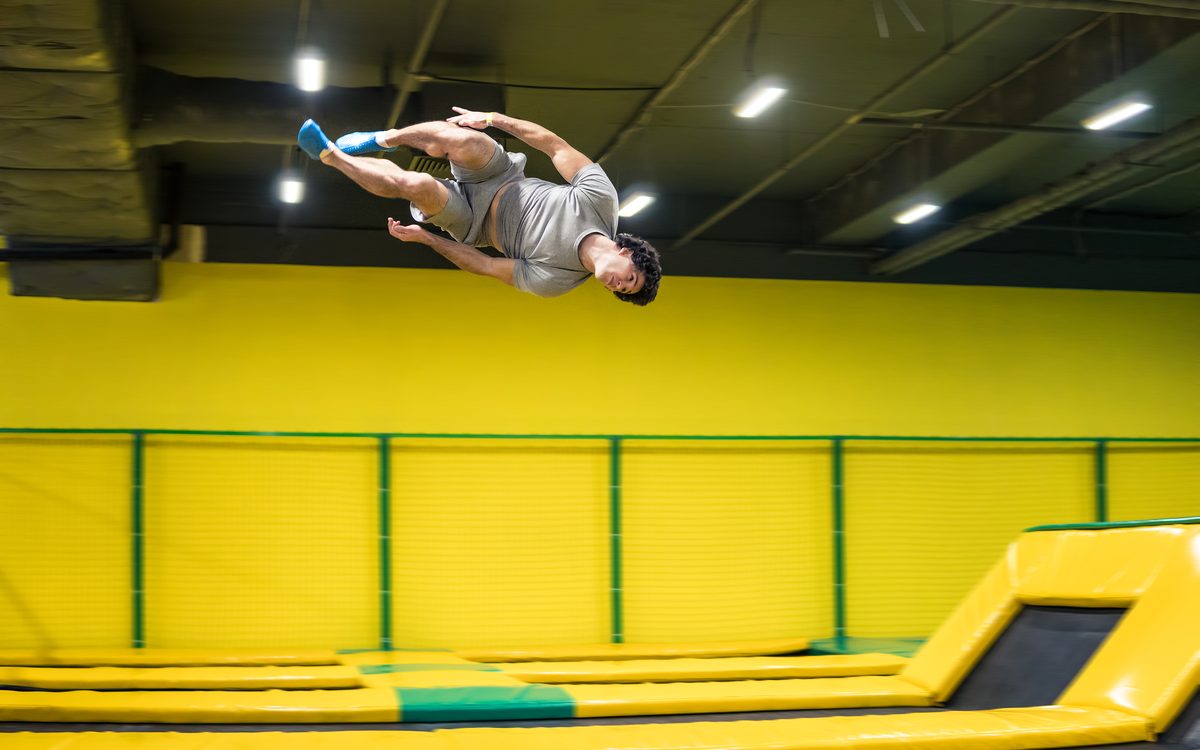
The gymnast stands in the middle of the bed, takes a few quiet bounces, and then the routine begins: a flip, a twist, another flip, ten skills linked with no pause between them, and a last landing that has to be held still. Trampoline gymnastics rules are the FIG Code of Points and its national versions, and they decide what counts as a skill, what earns points and what costs them. The sport itself is on our trampoline gymnastics page, and the wider family is in the gymnastics hub.
Quick answer: A competition trampoline routine has ten skills (somersaults, with or without twists) performed back to back with no straight bounces. The score adds execution, horizontal displacement (how little you drift from the center), time of flight and difficulty, then subtracts penalties (FIG Code of Points 2025-2028). Beginners start in a club class with coaches who spot; they do not learn somersaults alone.
What a routine looks like
The FIG Code of Points 2025-2028 describes a trampoline exercise as ten elements, planned to show a mix of forward and backward somersaults, with or without twists, in a high and continuous rhythm “feet to feet and feet to back, front or seat,” without intermediate straight bounces. If an athlete bounces straight in the middle of a routine, the Code treats it as an interruption and only the skills completed before it count. The same happens if the athlete lands on one foot, lands on something other than the feet, seat, front or back, leaves the bed, or is touched by a spotter.
Each somersault is shown in one of three body shapes. The Code defines them by angles: in a straight position the angle between upper body and thighs is greater than 135 degrees, in a pike the body is folded at the hips (135 degrees or less) with the legs mostly straight, and in a tuck both hips and knees are bent. Feet and legs stay together with toes pointed. A repeated element earns no difficulty, although the same rotation in a tuck, a pike and a straight shape counts as three different elements.
The routine starts on a signal, and the gymnast has one minute to begin the first element. After it starts, the gymnast’s own spotters may not talk to them or signal in any way, which costs 0.6 points under the Code.
The four parts of the score
The Code adds up a difficulty score (D), an execution score (E), a horizontal displacement score (H) and a time of flight score (T), then takes off any penalties. Three of these are partly or fully measured by machines at major events.
- Difficulty: judges add up what the athlete performed, with no upper limit. Each quarter somersault is worth 0.1, a full single somersault 0.5, a double 1.0, a triple 1.6 and a quadruple 2.2, and each half twist adds 0.1. A tuck jump, pike jump, straddle jump or seat drop is worth 0.1. Straight and piked shapes earn small bonuses, so a straight single somersault with no twist is worth 0.6 under Code section 17.1.4.
- Execution: the Code starts from a maximum of 20 points and takes off the deductions judges record for each skill (up to 0.5 per element for form, plus landing deductions). Typical faults are bent knees, knees or feet apart, toes not pointed and elbows away from the trunk.
- Horizontal displacement: the bed is marked with zones, and each landing outside the target zone costs 0.0 to 0.3 points, taken from a maximum of 10.0. At major events this is measured by a device, and judges use video only if the device fails.
- Time of flight: the time the athlete is actually in the air is measured electronically to hundredths of a second and counts toward the score, which is why height and control are rewarded.
Landings, stability and penalties
The routine ends with a landing that must be stable. After the tenth skill the gymnast may do one controlled straight bounce, then must stand upright and show stability for about three seconds. Deductions from the Code’s execution section include 0.1 to 0.2 for a lack of stability, 0.5 for touching the bed with a hand after landing, 1.0 for touching or falling to the knees, hands, front, back or seat, and 1.0 for landing outside the bed or doing an extra element. Dress breaches (jewelry, piercings, watches, loose hair) and overrunning the 45-second warm-up touch each gymnast gets before a round cost 0.2 each.
Basic skills and how a beginner is taught
The list of easiest elements comes straight from the Code: tuck jump, pike jump, straddle jump and seat drop are all legal elements worth 0.1 each, and landing on the front or back is also part of the sport. What follows is general coaching practice, not a rulebook: new gymnasts learn to stand and bounce in the middle of the bed, to stop the bed by absorbing the bounce, to jump to straight, tuck, pike and straddle shapes, and to drop to seat, front and back. Somersaults come later, in small steps, with a coach using a spotting rig or hand spotting, and with supervision. The American Academy of Orthopaedic Surgeons says not to attempt somersaults or similar stunts without supervision, instruction and protective equipment such as a harness, and the American Academy of Pediatrics (2012) strongly discourages home trampoline use.
Levels, age groups and competition format
At senior FIG level an individual competition has two qualification routines with the better one counting, a smaller second qualification when there are enough entries (the top 16 if there are 32 to 47, or the top 24 if there are 48 or more), and a final of eight with one routine. Junior and age-group competitions have two qualifying routines that both count; the first has special requirements, and each missing requirement is a 2.0 penalty. Quadruple somersaults are not allowed in Youth and Junior competitions, and an athlete who performs one is disqualified.
In the United States, USA Gymnastics’ Trampoline & Tumbling program has Levels 1 to 4 as developmental, Levels 5 to 7 as compulsory and Levels 8 to 10 as optional, followed by an Elite track. An older USA Gymnastics Q&A (2015) describes junior Olympic routines as scored out of 10.0 with three execution judges at the lower levels; check the current rules and policies before relying on that.
How to get started
- Look for a club that runs a Trampoline & Tumbling program. USA Gymnastics’ rules and policies list state and regional chairs, and an older USA Gymnastics Q&A says many gymnastics clubs already offer trampoline classes. Try recreational classes before competitive levels.
- Ask about the coach. USA Gymnastics offers a Trampoline & Tumbling development coaches course (T200) that covers discipline-specific safety and risk management.
- Look at the equipment. The same Q&A says a developmental program can run on a standard trampoline with skill cushions, and that competition trampolines matter from Level 8 on. Ask to see the pads, mats and spotting rig.
- Read the rulebook yourself. The FIG Code of Points 2025-2028 for trampoline is public, and USA Gymnastics posts its own rules for each level.
See training for what a week looks like, injury prevention before the first somersault, and gear for what to bring.
Trampoline rules FAQs
How many skills are in a trampoline routine?
Ten. The FIG Code of Points 2025-2028 defines an exercise as ten elements, and doing more than ten brings a 1.0 landing deduction. Synchronized routines also have ten, with two athletes on side-by-side trampolines.
What does “horizontal displacement” mean?
It means how far from the center of the bed the athlete lands. The bed has marked zones, and each landing outside the target zone costs 0.0 to 0.3, from a starting 10.0.
What is time of flight?
It is the total time the athlete spends in the air during the routine, measured electronically to hundredths of a second. A taller, more controlled routine scores higher on this part.
Can I learn trampoline gymnastics at home?
The American Academy of Pediatrics strongly discourages home trampoline use (2012), and the American Academy of Orthopaedic Surgeons advises supervision and one jumper at a time. A club with coaches, spotters and proper equipment is the route for learning skills.
Sources
- FIG, Trampoline Gymnastics Code of Points 2025-2028 (copy hosted by London Youth Games): PDF; FIG rules page: gymnastics.sport
- USA Gymnastics, Trampoline & Tumbling Q&A on starting a program (2015): members.usagym.org PDF; development program rules: PDF
- American Academy of Pediatrics, Trampoline Safety in Childhood and Adolescence (2012): PubMed
- American Academy of Orthopaedic Surgeons, Trampoline Injury Prevention: OrthoInfo
Keep going: the trampoline gymnastics hub page, the gymnastics hub, artistic gymnastics for another judged discipline, and the sports hub.
General information for education only, not medical advice. It does not replace a sports medicine doctor, physical therapist, athletic trainer or your coach. How we research and write these pages is in our editorial policy.