This article contains affiliate links: if you buy through them we may earn a commission, at no extra cost to you. Read our affiliate disclosure.
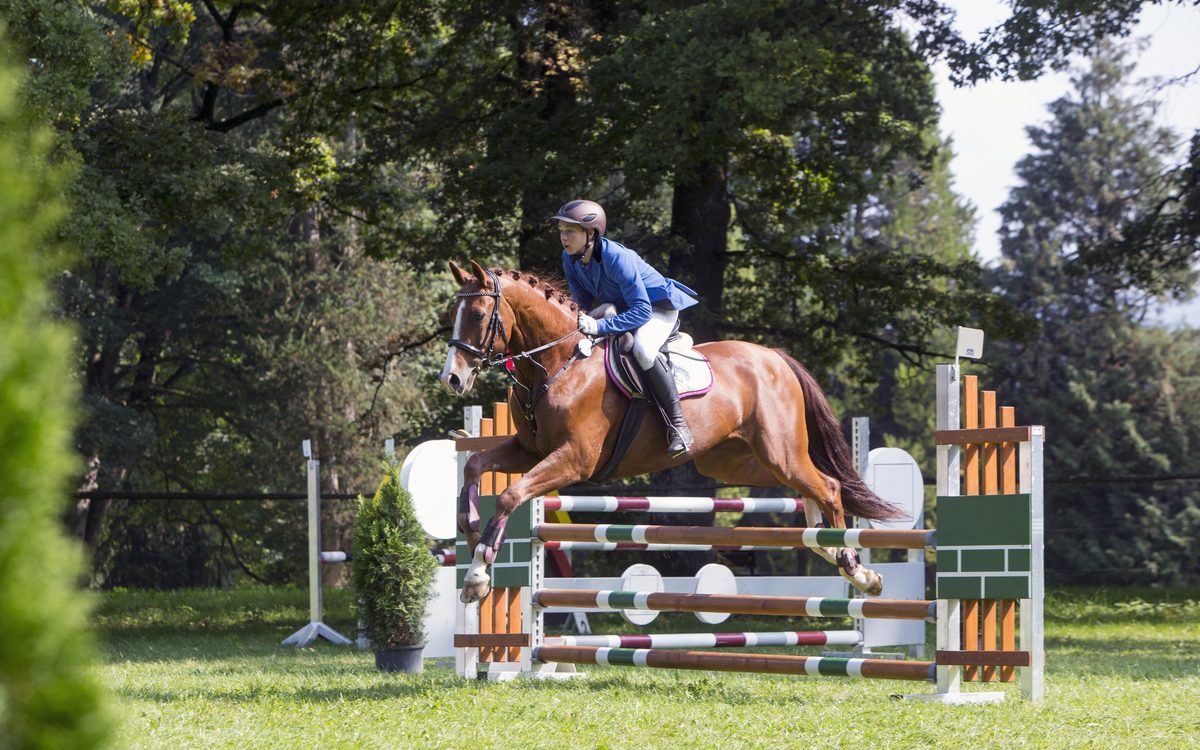
Before every class, a rider tugs the chin harness, taps the top of the helmet and checks that the stirrup leathers are not cracked. It takes ten seconds, and it is the most useful part of any gear list. Show jumping gear is the equipment a rider needs to jump safely and legally: a certified helmet, boots with a heel, suitable clothing, and optionally a body protector and gloves. This page explains what matters, how to check fit and condition, and where to separate a verified standard from a maker’s claim. It does not replace advice from your instructor.
Quick answer: Start with a certified helmet that fits, boots with a distinguishable heel, and clothing your show requires. A body protector or safety vest is optional in most classes. Look for the certification on the label, such as ASTM F1163 with SEI, have the fit checked, inspect the gear before every ride, and replace a helmet after an impact. A standard on the label is more reliable than a marketing line. If you hit your head, see a healthcare provider whatever the helmet looks like.
The helmet
US Equestrian rules (GR801) make an approved helmet compulsory for anyone mounted at licensed competitions, with the chin harness secured. The USEF list of accepted standards names ASTM F1163 (through the SEI certification programme), PAS 015, VG1 01.040 and Snell. ASTM F1163 covers impact tests after conditioning at normal, low and high temperatures and in water, using both a flat anvil and an equestrian hazard anvil, along with tests of the retention system. The USEF Jumper rules also have a rule about a helmet that comes off or is unfastened during a round, so read the rule for your class.
Evidence on helmets: a German survey of 363 show jumpers found riders who often or always wore one had fewer head injuries and shorter total injury time (Meyer and colleagues, 2022), and a 2025 systematic review found helmets protect against skull fracture and traumatic brain injury (Crawford and colleagues). A 2025 study of 357 collegiate riders found head injury risk was similar across helmet brands and between MIPS and non-MIPS models (Gould and colleagues). In other words, certification and fit are what the evidence supports; features and a higher price are not shown to add protection.
Fit and replacement
The USEF’s list says a helmet should be fitted by someone qualified, and advises against assuming that the same model in a new size will fit the same way. One listing for a Troxel helmet advises measuring about an inch above the eyebrows. A helmet should sit level, not tip back, with the harness snug and no gap between the head and the pad. Maker guidance, such as Troxel’s, is to replace a helmet after one impact event or accident, and every five years, and to look for the SEI seal and date of manufacture under the liner. This is maker guidance, not a regulation. If you order a helmet online, you cannot try it before it arrives, so check the return rules and have a trained fitter check the result.
Body protectors and safety vests
GR801 allows body protectors in any class and recommends ASTM F1937 or SEI standards. In the German survey, only 14% of riders often or always wore a vest, and those who did reported fewer spinal injuries (Meyer and colleagues); the 2025 review, though, found vests were not associated with a smaller risk of spinal cord injury and may protect the chest. Evidence is mixed, so fit, comfort and your trainer’s advice matter. A protector that is too loose or too short will not sit where it should. Air vests exist, and USEF eventing rules cover how they may be worn; if you jump in another discipline, check its rules first. A protector is not a substitute for a helmet.
Boots, clothing and gloves
- Boots. GR801 requires boots with a distinguishable heel so the foot cannot slip through the stirrup (with some exceptions for specific breeds and divisions). Paddock boots with half chaps and tall boots are both common; the fit should leave the ankle supported without pinching.
- Breeches and coat. The USEF Jumper rules set attire for the show ring, so read them for your class. At home, comfortable breeches with a seat that does not slip are common practice.
- Gloves. Many riders wear gloves for grip when the reins are wet. This is a practical choice, not a rule.
Inspect before every ride
This list is general good practice from instructors, not a standard:
- Helmet: shell without cracks or dents, harness and buckle working, no impact in its history.
- Stirrup leathers and irons: no cracks, stitching intact, same length on both sides.
- Girth, billets and reins: no wear at stitching or the buckle, no stretching.
- Saddle: sits level and fits the horse. Ask a qualified fitter if you are unsure.
- Boots: sole and heel intact, zip or laces secure.
Standards versus maker claims
A certification on a label (ASTM, SEI, PAS 015, VG1, Snell) means the product has been tested to a published test method. Words like “lightweight,” “advanced” or “safest” are marketing. The cards below show gear that other riders use. For the helmet and body protector, the maker or listing says it meets ASTM and SEI; check the actual label when it arrives. For boots and gloves, there is no safety standard involved, so the descriptions are the makers’ features only.

Ovation Deluxe Schooler Helmet
- ASTM F1163-15 + SEI (listing says)
- Removable washable liner
- Dial adjuster

Troxel Spirit Duratec Helmet
- Full coverage, low profile (maker)
- DialFit adjustment
- Removable washable headliner
$78.99 at Amazon, as of Nov 17, 2026 01:07 UTC
Check price on Amazon
Tipperary Contender ASTM Body Protector
- ASTM and SEI certified (maker)
- Lace sides, zip front
- Adjustable shoulders

Ariat Women's Heritage IV Zip Paddock Boot
- Full-grain leather (maker)
- Zip closure
- Not a tested safety standard

SSG Digital Riding Glove
- Grip pattern, grip when wet (maker)
- Smooth seams between fingers
- Machine washable
Our shopping picks are examples, not endorsements, and availability changes. Read how we pick products in our editorial policy. For the rules that decide what you must wear, see show jumping rules, and for how gear fits into risk, injury prevention. Parent: horseback riding.
Show jumping gear FAQs
What gear do I need to start show jumping?
An approved helmet that fits, boots with a heel, long pants or breeches and a lesson program that provides a school horse and tack. The USHJA says an approved helmet is expected at all times.
Which helmet standard should I look for?
The USEF accepts ASTM F1163 through SEI, PAS 015, VG1 01.040 and Snell. Look for the certification on the label and have the fit checked.
Do I need a body protector for show jumping?
Not in most classes. The USEF allows them in any class and recommends ASTM F1937 or SEI. Research on vests is mixed, so talk to your trainer.
When should I replace my helmet?
After any impact, according to makers such as Troxel, and after about five years. Follow the maker’s instructions.
Is a more expensive or MIPS helmet safer?
A 2025 study of 357 collegiate riders found head injury risk was similar across brands and with or without MIPS. Certification and fit matter most.
Sources
- USEF GR8: Conduct of Licensed Competitions (GR801 safety equipment) and USEF Jumper Division rules
- USEF: list of applicable international helmet standards
- ASTM F1163-15 scope and ASTM F1937 (body protectors)
- Troxel helmet certifications (maker guidance)
- USHJA: Hunter/Jumper 101
- Meyer et al., show jumpers, Int J Environ Res Public Health 2022, Crawford et al., Sports Health 2025, Gould et al., Clin J Sport Med 2025
General information for education only, not medical advice. It does not replace a visit with a doctor, physical therapist or athletic trainer. See how we write and check our pages in our editorial policy.