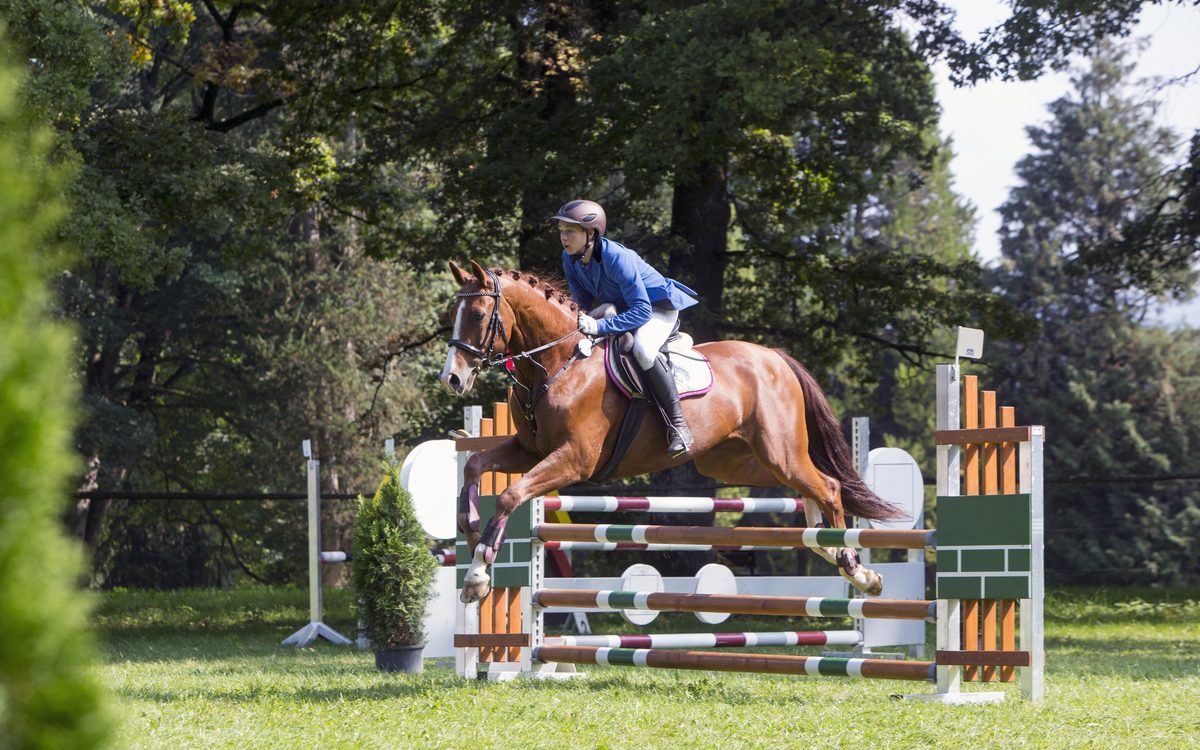
A rider on a patient school horse trots over a single pole on the ground, then a cross-rail the height of a dinner table, and grins. Nobody in the ring has seen a scoreboard yet, but the whole sport is already there: a horse, a rider, a fence and the question of whether they get over it together. Show jumping (also called jumping, stadium jumping or the “jumper” division) is the equestrian sport in which a horse and rider ride a course of fences and the fewest faults wins. This page explains the rules in plain words, the basic skills, and how a beginner can start. The full overview is on the show jumping hub.
Quick answer: A round is a numbered course of fences. In the US Equestrian (USEF) rules a knockdown or a first disobedience costs 4 faults, each commenced second over the time allowed costs 1, and a second disobedience or a fall means elimination. Fewest faults wins, and ties are often settled in a jump-off. To start, you do not need your own horse: find a qualified instructor and a lesson program, wear an approved helmet and boots with a heel, and learn balance and rhythm before height.
How a round works
Riders walk the course on foot first, then ride it one at a time in a set order. The course designer builds uprights (verticals), spreads (oxers), water jumps and combinations of two or three fences set a few strides apart. The USHJA’s beginner guide says jumper courses are scored objectively on speed and accuracy and are typically 12 to 16 jumps long. The fault values below are from the USEF Jumper Division rules (effective December 2025):
| What happens | Result (USEF Jumper rules) |
|---|---|
| Knockdown of a fence | 4 faults |
| First disobedience (refusal, run-out, or circling) | 4 faults; the rider re-jumps the fence |
| Each commenced second over the time allowed | 1 fault |
| Second disobedience | Elimination |
| Fall of horse or rider (most classes) | Elimination |
| Going off course, or jumping a fence before it is reset | Elimination |
| Excessive use of whip or spurs | Elimination |
Different classes use different scoring tables. Some count faults and time, some count faults only, some turn faults into seconds, and optimum-time classes reward finishing close to a target time. The USEF rules define a knockdown as a change to any part of a fence that sets its height, a refusal as stopping in front of a fence and a run-out as avoiding it. A horse has fallen when its shoulder and haunch on the same side touch the ground. If riders tie on faults, many classes use a shorter, faster jump-off.
Jumper, hunter and equitation: what is different
Jumping is often mixed up with the hunter ring. In jumper classes the score is a number: faults and time. In the USEF hunter rules, the horse is judged on performance and soundness, and in equitation classes only the rider is judged, on seat, hands and the effectiveness of the aids. The USEF says jumpers may be of any breed, height or sex.
Fence heights and levels
The USEF height table starts at 0.70 m (2 feet 3 inches) and rises in 5 cm steps; the table we read runs to 1.45 m (4 feet 9 inches), and international classes go higher. The USEF also lists separate sections for riders under 25, juniors, young riders, amateurs, ponies, and young jumpers aged four to seven. A class may be advertised as a range, for example 1.30 to 1.35 m.
At the international level the FEI writes the jumping rules. The FEI Jumping Rules were completely restructured for 2026, with new article numbers, and a trade report says children and pony championships now use a different scoring table (Table C). Fault values can differ by class and by year, so check the rulebook for your class.
Basic skills a beginner learns
What follows is general coaching practice, not a rule, and your instructor will adapt it to you. Beginners usually learn in this order: a secure balanced seat on the flat, then ground poles, then the jumping position (often called half seat or two-point), then single small fences, then lines and simple courses. A 2026 biomechanics study of 16 intermediate show jumpers found that stirrup forces were highest in the two-point seat, which is one reason riders train that position carefully. Two ideas show up in most lesson programs:
- Rhythm. A steady canter pace, with the same number of strides between fences, makes distances easier to see. Many trainers teach rhythm first and distance second.
- Straightness and turns. A fence jumped from a straight, balanced approach is easier on the horse than one jumped from a crooked turn. Planning the track between fences is as much a skill as the jump itself.
- Soft hands and independent legs. The goal is to stay with the horse’s movement instead of pulling on the reins or gripping with the knee.
How a beginner starts
The USHJA’s Hunter/Jumper 101 page says you do not need to own a horse: many lesson programs provide trained horses, and leasing is an option later. It suggests touring a stable and watching a lesson first. Good signs it names include a signed waiver, instruction on the ground as well as in the saddle, and instructors with credentials such as the USHJA Instructor Credential plus CPR or first-aid training. It also notes that insurance is rarely required of stables by US state or local rules, so ask about liability coverage yourself.
- Clothing. The USHJA expects long pants, closed-toe boots with a heel, no loose clothing, and an approved helmet at all times. Our gear page explains helmet standards and fit.
- Where to look. The USHJA lists a Recognized Riding Academy directory and an Instructor Credential Directory. The USEF youth programs page covers instructor certifications. Pony Club, 4-H, the Interscholastic Equestrian Association and college teams are the usual youth and school routes.
- First competitions. Many riders begin at schooling shows before USEF-licensed competitions.
Olympic status, by edition
Equestrian sport has been Olympic since 1912, and men and women compete on equal terms. For the Los Angeles 2028 Games, the organizers list team and individual jumping at Santa Anita Park, and the FEI’s provisional timetable shows the team qualifier on 25 July 2028, the team final on 26 July, the individual qualifier on 28 July and the individual final on 29 July. Check the official programme for the current Games before planning anything. Riders with a disability should also look at our para equestrian hub for classification and access routes, since FEI para-equestrian competition is organized separately from the jumper rules above.
Next: training and performance, injury prevention, gear. See also the horseback riding hub, eventing (which has its own jumping phase) and dressage.
Show jumping rules FAQs
How many faults is a refusal in show jumping?
Under the USEF Jumper Division rules, the first disobedience (a refusal, run-out or similar) costs 4 faults and the rider re-jumps the fence. A second disobedience is elimination.
What is a jump-off?
A shorter, faster course ridden by the riders who tied on faults. The USEF has tables that decide how ties are broken.
Do I need my own horse to start show jumping?
No. The USHJA says many lesson programs provide trained horses, and leasing is possible once you have more experience. Start with a qualified instructor and a school horse.
What is the difference between jumper and hunter classes?
Jumper classes are scored by faults and time. In hunter classes the USEF rules judge the horse on performance and soundness, so style counts. Equitation classes judge only the rider.
How high are the fences?
The USEF table we read starts at 0.70 m (2 feet 3 inches) and goes up in 5 cm steps; classes are usually advertised in height ranges. Beginners start with ground poles and small cross-rails, and your instructor decides when to raise them.
Sources
- USEF Jumper Division rules (JP) and GR8: Conduct of Licensed Competitions
- USHJA: Hunter/Jumper 101 (getting started, jumper classes)
- US Equestrian: youth programs and instructor certifications
- FEI: Jumping rules page and JumperNews: FEI 2026 jumping rule changes (trade report)
- LA28 Equestrian, FEI: LA28 equestrian timetable and FEI history
- Regnault et al., rider biomechanics during jump approach, J Biomech 2026
General information for education only, not medical advice. It does not replace a visit with a doctor, physical therapist or athletic trainer. See how we write and check our pages in our editorial policy.